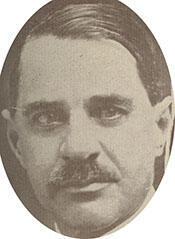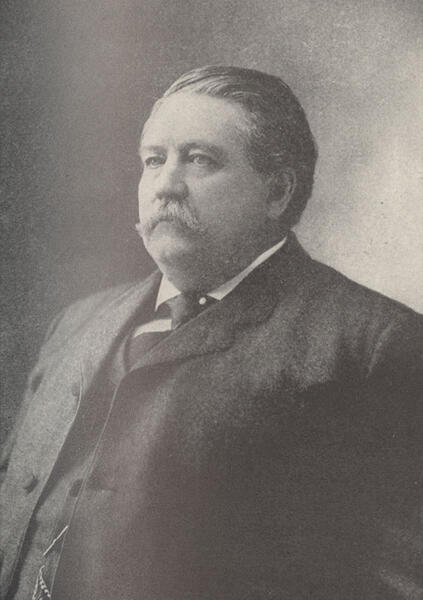
Charles Albert Plumley (April 14, 1875 – October 31, 1964) was an American lawyer, educator, and Republican politician who represented Vermont in the United States House of Representatives from 1933 to 1951. A member of a prominent political family and the son of U.S. Representative Frank Plumley, he served nine consecutive terms in Congress and played a sustained role in Vermont and national public life during a period that encompassed the Great Depression, World War II, and the early Cold War.
Plumley was born in Northfield, Washington County, Vermont, to Frank Plumley and Lavinia Fletcher Plumley. He was educated in the local schools and attended Northfield High School. He then enrolled at Norwich University in Northfield, Vermont, where he received a Bachelor of Arts degree in 1896. He continued his studies at Norwich, earning a Master of Arts degree in 1899. Over the course of his career he was recognized with several honorary degrees: an LL.D. from Norwich University in 1921 and a Doctor of Letters from Norwich in 1947; LL.D. degrees from Middlebury College in 1922, from Boston University in 1940, and from the University of Vermont in 1941. In 1900 he married Emilie Adele Stevens; the couple had three children: Allan R. Plumley, Fletcher D. P. Plumley (named for Governor Fletcher Dutton Proctor), and Evelyn Stevens Plumley Adams.
Plumley began his public service early, serving as assistant secretary of the Vermont State Senate in 1894. After graduating from Norwich, he worked in education as principal and superintendent of the Northfield grade school and Northfield High School from 1896 to 1900. He also pursued a military association, serving as a captain in the Vermont National Guard in 1901 and later holding the rank of colonel in the Officers’ Reserve Corps. During this period he studied law, and in 1903 he was admitted to the bar, commencing the practice of law in Northfield, Vermont. His legal and administrative skills led to his appointment as Secretary of the French-Venezuela Mixed Commission in 1906, a body established to address international claims.
Plumley’s political career in Vermont advanced rapidly. He was elected to the Vermont House of Representatives and served from 1912 to 1915. During this tenure he was chosen Speaker of the Vermont House of Representatives, holding that position from 1912 to 1915. Simultaneously, he was appointed Commissioner of Taxes for the State of Vermont, serving from 1912 to 1919, where he gained extensive experience in fiscal and revenue matters. After leaving state office, he broadened his professional experience in the private sector as general counsel and tax attorney for a rubber company in Akron, Ohio, from 1919 to 1920. He then returned to Vermont and resumed legal practice in partnership with his father, Frank Plumley, and Murdock A. Campbell.
In addition to his legal and political work, Plumley was deeply involved in higher education and business. He served as president of Norwich University from 1920 to 1934, guiding the institution through the post–World War I era and the early years of the Great Depression. Under his leadership, Norwich continued to develop as a military and academic institution; in recognition of his contributions, Plumley Armory, built in 1929 on the Norwich campus to house military and athletic facilities, was named in his honor in 1962. He was also active in the banking industry in Vermont, reflecting his long-standing engagement with financial and tax matters. On the national political stage, he served as reading clerk of the Republican National Conventions in 1936 and 1940, underscoring his prominence within the Republican Party.
Plumley entered national office during a critical period in American history. In 1934 he was elected as a Republican to the Seventy-third Congress to fill the vacancy caused by the resignation of Representative Ernest W. Gibson, taking his seat as Vermont’s at-large U.S. Representative on January 16, 1934. He was subsequently reelected to the Seventy-fourth and to the seven succeeding Congresses, serving continuously from January 16, 1934, to January 3, 1951. Over these nine terms in the House of Representatives, he participated in the legislative process during the New Deal, World War II, and the beginning of the postwar era, representing the interests of his Vermont constituents and contributing to debates on national policy as a member of the Republican Party. He chose not to be a candidate for renomination in 1950.
After leaving Congress in January 1951, Plumley returned to Northfield, Vermont, where he resumed the practice of law. He remained a respected figure in Vermont public life, associated with his long record of service in state government, higher education, and the United States Congress. Charles Albert Plumley died on October 31, 1964, in Barre, Vermont. He was interred at Mount Hope Cemetery in Northfield, Vermont, closing a life that spanned nearly nine decades and linked two generations of a family active in Vermont’s representation in the national legislature.
Congressional Record