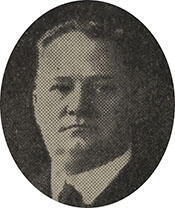
Charles Edgar Pickett (January 14, 1866 – July 20, 1930) was a two-term Republican U.S. Representative from Iowa’s 3rd congressional district. Born near Bonaparte, Van Buren County, Iowa, he spent his early years in the rural Midwest and attended the common schools of the area, receiving a basic education that prepared him for advanced study. His upbringing in southeastern Iowa placed him within a predominantly agricultural region whose interests he would later represent in public life.
Pickett pursued higher education at the University of Iowa in Iowa City, from which he graduated in 1888. He continued at the same institution’s College of Law, earning his law degree in 1890. That same year he was admitted to the bar and commenced the practice of law in Waterloo, Iowa, a growing commercial and industrial center in the northeastern part of the state. His legal career in Waterloo provided the foundation for his later business and political activities and established him as a prominent figure in local professional circles.
In addition to his law practice, Pickett became active in banking and higher education governance. He served as vice president of the Pioneer National Bank, reflecting his engagement with the financial and commercial development of Waterloo and the surrounding region. From 1896 to 1909 he served as a regent of the University of Iowa, participating in the oversight and administration of his alma mater during a period of expansion in public higher education. His growing influence within the Republican Party was marked by his service as chairman of the Republican State Convention in 1899, a role that underscored his standing in state politics.
Pickett’s congressional career began with his election in 1908 as a Republican to represent Iowa’s 3rd congressional district in the Sixty-first Congress. He took office on March 4, 1909, and was re-elected in 1910 to serve in the Sixty-second Congress, holding his seat until March 3, 1913. During these two terms in the United States House of Representatives, he served as a Representative from Iowa in the United States Congress from 1909 to 1913 and contributed to the legislative process during a significant period in American history, which included the later years of the Progressive Era. As a member of the House of Representatives, he participated in the democratic process and represented the interests of his constituents in northeastern Iowa, aligning with the Republican Party’s positions of the time.
In 1912, amid a deep division within the Republican Party between supporters of President William Howard Taft and those backing former President Theodore Roosevelt’s Progressive (“Bull Moose”) movement, Pickett sought re-election to a third term. The party split weakened many incumbent Republicans, and Pickett was defeated by Democrat Maurice Connolly of Dubuque. His loss in that election ended his congressional service after two consecutive terms, but he remained an active figure in Republican politics in Iowa.
Following his departure from Congress, Pickett resumed the practice of law in Waterloo, returning to the profession that had launched his public career. He continued to play a role in party affairs, again serving as chairman of the Republican State Convention in 1916. His prominence within the party was further demonstrated when he served as a delegate at large to the 1920 Republican National Convention, participating in the national deliberations that shaped the party’s platform and presidential ticket in the post–World War I era.
Pickett remained engaged in electoral politics into the 1920s. In 1922, when U.S. Senator William S. Kenyon of Iowa resigned to accept a federal judgeship, a special election was called to fill the vacancy. Pickett was one of six Republicans who sought the party’s nomination for Kenyon’s former Senate seat. In the primary contest he was decisively outpolled by insurgent Republican Smith W. Brookhart, who finished far ahead of Pickett and the other candidates by a sufficient margin to avoid a convention fight, thereby ending Pickett’s final major bid for higher office.
Charles Edgar Pickett spent his later years in Waterloo, remaining a respected member of the legal and civic community. He died in Waterloo on July 20, 1930, and was interred in Elmwood Cemetery in that city. His papers, documenting his legal, political, and congressional activities, are housed at the University of Iowa Libraries Special Collections & Archives, preserving the record of his contributions to Iowa’s public life and to the national legislature.
Congressional Record