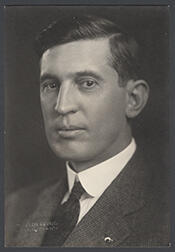
Charles Franklin Ogden (February 4, 1873 – April 10, 1933) was a lawyer, state legislator, Spanish–American War veteran, and Republican U.S. Representative from Kentucky who served in Congress from 1919 to 1923. Over the course of a public career that spanned the turn of the twentieth century, he participated in state and national politics during a period of significant political and social change in the United States.
Ogden was born on February 4, 1873, in Charlestown, Clark County, Indiana. He spent his early years in southern Indiana, where he attended local schools before enrolling at Jeffersonville High School in nearby Jeffersonville, Indiana. After completing his secondary education, he moved to Kentucky to pursue legal studies, reflecting the close economic and social ties between the Ohio River communities of Indiana and Kentucky at the time.
Ogden studied law at the University of Louisville Law School in Louisville, Kentucky, and graduated in 1896. Upon admission to the bar, he commenced the practice of law in Louisville. His early legal career coincided with a period of rapid urban and industrial growth in Louisville, and his work as a lawyer provided the professional foundation for his later involvement in public affairs and elective office.
In addition to his legal practice, Ogden served in the military during the Spanish–American War. He was a member of Company H, Eighth Regiment, United States Volunteer Infantry, one of the volunteer units raised to support the nation’s war effort in 1898. His service in this conflict placed him among the generation of younger professionals whose military experience helped shape their subsequent civic and political engagement.
Ogden entered elective politics soon after beginning his legal career. He was elected to the Kentucky House of Representatives and served as a member of that body from 1898 to 1899. His term in the state legislature gave him experience in lawmaking and party organization at the state level. He remained active in Republican politics in Kentucky in the years that followed, although he faced setbacks in his efforts to secure additional local and state offices. He was an unsuccessful candidate for county attorney in 1901 and an unsuccessful candidate for the Kentucky state senate in 1902, but he continued his legal practice and political involvement in Louisville.
Ogden’s persistence in public life culminated in his election to the United States House of Representatives as a Republican. He was elected to the Sixty-sixth Congress and reelected to the succeeding Sixty-seventh Congress, serving from March 4, 1919, to March 3, 1923. Representing a Kentucky district as a member of the Republican Party, he contributed to the legislative process during two terms in office. His service in Congress took place during a significant period in American history, encompassing the immediate post–World War I era, the beginning of Prohibition, and the early years of the women’s suffrage movement. As a member of the House of Representatives, Ogden participated in the democratic process and represented the interests of his constituents in Kentucky within the broader national debates of the time. He chose not to be a candidate for renomination to the Sixty-eighth Congress in 1922.
After leaving Congress in March 1923, Ogden returned to private life in Louisville, resuming his legal practice and remaining a figure identified with Republican politics and public service in Kentucky. He lived in Louisville until his death on April 10, 1933. Charles Franklin Ogden was interred in Resthaven Cemetery in Louisville, Kentucky, closing a career that had encompassed military service, state legislative work, and two terms in the United States House of Representatives.
Congressional Record