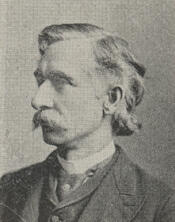
Charles Triplett “Trip” O’Ferrall (October 21, 1840 – September 22, 1905) was a Virginia lawyer, judge, and Democratic politician who served six terms as a Representative from Virginia in the United States Congress from 1883 to 1895 and later as the forty‑second governor of Virginia from 1894 to 1898. A Confederate cavalry officer during the Civil War, he became a prominent figure in Virginia’s postwar Conservative Democratic politics and an advocate for the gold standard in the 1890s.
O’Ferrall was born in Brucetown, Virginia, then in Frederick County (now near Berkeley Springs, Morgan County, West Virginia), to John O’Ferrall and Jane Laurens Green O’Ferrall. His father, an innkeeper and former member of the Virginia General Assembly, was elected Clerk of Court of Morgan County in 1851 and trained his son for that position. Growing up in a family engaged in both public service and business, O’Ferrall received an education appropriate to his social class in local private schools, as Virginia had no statewide system of public schools before the Civil War. The early death of his father in 1855 abruptly thrust him into public responsibility and shaped his entry into public life.
When John O’Ferrall died suddenly in 1855, the local judge appointed the fifteen‑year‑old Charles O’Ferrall to hold the clerk’s post until an election could be held, a sign of the community’s confidence in his abilities. At seventeen, O’Ferrall won election to a full six‑year term as Clerk of Court of Morgan County. He served less than half of that term before the outbreak of the Civil War. Although Morgan County and what would become West Virginia were predominantly loyal to the United States, O’Ferrall supported Virginia’s decision to secede and joined the Confederate States Army. Enlisting as a private in the 12th Virginia Cavalry, he was immediately offered the position of sergeant and soon distinguished himself in several engagements. Promoted to major, he was authorized to form the 23rd Virginia Cavalry, a battalion‑sized cavalry command. Over the course of the war he was wounded eight times, twice severely. On June 21, 1863, during the Battle of Upperville in Fauquier County, he was shot near the heart and initially given up for dead by a surgeon, but survived under the care of his mother and Dr. Thomas Settle of Paris, Virginia. On September 22, 1864, at the Battle of Fisher’s Hill, he suffered a serious wound near his right knee that kept him out of action for several months, likely recuperating near New Market. By the end of the war he held the rank of colonel and commanded all Confederate cavalry in the Shenandoah Valley, and his regiment took part in what was regarded as the last fight of the war on Virginia soil, dispersing Federal troops encamped at Pugh’s Run near Woodstock.
While recovering from one of his war wounds in Enterprise, Mississippi, O’Ferrall met Annie Hand. The two married on February 8, 1865, before he returned to active duty, and they had two children. After her death, he married Jennie Wickliff Knight in 1881, with whom he had four additional children. Following the war, O’Ferrall returned to manage the family inn but found the work personally and financially unsatisfying. He decided to pursue a legal education and enrolled at Washington College (later Washington and Lee University) in Lexington, Virginia. He graduated in 1869 and established a law practice in Harrisonburg, Rockingham County, which remained his home until he moved to Richmond in 1893 at the outset of his gubernatorial service. In Harrisonburg he first lived on East Market Street and later moved to the east side of South Main Street, next to Judge George G. Grattan.
With the restoration of civil rights to former Confederates, O’Ferrall quickly reentered politics. In 1871 he was elected to the Virginia House of Delegates, marking his formal return to public office in the postwar era. He unsuccessfully sought a seat in the U.S. Congress in 1872, but in 1874 his fellow legislators elected him judge of the Rockingham County court. Finding judicial work tedious, he completed his six‑year term and then returned to private legal practice while remaining active in Conservative Democratic politics and assisting various party candidates. In 1883 he challenged one‑term incumbent John Paul, a former Rockingham County commonwealth’s attorney and state senator who was then aligned with the Readjuster Democrats, for Virginia’s 7th congressional district. The initial count in the three‑way race showed O’Ferrall trailing by about 200 votes out of roughly 24,000 cast, but he contested the result and was ultimately seated in the U.S. House of Representatives. He subsequently won reelection five times, serving in Congress from 1883 to 1894 and contributing to the legislative process during a significant period in American history as a member of the Democratic Party and a representative of his Virginia constituents.
O’Ferrall’s congressional career, though not marked by major national legislation, established him as a staunch advocate for Virginia’s interests and for Democratic President Grover Cleveland. In the 1884 election he was elected to the U.S. House of Representatives with 56.37 percent of the vote, defeating Republican Dr. Joseph B. Webb. He was reelected in 1886 with 51.71 percent of the vote, defeating Independent Democrat John E. Roller; in 1888 with 54.32 percent, defeating Roller, then running as a Republican, and Populist John C. Rivercombe; in 1890 with 89.25 percent, defeating Republican I. M. Underwood; and in 1892 with 64 percent of the vote, defeating Populist Edmund R. Cocke. His service in Congress, spanning six terms from 1883 to 1895, coincided with debates over tariff policy, monetary issues, and the evolving political realignment in the post‑Reconstruction South, and he consistently aligned with the conservative, pro‑Cleveland wing of the Democratic Party.
After twice failing to secure the Democratic nomination for governor of Virginia, O’Ferrall mounted a determined campaign in 1893. With the backing of the statewide Democratic organization led by U.S. Senator Thomas Staples Martin, he easily captured the nomination. The Republican Party chose not to field a candidate, leaving O’Ferrall to face only Populist Edmund R. Cocke, whom he defeated with 59.71 percent of the vote—a margin that was reported as the largest majority ever received by a Virginia governor to that time. He moved from Harrisonburg to Richmond in 1893 to assume the governorship. The first half of his term was defined by a strong commitment to law and order. He dispatched armed forces to protect nonstriking miners and maintain peace during a miners’ strike and ordered state troops to drive Coxey’s “army” of protest marchers out of Virginia. Although he publicly espoused white supremacist views typical of many white Southern Democrats of his era, he also acted decisively to send troops to prevent lynchings and to break up mob violence, thereby defusing several potentially explosive situations. These actions helped maintain his popularity through the end of 1895.
In 1896, during a presidential election year, the Democratic Party was riven by the controversy over bimetallism and the “Free Silver” movement. O’Ferrall, a long‑time advocate of the gold standard, opposed the party’s turn toward silver and rejected the candidacy of William Jennings Bryan, the Democratic nominee that year. He joined a small group of Virginia Democrats who supported the gold standard and opposed Bryan, a stance that alienated many of his former supporters and effectively rendered him a lame‑duck governor for the remainder of his term. His opposition to Free Silver and Bryan undermined his political base and ensured that he would leave office in 1898 without further significant political accomplishments, effectively ending his public career.
After his gubernatorial term, O’Ferrall attempted to resume his legal practice, but his health had been undermined by the cumulative effects of his wartime injuries and years of strenuous public service. Despite these difficulties, he remained intellectually active and in 1904 published his autobiography, “Forty Years of Active Service,” which recounted his experiences in war and politics. Charles Triplett O’Ferrall died on September 22, 1905, in Richmond, Virginia, and was buried in Hollywood Cemetery in that city. His executive papers as governor are preserved by the Library of Virginia, and additional collections of his papers are held by the Special Collections Research Center at the College of William & Mary and by the James Madison University library, providing valuable documentation of his role in Virginia’s political life in the late nineteenth century.
Congressional Record