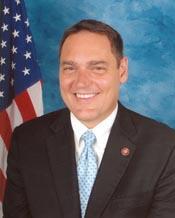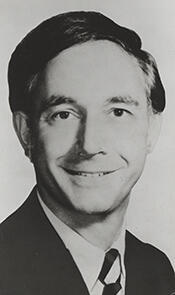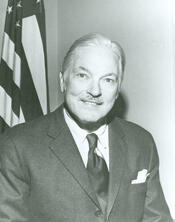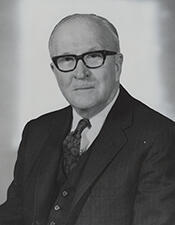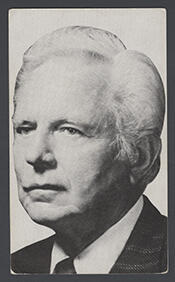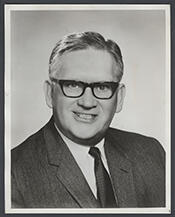
Charles Adams Mosher (May 7, 1906 – November 16, 1984) was an American newspaperman and Republican politician who served eight consecutive terms as a member of the United States House of Representatives from Ohio from 1961 to 1977. Over the course of his congressional career, he represented his Ohio constituents during a period of significant social, political, and technological change in the United States and contributed actively to the legislative process, particularly in the fields of science policy, education, and civil rights.
Mosher was born on May 7, 1906, in Sandwich, Illinois. He attended the public schools there and graduated from Sandwich High School. He went on to Oberlin College in Oberlin, Ohio, graduating in 1928. His connection to Oberlin would become a defining feature of his professional and political life, anchoring his subsequent career in journalism, local government, and national politics.
After completing his undergraduate education, Mosher entered the newspaper business. From 1929 to 1940 he worked on daily newspapers in Aurora, Illinois, and Janesville, Wisconsin, gaining experience as a newspaperman and developing the communication skills and public awareness that would later inform his political career. In 1940 he returned to Oberlin, where he became president and manager of the Oberlin Printing Company and editor-publisher of the Oberlin News-Tribune, positions he held from 1940 to 1961. Through these roles he became a prominent figure in the community and an influential voice in local affairs.
Mosher’s entry into public office began at the municipal level. He served on the Oberlin City Council and was vice chairman of the council from 1945 to 1951, participating in the governance and development of the city. His interest in public policy, particularly in education and legislative improvement, soon extended to the state level. He was a member of the Ohio Legislative Service Commission from 1947 to 1959, working to strengthen the research and drafting capacity of the state legislature. He served as a member of the Ohio State Senate from 1951 to 1960, where he built a reputation as a thoughtful and policy-oriented legislator. During this period he also served as vice chairman of the Ohio School Survey Commission from 1954 to 1955 and was a delegate to the White House Conference on Education in 1955, reflecting his sustained engagement with educational reform. In addition, he was director of the Oberlin Improvement and Development Corporation, further linking his legislative interests with local economic and civic development.
In 1960, Mosher successfully sought election to the United States House of Representatives as a Republican from Ohio. He was elected to the Eighty-seventh Congress and reelected to the seven succeeding Congresses, serving from January 3, 1961, to January 3, 1977. His service in Congress thus spanned sixteen years, encompassing the Kennedy, Johnson, Nixon, and Ford administrations and major national debates over civil rights, social welfare, and scientific and technological advancement. During his tenure, he served on the House Committee on Science and Astronautics, and by 1961 he was listed as a member of that committee under the chairmanship of Overton Brooks. In that capacity he contributed to what became popularly known as the “Brookings Report” (1961), which examined the long-term implications for American society of space exploration. In 1971, following the death of Representative James G. Fulton, Mosher became the ranking minority member of the House Science Committee, underscoring his prominence in congressional science and technology policy.
Mosher’s legislative record reflected a moderate, policy-driven Republican approach. He voted in favor of the Civil Rights Act of 1964 and the Voting Rights Act of 1965, supporting landmark federal protections for civil and voting rights. He also supported the creation of the Medicare program for the elderly and voted for the Civil Rights Act of 1968. In the field of health policy, he joined fellow Republicans Seymour Halpern, F. Bradford Morse, and Ogden Reid in co-sponsoring the Health Security Act of 1971, a bipartisan proposal advocating the creation of a government health program that would have provided coverage for every person in the United States. His votes and sponsorships placed him among those members of Congress willing to endorse expansive federal action in civil rights and health care. Mosher chose not to be a candidate for re-election in 1976 to the Ninety-fifth Congress, concluding his House service at the end of his eighth term in January 1977.
After leaving Congress, Mosher remained active in public affairs and in the world of ideas. In 1977 he was elected to the National Governing Board of Common Cause, a nonpartisan citizens’ organization dedicated to government accountability and political reform. That same year he returned to Capitol Hill in an administrative and advisory capacity, serving as executive director of the House Science and Technology Committee in Washington, D.C., from September 1977 to 1979, where he continued to shape national science and technology policy from a staff leadership position. In 1980 he was a fellow at the Woodrow Wilson International Center for Scholars at the Smithsonian Institution, reflecting recognition of his experience and insight into legislative processes and public policy. Demonstrating an enduring commitment to scholarship, he earned a Master of Arts degree from Oberlin College in 1982.
In his later years, Mosher also turned to writing and reflection on the institution in which he had spent so much of his career. He authored “Reinterpreting Congress and Its Works; A Speculative Theory Essayed: The Reflections, Confessions and Credo of Charles Adams Mosher,” published in Oberlin, Ohio, in 1984, in which he set out his views on Congress and its role in American government. A long-time resident of Oberlin, Ohio, he lived there until his death on November 16, 1984, at the age of 78. His career as a newspaperman, state legislator, and eight-term member of the U.S. House of Representatives left a record of sustained engagement with education, science, civil rights, and the functioning of representative government.
Congressional Record