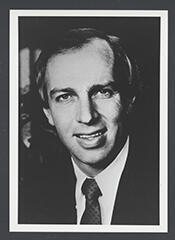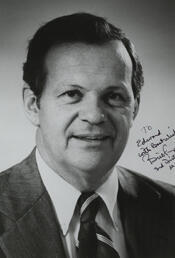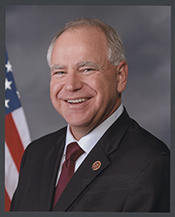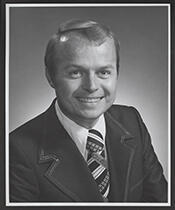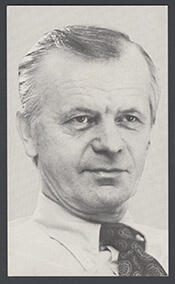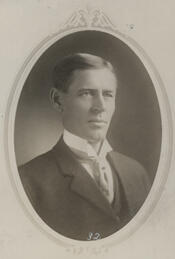
Charles August Lindbergh (born Carl Månsson; January 20, 1859 – May 24, 1924) was a Republican Representative from Minnesota who served in the United States House of Representatives from 1907 to 1917, representing Minnesota’s 6th congressional district. Serving five consecutive terms in Congress, he became nationally known for his outspoken opposition to the 1913 Federal Reserve Act and to American entry into World War I. He is also widely remembered as the father of famed aviator Charles Lindbergh.
Lindbergh was born in Stockholm, Sweden, to Lovisa Carlén, the 19-year-old mistress of Ola Månsson, a peasant member of the Riksdag of the Estates and a bank manager. When Ola Månsson was accused of bribery and embezzlement, he changed his name to August Lindbergh, left his wife and seven children in Sweden, and emigrated to the United States in 1859 with Lovisa and their infant son, Carl. In America, Lovisa became Louisa and Carl became Charles August Lindbergh. The family settled in Melrose, Minnesota, where August Lindbergh worked as a farmer and blacksmith for 26 years. August’s first wife died in Sweden in 1864, and he and Louisa were married in 1885 after he became a widower; together they had six more children in Minnesota.
Lindbergh pursued higher education in the United States and studied law at the University of Michigan Law School. He graduated in 1883 and was admitted to the bar that same year. He subsequently established himself as a practicing attorney in Minnesota. In 1887, he married Mary LaFond, with whom he had three daughters: Edith, Lillian, and Eva. Edith died in infancy, and Mary LaFond died in 1898. Professionally, Lindbergh’s early legal career advanced when he served as prosecuting attorney for Morrison County, Minnesota, from 1891 to 1893, gaining experience that would later support his entry into national politics.
In 1901, Lindbergh married Evangeline Lodge Land (1876–1954). The following year, in 1902, they settled in Little Falls, Minnesota, where he established a successful law practice. Evangeline faced difficulties in raising her two surviving stepdaughters, Lillian and Eva, who eventually moved away from the household. The marriage was often troubled; Evangeline repeatedly threatened divorce, and Lindbergh, concerned that a divorce might jeopardize his political prospects and his seat in Congress, acceded to many of her demands. By 1909, Evangeline had begun living in a separate residence, and the couple formally separated in 1918. Their only child together was Charles Lindbergh, born in 1902, who would later become an internationally renowned aviator and, like his father, a prominent antiwar advocate.
Lindbergh entered national politics as a member of the Republican Party and was elected to the United States House of Representatives in 1906. He served in the 60th, 61st, 62nd, 63rd, and 64th Congresses, holding office from March 4, 1907, to March 3, 1917. During this decade in Congress, he represented the interests of his Minnesota constituents and participated actively in the legislative process during a period marked by the Progressive Era reforms and growing national debate over banking, finance, and foreign policy. In 1912, he supported former President Theodore Roosevelt’s unsuccessful Progressive (“Bull Moose”) Party bid for the White House, aligning himself with elements of the reform movement within and around the Republican Party. In 1916, he made an unsuccessful campaign for a seat in the United States Senate.
Lindbergh’s congressional career was most notable for his early and vigorous criticism of the emerging Federal Reserve System. He became one of the first outspoken opponents of the Federal Reserve Act of 1913, warning that it would place control of the nation’s economy in the hands of “a purely profiteering group” operating “for the sole purpose of obtaining the greatest possible profits from the use of other people’s money.” His stature as a critic of concentrated financial power grew after he was profiled in The American Magazine, which described him as “a Swede who dreams” and credited him with raising in Congress “the hue-and-cry of the Money Trust Hunt.” Lindbergh declared that the Federal Reserve Act “establishes the most gigantic trust on Earth” and asserted that, once signed, it would “legalize” an “invisible government by the Monetary Power,” calling it “the worst legislative crime of the ages.” In 1913, he published “Banking, Currency, and the Money Trust,” a book that attacked the Federal Reserve and large banking interests. His opposition culminated in 1917, when he introduced articles of impeachment against members of the Federal Reserve Board of Governors, including Paul Warburg and William P. G. Harding, charging that they were involved “in a conspiracy to violate the Constitution and laws of the United States.”
With the outbreak of World War I in Europe in 1914, Lindbergh became a vocal advocate of American neutrality, arguing that the United States should avoid foreign entanglements. His anti-interventionist stance shaped his political fortunes. In 1916, he lost his Senate bid to a candidate who openly supported American intervention in Europe. In March 1917, as the United States moved closer to war, Lindbergh was one of only fourteen members of Congress to vote against the arming of United States merchant ships. By that time, his son Charles was 16 years old, raising the possibility of future conscription and adding a personal dimension to his antiwar views. Lindbergh authored an antiwar polemic, “Why is Your Country at War?”, which, along with his earlier monetary writings, was targeted under the Comstock laws; in 1918 federal agents destroyed the printing plates of both publications. The later work was posthumously reissued in 1934 under the revised title “Your Country at War, and What Happens to You After a War.” In its opening chapter, he argued that “it is impossible according to the big press to be a true American unless you are pro-British,” contending that those who put “America first, last and all time” were unfairly branded as pro-German by a press “supported by the speculators.” These ideas would later influence his son’s prominent opposition to American intervention in World War II.
After leaving Congress in 1917, Lindbergh remained active in Minnesota politics and in the broader progressive and agrarian reform movements. In 1918, he ran for governor of Minnesota as a Republican, challenging the Republican incumbent, Joseph A. A. Burnquist. He was endorsed by the Farmers Nonpartisan League, which advocated government ownership of certain agricultural enterprises, including mills, plants, and grain elevators. Lindbergh’s campaign drew large crowds, and many of his speeches were attended by thousands of supporters. However, his opposition to American entry into World War I and his association with what critics labeled the “Socialistic” Farmers Nonpartisan League made him a target of intense press hostility. Protesters frequently disrupted his appearances, sometimes pelting him with eggs and rocks. His son Charles served as his driver during this campaign and later recalled the hostile crowds and derisive press coverage that marked his father’s gubernatorial bid. Lindbergh was defeated in the 1918 election. In 1924, he again sought the governorship, this time as a candidate of the Minnesota Farmer–Labor Party. His campaign was cut short by illness and death; had he been elected, he would have been the first Minnesota governor from that party.
Charles August Lindbergh died of brain cancer on May 24, 1924, in Crookston, Minnesota. He was cremated, and his remains were placed in the columbarium at Lakewood Cemetery in Minneapolis. Honoring his wishes, his son Charles later scattered some of his ashes near the Sauk River, over the site of the first Lindbergh family home. His life and political career have been the subject of historical study, including Bruce L. Larson’s “Lindbergh of Minnesota: A Political Biography” (1973), and his family papers are preserved for research at the Minnesota Historical Society.
Congressional Record