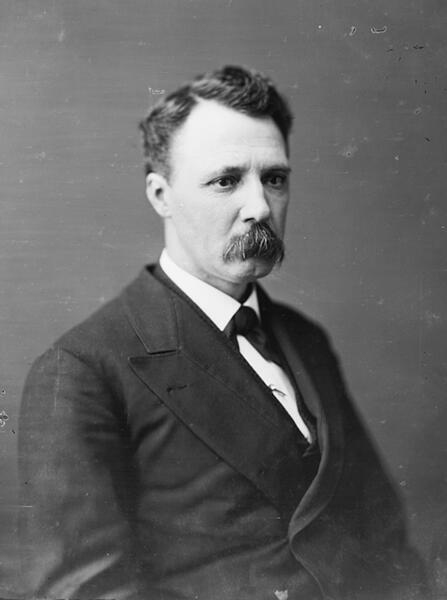
Charles Herbert Joyce (January 30, 1830 – November 22, 1916) was an American lawyer, Civil War officer, and Republican politician who served four terms as a U.S. Representative from Vermont from 1875 to 1883. Over the course of a long public career, he held a series of legal and legislative offices at the state and federal levels and contributed to the legislative process during a significant period in American history.
Joyce was born near Andover, Hampshire, England, to Charles Joyce and Martha E. Grist Joyce. In 1836, when he was six years old, he immigrated to the United States with his parents, who settled in Waitsfield, Vermont. Growing up in rural Vermont, he was introduced early to public affairs and the workings of state government, experiences that would shape his later career in law and politics.
Joyce received his education at local institutions that were important training grounds for many of Vermont’s nineteenth‑century leaders. He attended Waitsfield Academy and Northfield Academy before enrolling at Newbury Seminary. As a youth, he served as a page in the Vermont House of Representatives for three sessions, gaining firsthand exposure to legislative procedure. While reading law under the guidance of prominent Vermont attorneys Francis V. Randall, John L. Buck, and Farrand F. Merrill, he supported himself by teaching school. He was admitted to the bar in 1852 and began the practice of law in Northfield, Vermont, in 1855.
In addition to his private legal practice, Joyce quickly assumed responsibilities within Vermont’s state institutions. He spent one year as assistant state librarian and then two years as state librarian, positions that placed him at the center of the state’s legal and governmental records. He further advanced his legal career by serving as State’s Attorney of Washington County in 1857 and 1858, prosecuting cases on behalf of the state and establishing his reputation as a capable lawyer and public servant.
With the outbreak of the American Civil War, Joyce entered military service in the Union Army. He served with the Second Vermont Volunteers, rising to the ranks of major and lieutenant colonel. His wartime service linked him to the broader Union effort and to the generation of veterans who would play influential roles in postwar politics. After the war, he resumed his legal practice, relocating to Rutland, Vermont, where he became an active figure in the community and in state politics.
Joyce’s postwar political career began in the Vermont House of Representatives, where he served as a member from 1869 until 1872. During this period he was chosen by his colleagues as Speaker of the Vermont House, holding that leadership position from 1870 to 1872. His tenure as speaker demonstrated his skill in managing legislative business and helped elevate his standing within the Republican Party at a time when the party dominated Vermont politics.
Building on his state legislative experience, Joyce was elected as a Republican to the Forty-fourth Congress and to the three succeeding Congresses, serving as a Representative from Vermont in the United States House of Representatives from March 4, 1875, until March 3, 1883. His four consecutive terms in Congress coincided with the post–Civil War and Reconstruction era, a significant period in American history marked by debates over economic policy, veterans’ affairs, and the integration of the reunited states. As a member of the House of Representatives, Charles Herbert Joyce participated in the democratic process, contributed to the legislative work of the institution, and represented the interests of his Vermont constituents. He was not a candidate for renomination in 1882 and concluded his congressional service at the end of the Forty-seventh Congress.
After leaving Congress, Joyce returned to Rutland and again took up the practice of law. He continued in active legal work until his retirement in 1895. In his later years he resided in Pittsfield, Vermont, maintaining his ties to the state where he had spent virtually his entire life since childhood. Joyce married Rouene Randall, the sister of his legal mentor Francis V. Randall. They had three children: Inez Rouene Joyce, Grace Randall Joyce, and Charles P. F. Joyce, reflecting the close interconnection between his family life and professional associations.
Charles Herbert Joyce died in Pittsfield, Vermont, on November 22, 1916. He was interred in Evergreen Cemetery in Rutland, Vermont. His long career as a lawyer, Civil War officer, state legislator, and four-term Republican member of Congress placed him among the notable public figures of nineteenth-century Vermont, and his service is recorded in federal and state biographical references and memorialized in the historical record.
Congressional Record