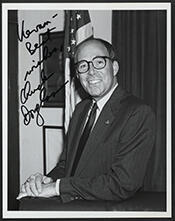
Charles Gywnne Douglas III (born December 2, 1942) is an American politician, jurist, and trial lawyer who served as a Representative from New Hampshire in the United States Congress from 1989 to 1991. A member of the Republican Party, he is also a former associate justice of the New Hampshire Supreme Court and has had a long career in both public service and private legal practice.
Douglas was born in Abington, Montgomery County, Pennsylvania, the son of Betsy (née Graham) and Charles Gwynn Douglas Jr. He grew up in the Philadelphia area and graduated from William Penn Charter School in Philadelphia in 1960. He attended Wesleyan University from 1960 to 1962 before transferring to the University of New Hampshire, where he received a Bachelor of Arts degree in 1965. He went on to earn a Juris Doctor degree with honors from Boston University School of Law in 1968.
Admitted to the bar in 1968, Douglas commenced the practice of law in Manchester, Hillsborough County, New Hampshire, where he practiced from 1970 to 1972. He soon entered public service at the state level, serving as legal counsel and legislative counsel to Governor Meldrim Thomson Jr. from 1973 to 1974. His judicial career began with his appointment as an associate justice of the New Hampshire Superior Court, a position he held from 1974 to 1976. He was then elevated to the New Hampshire Supreme Court, serving as an associate justice from 1977 to 1983 and as senior justice from 1983 to 1985. Parallel to his legal and judicial work, Douglas served in the New Hampshire Army National Guard from 1968 to 1991, retiring with the rank of colonel.
Elected as a Republican to the 101st Congress, Douglas served as United States Representative for New Hampshire from January 3, 1989, to January 3, 1991. His service in Congress occurred during a significant period in American history at the close of the Cold War. As a member of the House of Representatives, he participated in the democratic process and represented the interests of his New Hampshire constituents. During his term, he served on the Committee on the Judiciary from January 3, 1989, to October 28, 1990, contributing to the legislative process in areas central to his legal expertise. He was an unsuccessful candidate for reelection in 1990 to the 102nd Congress, concluding his one term in federal office.
After leaving Congress, Douglas returned to the practice of law and to a variety of legal, educational, and advisory roles in New Hampshire. He became president of Douglas Leonard & Garvey P.C., a plaintiff’s law firm based in Concord, New Hampshire, where he built a reputation as a leading personal injury and employment law trial lawyer. Because of his experience as a New Hampshire judge and New Hampshire Supreme Court justice, as well as his record of success as a trial lawyer, he has been frequently requested to lecture on personal injury and employment law matters. He has served as an adjunct faculty member at the University of New Hampshire School of Law and has taught at the American Bar Association’s Appellate Judges Seminars, sharing his expertise with both practitioners and members of the judiciary.
Douglas has also played a prominent role in state commissions and judicial administration. He served as chairman of the New Hampshire Constitution Bicentennial Education Commission and was a member of the Constitutional Convention Study Commission, contributing to public understanding of constitutional issues in the state. From 2004 to 2008 he was chairman of the New Hampshire Judicial Retirement Plan Board of Trustees and thereafter served as executive director of the plan. Beginning in 2017, he became chairman of the Governor’s Judicial Selection Commission, and as of 2023 he continued in that role, helping to shape the composition of the state’s judiciary. From 2014 through 2017 he served as legal counsel to the New Hampshire House of Representatives, and in 2024 he served as legal counsel to the Nikki Haley for President campaign in New Hampshire.
In addition to his work as a lawyer and public official, Douglas has been an active legal scholar and author. He has published more than forty articles and is the author of several influential legal treatises. His book New Hampshire Practice and Procedure: Family Law is regarded as the definitive source for New Hampshire divorce and family law, is widely used by New Hampshire divorce and family law attorneys, and is frequently cited in New Hampshire Supreme Court decisions. He also authored the New Hampshire Evidence Manual, an evidence treatise relied upon by New Hampshire lawyers and courts during litigation and regularly cited by the New Hampshire Supreme Court. Extending his writing beyond legal texts, in 2022 he published C.C.A. Baldi, The King of Little Italy, a biographical work about his great-grandfather in Philadelphia, Charles Carmine Antonio Baldi.
Douglas has received numerous professional honors in recognition of his contributions to the law and the bar. In 2014 he received a Lifetime Achievement Award from the New Hampshire Association for Justice, and in 2017 he was honored with the Distinguished Service to the Profession Award from the New Hampshire Bar Association. In 2018 New Hampshire Magazine named him the number one personal injury trial lawyer in New Hampshire. Outside of his legal and governmental work, he has been active in local civic life as the publisher of the Bow Times newspaper in Bow, New Hampshire, where he also served on the town budget committee.
A resident of Pembroke, Merrimack County, New Hampshire, Douglas is married to Debra M. Douglas, who serves as chairman of the New Hampshire State Lottery Commission. He is the first cousin, once removed, of singer Taylor Swift through his grandparents Charles Gwynn Douglas I and Louise Douglas (née Baldi), daughter of Charles Carmine Antonio Baldi, whose life he chronicled in his 2022 book.
Congressional Record