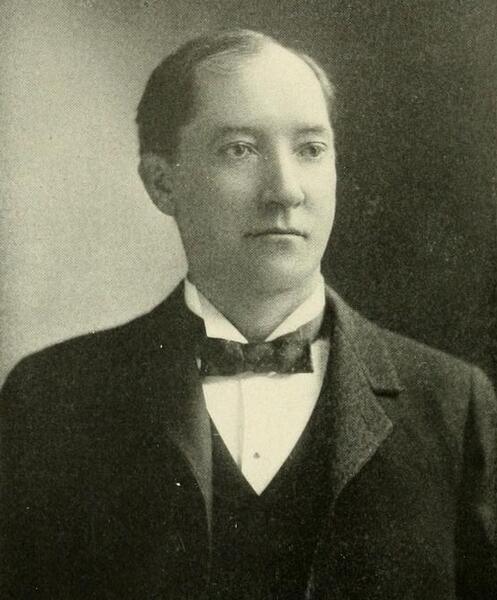
Charles Phillips Dorr (August 12, 1852 – October 8, 1914) was a lawyer and Republican politician from West Virginia who served as a United States Representative in the Fifty-fifth Congress. He was born in Miltonsburg, Monroe County, Ohio, where he spent his early childhood before moving with his family elsewhere in the state.
In 1866 Dorr moved with his parents to Woodsfield, the county seat of Monroe County, Ohio. Growing up in this small but active community, he received his education in local schools and soon entered the teaching profession. As a young man he taught school in both Ohio and the neighboring state of West Virginia, an experience that helped establish his reputation in the region and introduced him to the communities in which he would later practice law and enter public life.
While engaged in teaching, Dorr studied law, preparing for admission to the bar through the traditional method of reading law rather than formal law school, which was common in the nineteenth century. In 1874 he was admitted to the bar and, in that same year, began the practice of law in West Virginia. He settled in Webster Springs, then a developing community in Webster County, where he built a legal practice that served local residents and businesses and became a prominent member of the bar.
Dorr’s involvement in local affairs soon led him into public service. In Webster Springs he served on the town council, participating in the governance and civic development of the community. His growing stature in Republican Party circles and his experience in local government positioned him for election to state office. He was elected to represent the fourth delegate district in the West Virginia House of Delegates in 1884 and again in 1888, reflecting sustained support from his constituents. In addition to his legislative duties, he was chosen in 1887 to serve as Sergeant at Arms, a position that placed him in charge of maintaining order and carrying out the directives of the House, and that further enhanced his visibility in state politics.
Building on his record in state government, Dorr sought and won federal office as a Republican. In 1896 he was elected to the United States House of Representatives as a member of the Fifty-fifth Congress, serving from March 4, 1897, to March 3, 1899. During his term he represented a West Virginia district at a time when the state was experiencing economic and industrial growth, particularly in timber and coal, and when national politics were dominated by debates over currency, tariffs, and economic policy in the aftermath of the Panic of 1893. Although he served only a single term, his election reflected the strength of the Republican Party in parts of West Virginia during this period.
Dorr chose not to be a candidate for renomination in 1898 and returned to private life at the close of his congressional term. He resumed the practice of law in Webster Springs, West Virginia, where he continued to be a respected figure in the legal and civic affairs of the community. In his later years he acquired an estate at Clover Lick in Pocahontas County, a rural area of the state, where he spent much of his time away from active political life.
Charles Phillips Dorr died on his estate at Clover Lick, West Virginia, in Pocahontas County on October 8, 1914. He was interred in Clover Lick Cemetery. His career traced a path from rural Ohio schoolteacher to West Virginia lawyer, local official, state legislator, and member of the United States House of Representatives, reflecting the opportunities for public service available in the rapidly changing Appalachian region in the late nineteenth century.
Congressional Record