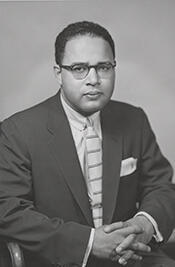
Charles Coles Diggs Jr. (December 2, 1922 – August 24, 1998) was an American politician from Detroit, Michigan, who served in the Michigan State Senate and in the United States House of Representatives. A member of the Democratic Party, he was the first African American elected to Congress from Michigan and served as a Representative from Michigan in the United States Congress from January 3, 1955, to June 3, 1980, encompassing 13 terms in office. His long tenure in Congress coincided with a transformative period in American history, during which he became an early and prominent participant in the civil rights movement and a leading critic of apartheid in South Africa.
Diggs was born in Detroit, Michigan, the only child of Mayme E. Jones Diggs and Charles Diggs Sr. He grew up in a family deeply rooted in business and public service; his father operated the House of Diggs, which became one of Michigan’s largest funeral homes, and also served in the Michigan Senate from 1937 to 1944. Charles Diggs Jr. was educated at Fisk University, the University of Michigan, and the Detroit College of Law, which he attended in 1952. During World War II, he served in the United States Army from 1943 to 1945. After his military service, he returned to Detroit and worked as a funeral director, continuing the family’s involvement in the House of Diggs and solidifying his ties to the city’s African-American community.
Diggs’s political career began at the state level, closely following the path of his father. He was elected to the Michigan Senate from the 3rd district and served from 1951 to 1954. In that role he gained experience in legislative work and developed a reputation as an advocate for his constituents in Detroit. His service in the state senate provided the foundation for his subsequent rise to national office and helped establish him as a significant African-American political figure in Michigan at mid-century.
In 1954, Diggs challenged and defeated incumbent U.S. Representative George D. O’Brien in the Democratic primary for Michigan’s 13th congressional district. He then won the general election to the 84th Congress and was subsequently re-elected to the next twelve Congresses, serving continuously from January 3, 1955, until his resignation on June 3, 1980. As a member of the House of Representatives, Charles Coles Diggs participated in the democratic process and represented the interests of his constituents during a significant period in American history, contributing to the legislative process over more than a quarter-century in office.
From the outset of his congressional career, Diggs was deeply involved in the emerging civil rights movement. In April 1955, only three months after being sworn in, he delivered a well-received speech to a crowd of about 10,000 people in Mound Bayou, Mississippi, at the annual conference of the Regional Council of Negro Leadership, then the largest civil rights organization in Mississippi. His host was the group’s leader, Dr. T. R. M. Howard, a prominent Black surgeon and entrepreneur. Later that year, in September 1955, Diggs gained national attention as the only member of Congress to attend and monitor the trial of the two white Mississippians accused of murdering Emmett Till, a Black teenager from Chicago. Despite his status as a congressman, he was subjected to Jim Crow segregation and was forced to sit at a small table with Black reporters in the courtroom. After the trial, as white mobs sought to intimidate and locate witnesses, Diggs personally helped protect one of them, then-18-year-old Willie Reed. He escorted Reed from Mississippi to Detroit after a nighttime escape, where Reed changed his name to Willie Louis for safety. Following the trial, Diggs called on President Dwight D. Eisenhower to convene a special session of Congress to consider civil rights legislation, underscoring his early and active role in the national struggle for racial justice.
Within the House, Diggs became a central figure in the organization and leadership of African-American members of Congress. He is widely acknowledged as the main founder of the “Democratic Select Committee,” a predecessor to the Congressional Black Caucus, which he chaired from 1969 to 1971. When the Congressional Black Caucus was formally established, Diggs was a founding member and was elected its first chairman. In that capacity he worked to coordinate the efforts of Black representatives and senators to address the needs and rights of Black constituents nationwide. Under his leadership, the caucus organized a boycott of President Richard Nixon’s State of the Union Address after Nixon refused to meet with them to discuss issues affecting African Americans, an action that contributed to Diggs’s inclusion on the Nixon administration’s “Master list” of political opponents.
Diggs also played a prominent role in shaping U.S. policy toward Africa, particularly South Africa. In 1969, he was appointed chairman of the Subcommittee on Africa of the House Committee on Foreign Affairs. From this position he became one of the most vocal critics in Congress of the apartheid regime. In his 1972 “Action Manifesto,” Diggs expressed support for the armed struggle against apartheid and criticized the United States government for condemning violence by liberation movements while failing to denounce the repressive measures used by the South African government against its Black majority. He argued that American corporate investment helped sustain the apartheid system. His outspoken advocacy led the South African government to ban him from entering the country, and he became widely recognized as a committed publicist for African liberation causes.
Despite his legislative achievements, Diggs’s career was marred by legal and ethical controversy in its later years. In March 1978, he was charged with taking kickbacks from congressional staff members whose salaries he had raised. On October 7, 1978, he was convicted on 11 counts of mail fraud and filing false payroll forms. Maintaining that he had done nothing wrong, Diggs nonetheless continued to serve in Congress and was re-elected while awaiting sentencing. On July 31, 1979, the House of Representatives formally censured him. Under mounting pressure, he resigned from Congress on June 3, 1980. He was sentenced to three years in prison and ultimately served 14 months of that term. Diggs resigned from the United States House of Representatives and served 14 months of a three-year sentence for mail fraud, although he consistently maintained his innocence.
In his later years, Diggs lived in the Washington, D.C., area. He died of a stroke on August 24, 1998, at Greater Southeast Community Hospital in Washington, D.C. Charles Coles Diggs Jr. was interred at Detroit Memorial Park in Warren, Michigan, returning in death to the metropolitan area where his family had long been prominent in business and politics.
Congressional Record