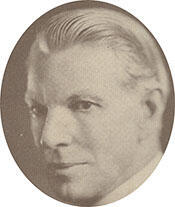
Charles Forrest Curry (March 14, 1858 – October 10, 1930) was an American businessman and politician who served nine terms as a Republican U.S. Representative from California from 1913 until his death in 1930. Over the course of his long public career, he held a series of important state and federal offices and became a prominent figure in California politics during a transformative period in American history. He was the father of Charles Forrest Curry Jr., who succeeded him in Congress.
Curry was born in Naperville, Illinois, on March 14, 1858. He attended the common schools and later the Episcopal Academy in Mineral Point, Wisconsin. In 1872, he moved with his parents to Seattle, Washington, and in 1873 the family relocated again to San Francisco, California. He pursued further education through one year of study at the University of Washington in Seattle and also received instruction from a private tutor, combining formal and individualized study in his early years.
After settling in California, Curry engaged in a variety of business and agricultural pursuits. He worked in agriculture and became involved in the cattle, lumber, and mining businesses, experiences that acquainted him with the economic development of the West and the concerns of its growing population. His interest in public affairs led him into state politics, and he was elected to the California State Assembly, serving as a member in 1887 and 1888. During this period, he also studied law and was admitted to the bar of San Francisco in 1888, adding legal training to his business and legislative background.
Curry soon moved into administrative and executive roles in local and state government. From 1890 to 1894 he served as superintendent of Station B post office in San Francisco, gaining experience in federal postal administration at the local level. He was then clerk of San Francisco city and county from 1894 to 1898, a position that placed him at the center of municipal governance during a time of rapid urban growth. In 1899 he was elected Secretary of State of California, a statewide constitutional office he held until 1910. As Secretary of State, he oversaw elections, state records, and various regulatory functions for more than a decade. In 1910 he sought the Republican nomination for governor of California but was unsuccessful. The following year, he was appointed Building and Loan Commissioner of California, reflecting his growing expertise in regulatory and financial matters. Also in 1911, he served as a representative to the Panama–Pacific International Exposition for the Pacific Coast and Intermountain States, helping to promote the region in advance of the major international fair that would be held in San Francisco.
Curry’s long tenure in national office began with his election as a Republican to the Sixty-third Congress. He was first elected to the U.S. House of Representatives from California for the term commencing March 4, 1913, and he served continuously in Congress until his death on October 10, 1930. Over these years he was reelected to successive Congresses, serving nine terms in all and participating in the legislative process during a significant period in American history that encompassed World War I, the postwar era, and the early years of the Great Depression. During his tenure as a congressman, he served as chairman of the House Committee on Territories from the Sixty-sixth through the Seventy-first Congresses, a role that gave him substantial influence over legislation affecting U.S. territories and their governance. As a member of the House of Representatives, he represented the interests of his California constituents while taking part in the broader national debates of his time.
Curry’s public service and prominence in California were recognized locally as well as nationally. In 1921, an elementary school in Vallejo, California, was named in his honor. The Charles F. Curry School, located at 321 Wallace Avenue, operated from 1921 until 1973. The grounds also housed Carol Vista School, a facility for handicapped and special needs students, extending his legacy into the field of public education and social services in the community.
Charles Forrest Curry died in office in Washington, D.C., on October 10, 1930, while still serving in the Seventy-first Congress. Following his death, his son, Charles Forrest Curry Jr., won his seat as a write-in candidate, continuing the family’s representation of their California district in the House of Representatives. Curry was originally interred in Abbey Mausoleum near Arlington National Cemetery in Arlington, Virginia. His remains were later reinterred in National Memorial Park in Falls Church, Virginia, marking the final resting place of a long-serving public official whose career spanned local, state, and national office.
Congressional Record