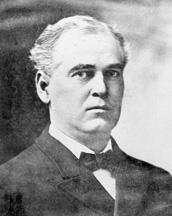
Charles Allen Culberson (June 10, 1855 – March 19, 1925) was an American political figure and Democrat who served as the 21st governor of Texas from 1895 to 1899 and as a United States senator from Texas from 1899 to 1923. Born in Dadeville, Alabama, he was the son of Eugenia (née Kimbal) and David Browning Culberson, a prominent Democratic politician. In 1856, when Charles was still an infant, the family moved to Texas, first settling in Gilmer and later in Jefferson. Growing up in a politically engaged household in a rapidly developing state, he was exposed early to public affairs and the law, influences that would shape his long career in Texas and national politics.
Culberson received his early education in Texas and then attended the Virginia Military Institute, from which he graduated in 1874. He went on to study law under the guidance of his father and later enrolled at the University of Virginia at Charlottesville in 1876 and 1877. While at the University of Virginia, he was active in the Jefferson Literary Society and participated in the Moot Court, experiences that honed his skills in rhetoric and legal argument. In 1877 he was admitted to the bar in Daingerfield, Texas, and began practicing law in Marion County, establishing himself professionally in Jefferson before moving his practice to the growing city of Dallas in 1887.
As a young attorney, Culberson gained attention for his role in challenging the constitutionality of the so‑called Ku Klux Law of Texas. He successfully overturned the conviction of a man found guilty of murder under that statute, and the law was subsequently declared unconstitutional. This case enhanced his reputation as a capable and principled lawyer. On December 7, 1882, he married Sallie Harrison; the couple had one daughter, Mary Harrison. His legal success and family connections, combined with his growing prominence in Democratic circles, laid the groundwork for his entry into statewide politics.
Culberson’s formal political career began with his election as Attorney General of Texas in 1890. Serving in that office until 1895, he built a record that helped propel him to higher office. In November 1894 he successfully campaigned for governor and took office in 1895 as the 21st governor of Texas. During his two terms as governor, which lasted until 1899, a wide range of reforms were carried out, reflecting a current of Texas liberal populism with which he was associated, similar to that of his predecessor, Governor Jim Hogg. According to one study, Culberson belonged, like Hogg, “to a stream of Texas liberal populism,” aligning himself with efforts to regulate corporate power and address the concerns of farmers and laborers within the Democratic Party framework.
After completing his gubernatorial service, Culberson was elected by the Texas legislature to the United States Senate on January 25, 1899, beginning a congressional career that would span four terms and continue until 1923. A member of the Democratic Party, he represented Texas in the Senate during a significant period in American history, including the Progressive Era, the Philippine–American War, and World War I. Early in his Senate tenure, he served on the Lodge Committee, which investigated alleged war crimes committed by U.S. forces during the Philippine–American War, reflecting the Senate’s expanding role in oversight of American imperial and military policy. Over the course of his service, he participated actively in the legislative process and represented the interests of his Texas constituents in national debates.
Culberson was reelected to the Senate in 1905 and 1911, and again in 1916, the latter time by popular vote following the ratification of the Seventeenth Amendment. His 1916 reelection was notable because health problems and alcoholism prevented him from campaigning in Texas, yet he nonetheless retained his seat, a testament to his longstanding political standing in the state. In the Senate he chaired several committees, most prominently the Committee on the Judiciary, which he led from 1913 to 1919, a period that encompassed major legislative developments in antitrust law, labor relations, and wartime measures. Labor leader Samuel Gompers described him as “a courageous, faithful and able advocate of the people’s demand for labor and for progressive legislation,” underscoring his reputation among organized labor and reform advocates.
Despite his association with certain progressive and populist causes, Culberson’s record on race reflected the dominant white supremacist attitudes of his era and region. He opposed demands for racial equality, asserting that such efforts would lead to the “consequent debasement, degradation or destruction of the white race.” His stance on race relations placed him firmly within the segregationist mainstream of Southern Democrats in the early twentieth century. In the early 1920s, his declining health, struggles with alcoholism, and his opposition to the rising influence of the Ku Klux Klan in Texas politics weakened his political position. In the Democratic primary of 1922 he lost his bid for another term in the Senate, and he was succeeded by fellow Democrat Earle Bradford Mayfield, then a member of the Texas Railroad Commission.
Following his departure from the Senate in 1923, Culberson lived in retirement, dividing his time between Texas and the nation’s capital. He remained a figure of historical interest in Texas politics, and his career continued to be cited as an example of the state’s turn‑of‑the‑century liberal populist tradition. Culberson died of pneumonia in Washington, D.C., on March 19, 1925. He was buried in East Oakwood Cemetery in Fort Worth, Texas. He was also a distant cousin of John Culberson, who later represented Texas’s 7th congressional district in the U.S. House of Representatives from 2001 to 2019, linking his family name to Texas political life across generations.
Congressional Record