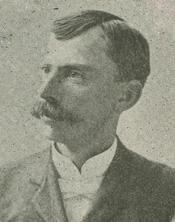
Charles Merian Cooper (January 16, 1856 – November 14, 1923) was an American attorney and Democratic politician who served two terms as a U.S. Representative from Florida from 1893 until 1897. As a member of the House of Representatives, he participated in the legislative process during a significant period in American history and represented the interests of his constituents in Florida’s 2nd congressional district.
Cooper was born on January 16, 1856, in Athens, Georgia. He was the son of Charles Phillip Cooper, who served as an agent of the United States Treasury Department until the outbreak of the American Civil War. During the war, his father was appointed to assist in organizing the Confederate States Treasury Department. In 1864, as Union forces advanced, the Cooper family moved to Jacksonville, Florida, seeking refuge from the conflict. This relocation during his childhood established the family’s long-term ties to Florida and shaped Cooper’s future legal and political career in the state.
Cooper pursued his education in Florida and studied law at Gainesville Academy, from which he graduated in 1867. In the same year, he was admitted to the Florida bar, an unusually early professional milestone that reflected both his precocity and the fluid educational standards of the Reconstruction era. Following his admission to practice, he established a private law practice in St. Augustine, Florida, where he began to build his reputation as an attorney and entered into the civic life of his community.
A Democrat, Cooper entered public office in 1880 when he was elected to the Florida House of Representatives representing St. John’s County. He served in the state House until 1884, participating in the post-Reconstruction political realignment of Florida. That year he advanced to the Florida Senate, again representing St. John’s County, further consolidating his standing in state politics. On January 13, 1885, Governor Edward A. Perry appointed him as the 15th Attorney General of Florida. Cooper served as attorney general until 1889, during which time he was involved in the legal affairs of a state undergoing economic development and the entrenchment of Democratic control. Later in 1889, he was appointed one of three commissioners charged with revising Florida’s statutes, a significant responsibility that placed him at the center of efforts to modernize and systematize the state’s legal code.
Cooper’s congressional career began in the context of shifting political currents in the early 1890s. In 1892, when Democratic U.S. Representative Robert Bullock of Florida’s 2nd congressional district declined to seek reelection, Cooper secured the Democratic nomination. In the general election he defeated Populist State Representative Austin S. Mann, winning approximately 76 percent of the vote; the Republican Party did not field a candidate in the race. He took his seat in the Fifty-third Congress in 1893. Cooper successfully sought reelection in 1894, again facing a Populist challenger, Montholom Atkinson, whom he defeated with about 80 percent of the vote, while Republicans again declined to nominate a candidate. He thus served two consecutive terms in the U.S. House of Representatives, from 1893 to 1897, during a period marked by economic turmoil, the Panic of 1893, and intense national debates over monetary policy and agrarian unrest. As a Democratic member of Congress, he contributed to the legislative process and represented the interests of his Florida constituents during this consequential era.
After completing his second term, Cooper chose not to run for reelection in 1896 and left Congress in 1897. He returned to private legal practice in Jacksonville, Florida, resuming the profession that had underpinned his public career. In private life he remained a prominent member of the Jacksonville bar and a figure of standing in the community, drawing on his experience as a former state attorney general and U.S. representative.
In his personal life, Cooper married Rosa Leonardi in 1880. The couple had two children, Charles Philip and James Jackson Gignilliat, and maintained their home in Florida throughout his years in public service and legal practice. Charles Merian Cooper died in Jacksonville on November 14, 1923, closing a career that had spanned local, state, and national office during a transformative period in Florida and United States history.
Congressional Record