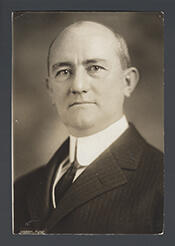
Charles Pearce Coady (February 22, 1868 – February 16, 1934) was a U.S. Representative from the third district of Maryland and a member of the Democratic Party who served four terms in the United States Congress from 1913 to 1921. He was born on February 22, 1868, in Baltimore, Maryland, to Mary (née Lyons) and Michael Coady. Raised in Baltimore, he attended the city’s public schools and completed his secondary education at Baltimore City College, from which he graduated in 1886. He subsequently pursued legal studies at the Baltimore School of Law, preparing for a career that would combine law, business, and public service.
After completing his formal education, Coady initially worked as a merchant, gaining experience in commercial affairs before entering the legal profession. In 1894, after finishing his legal studies, he was admitted to the bar and began practicing law in Baltimore. Alongside his private practice, he became active in the city’s financial and charitable institutions. He served as director and counsel of St. James’ Savings Bank and acted as counsel for five other associations, reflecting his growing prominence in legal and financial circles. He also served as a director of St. Vincent’s Orphan Asylum, demonstrating an engagement with philanthropic work in his native city.
Coady’s public career began in state politics. A Democrat, he was elected to the Maryland State Senate from the 1st legislative district of Baltimore City, serving from 1908 to 1912. He won a second term in the State Senate, but resigned in 1913 in order to run for the U.S. House of Representatives. His legislative experience at the state level helped establish his reputation as a capable lawmaker and prepared him for national office during a period of significant political and social change in the United States.
Coady entered national politics when he was elected as a Democrat to the 63rd United States Congress, representing Maryland’s third congressional district. He was chosen in a special election to fill the vacancy caused by the death of Representative George Konig and took his seat on November 4, 1913. He was subsequently reelected three times, serving continuously until March 3, 1921. During these four terms in office, he participated in the legislative process at a time that encompassed the Woodrow Wilson administration, the First World War, and major domestic reforms. As a member of the House of Representatives, Charles Pearce Coady represented the interests of his Baltimore constituents and contributed to the work of Congress during this significant period in American history.
In 1920, Coady sought a fifth term in the U.S. House of Representatives but was defeated by Republican John Boynton Philip Clayton Hill. With the close of his congressional service on March 3, 1921, he returned to Baltimore and resumed the practice of law. He continued to be involved in public affairs at the municipal level, drawing on his legal and administrative experience.
From 1922 to 1925, Coady served as Baltimore City collector and manager of the bureau of receipts, a position that placed him at the center of the city’s fiscal administration. In this capacity he oversaw the collection and management of municipal revenues, extending his record of public service beyond elective office. After completing this term of municipal service, he remained in Baltimore, continuing his professional activities and maintaining his longstanding ties to the city’s civic and institutional life.
Charles Pearce Coady died on February 16, 1934, in Baltimore, Maryland, just six days short of his sixty-sixth birthday. He was interred in New Cathedral Cemetery in Baltimore. His career spanned law, banking, charitable work, state legislation, and four terms in the United States House of Representatives, marking him as a significant Democratic figure in early twentieth-century Maryland politics.
Congressional Record