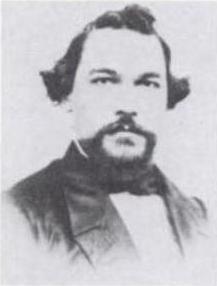
Charles P. Clever (February 23, 1830 – July 8, 1874) was a delegate from the Territory of New Mexico to the United States Congress and a prominent territorial official, lawyer, and businessman. He was born in Cologne, Prussia, where he attended the gymnasium of Cologne and later pursued higher studies at the University of Bonn. Trained in the German educational tradition, he emigrated to the United States in 1848, during a period of significant political upheaval in the German states, and moved westward to the American frontier. By 1850 he had settled in Santa Fe, in what was then the Territory of New Mexico, which would remain the principal center of his professional and political life.
In Santa Fe, Clever quickly became involved in commercial and civic affairs. From 1855 to 1862 he engaged in trade, participating in the mercantile activity that linked New Mexico to broader regional markets. His growing prominence led to his appointment as United States marshal for the Territory of New Mexico in 1857, a position that placed him at the center of federal law enforcement and administration in the region. In 1858 he became one of the owners of the Santa Fe Weekly Gazette, reflecting his interest in public affairs and the dissemination of news and opinion in the developing territory. During this period he also undertook the study of law; he was admitted to the bar in 1861 and commenced legal practice in Santa Fe. That same year he was again appointed United States marshal, underscoring the confidence federal authorities placed in his abilities.
Clever’s public service expanded significantly during the Civil War era. He served as adjutant on the staff of Union General Edward Canby at the Battle of Valverde in 1862, a key engagement in the New Mexico Campaign of the American Civil War. In addition to his field service, he was appointed adjutant general of New Mexico, serving in that capacity from 1861 to 1865, and again in 1867 and 1868. As adjutant general, he was responsible for organizing and overseeing the territorial militia and coordinating military affairs at a time when New Mexico was strategically important to Union control of the Southwest. Concurrently, he served as Territorial Attorney General from 1862 to 1867, combining legal and administrative responsibilities and playing a central role in the enforcement and interpretation of territorial law.
Clever’s prominence in territorial politics culminated in his election as a delegate to the United States Congress. He presented his credentials as Delegate-elect from the Territory of New Mexico to the Fortieth Congress and took his seat on September 2, 1867. As a territorial delegate, he could participate in debates and serve on committees, though without a vote on the House floor, and he represented New Mexico’s interests in matters of federal legislation, infrastructure, and governance. His tenure was contested, however, and after a challenge by his opponent, José Francisco Chaves, the House determined that Chaves was entitled to the seat. Clever consequently served until February 20, 1869, when he was succeeded by Chaves following the resolution of the contested election.
After leaving Congress, Clever remained active in public and legal affairs in New Mexico. He continued to practice law, building on the experience he had gained as attorney general and as a leading member of the territorial bar. He was appointed one of the incorporators of the Centennial Exposition, the international exhibition held in Philadelphia in 1876 to commemorate the centennial of American independence, reflecting the recognition of his standing beyond New Mexico in national circles of planning and promotion. In addition, he served as a commissioner to revise and codify the laws of New Mexico, contributing to the formal organization and modernization of the territory’s legal framework during a period of transition and development.
Clever engaged in the practice of law until his death. He died in Tomé, New Mexico, on July 8, 1874, while still professionally active. His remains were interred in the Santa Fe National Cemetery, a resting place for many who served in military and public capacities, symbolizing his long association with federal service and the territorial history of New Mexico.
Congressional Record