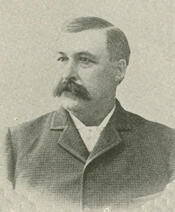
Charles Addison Chickering (November 26, 1843 – February 13, 1900) was a Republican member of the United States House of Representatives from New York who served from 1893 until his death in 1900. Over the course of four consecutive terms in Congress, he represented his constituents during a significant period in American political and economic development and played an active role in the legislative process, particularly in matters related to transportation and infrastructure.
Chickering was born on November 26, 1843, in Harrisburg, Lewis County, New York. He attended the local common schools and continued his education at Lowville Academy in Lowville, New York, an institution that prepared many young men of the region for professional and public life. After completing his studies, he remained at Lowville Academy for a time as a teacher, reflecting an early commitment to education and public service in his home county.
Following his work in education, Chickering entered private enterprise and engaged in business as a hardware merchant. His experience as a businessman in Lewis County provided him with practical knowledge of local economic conditions and the needs of rural communities in upstate New York. This combination of educational and commercial experience helped shape his later approach to public administration and legislative work.
Chickering’s formal public career began in local educational administration. He served as school commissioner of Lewis County from 1865 to 1875, a decade-long tenure during which he oversaw public schooling in the county in the years immediately following the Civil War. In this role he was responsible for supervising schools, promoting educational standards, and helping to organize and improve the county’s educational system at a time of expansion and reform in New York’s public schools.
Building on his prominence in local affairs, Chickering was elected to the New York State Assembly as the representative for Lewis County, serving in 1879, 1880, and 1881. His service in the Assembly introduced him to state-level legislative processes and party leadership. He later returned to Albany in an administrative capacity, serving as Clerk of the New York State Assembly from 1884 to 1890. As Clerk, he managed the Assembly’s records and proceedings and played a key role in the organization and operation of the legislative body, further solidifying his reputation as an experienced and reliable Republican official.
Chickering was also active in party politics beyond the legislature. He served as chairman of the Lewis County Republican committee, helping to organize and direct local party activities. At the state level, he was a member of the Republican State committee, where he served as secretary and as a member of its executive committee. These positions placed him in the inner circles of Republican Party organization in New York and contributed to his emergence as a candidate for national office.
In 1892, Chickering was elected as a Republican to the Fifty-third Congress and subsequently reelected to the Fifty-fourth, Fifty-fifth, and Fifty-sixth Congresses, serving from March 4, 1893, until his death on February 13, 1900. As a member of the House of Representatives, he participated fully in the democratic process and represented the interests of his New York constituents during a period marked by industrial growth, debates over monetary policy, and the expansion of the nation’s transportation networks. He served as chairman of the House Committee on Railways and Canals during the Fifty-fourth, Fifty-fifth, and Fifty-sixth Congresses, a position that gave him significant influence over legislation affecting the development and regulation of the country’s transportation infrastructure.
Chickering’s congressional service was cut short by an accidental death while still in office. On February 13, 1900, while on a business trip to New York City, he suffered fatal injuries from a fall from a window of the Grand Union Hotel. His death placed him among the members of the United States Congress who died in office in the early twentieth century. He was interred in Riverside Cemetery in Copenhagen, New York, in the region where he had been born, educated, and had built his career in public service.
Congressional Record