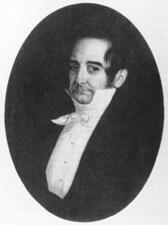
Charles Dominique Joseph Bouligny (August 22, 1773 – March 4, 1833) was a lawyer, planter, and politician who represented Louisiana in the United States Senate from 1824 to 1829. A member of the Adams Party and aligned with Henry Clay and the National Republican Party, he contributed to the legislative process during one term in office, representing the interests of his Louisiana constituents during a significant period in early American political development. Of French and Spanish descent, he was the brother of Louis Bouligny, a state representative, and the uncle of John Edward Bouligny, who later served as a U.S. Representative from New Orleans.
Bouligny, known familiarly as Dominique or by its Spanish form Domingo, was born in New Orleans, Louisiana (then part of New Spain), on August 22, 1773. His father, Francisco Bouligny, came to Louisiana as a military official when the territory was transferred from France to Spain and rose to become a high-ranking official in Spanish Louisiana. His mother, Marie-Louise Le Sénéchal d’Auberville, belonged to a prominent New Orleans Creole family. Charles Dominique Joseph Bouligny was the couple’s second child and eldest son, raised in a milieu that combined French, Spanish, and Creole influences and that was closely tied to the colonial administrative and military elite.
In 1786, at the age of twelve, Bouligny entered the Spanish colonial military, joining Spain’s Louisiana Regiment as a cadet. He earned a commission as sublieutenant two years later. With the outbreak of the War of the First Coalition in Europe, he was assigned to the regiment’s artillery corps and later placed in command of a squadron of gunboats sent up the Mississippi River to the District of Illinois. In that capacity he oversaw the initial construction of Fort San Fernando de las Barrancas. He was promoted to lieutenant in December 1795. Bouligny resigned from the regiment in 1803, when the Spanish forces departed the territory following Louisiana’s return to French rule under the terms of the secret Treaty of San Ildefonso and the subsequent transition that preceded the Louisiana Purchase.
Alongside his military service, Bouligny became involved in the civic life of New Orleans under Spanish rule. In 1800, he purchased a regidor perpétuo seat in the cabildo, the city’s municipal governing council, from Gilberto Andry for 800 silver pesos. The following year, he was elected by the council as one of two “annual commissioners,” who represented the cabildo before the governor and supervised audits of the city treasurer. After the Sale of Louisiana to the United States in 1803, Bouligny, like many colonial residents, assumed U.S. citizenship. Having resigned his Spanish military commission, he turned his attention to managing a large sugarcane plantation upriver from New Orleans, where he also produced tafia rum. He was a slaveholder, and his plantation and related enterprises formed the economic base that supported his subsequent political career.
Bouligny entered American territorial politics soon after the United States organized the region. In 1805, he was elected to the House of Representatives for the Territory of Orleans as one of seven representatives from Orleans County and was reelected in 1807. During his second term, he served on the committee that drafted the civil code of 1808, an important legal instrument that helped shape Louisiana’s distinctive civil law tradition. That same year, he was appointed a major in the territorial militia’s Fourth Regiment. After Louisiana was admitted to the Union as a state in 1812, Bouligny continued his public service; in 1813 he became a member of the Orleans Parish police jury, which oversaw local administration of the parish. During the War of 1812, he was appointed to the Committee for the Defense of New Orleans and played a role in rallying volunteers to protect the city during the British invasion of 1814–1815, a critical episode culminating in the Battle of New Orleans.
On the national stage, Bouligny’s congressional service came during a formative period in U.S. politics. In 1823 he was identified with the Adams Party, and in 1824 the Louisiana state legislature elected him to the United States Senate to complete the term of Senator Henry Johnson, who had been elected governor. Bouligny took his seat on November 19, 1824, and served until March 4, 1829. In the Senate he aligned himself with Henry Clay and the emerging National Republican Party. During the second session of the 20th Congress he served as chair of the Senate Committee on Agriculture. In that capacity he supported several tariff measures, including the Tariff of 1828, often called the “Tariff of Abominations,” which he believed would benefit Louisiana’s sugarcane industry and protect the economic interests of his state’s planters. His tenure in the Senate thus linked regional agricultural concerns with the broader national debates over tariffs and economic policy in the 1820s.
Rising Jacksonian sentiment in Louisiana and across the nation undermined Bouligny’s prospects for reelection at the close of his term. In 1829, the Louisiana legislature declined to return him to the Senate and instead elected Edward Livingston on the fifth round of balloting. After leaving Congress, Bouligny returned to Louisiana. He considered reentering public life at the municipal level, contemplating a campaign for mayor of New Orleans against the incumbent, Denis Prieur, but ultimately did not pursue that race. He began to divest from his plantation holdings upriver and shifted his investments increasingly toward property within the city of New Orleans, reflecting both changing economic conditions and his own evolving interests.
In his personal life, Bouligny married into another prominent Creole family. In early 1803, shortly before Louisiana was formally returned to France and then sold to the United States, he wed Anna Arthémise Le Blanc (1785–1848), the daughter of a well-connected local family allied with the Boulignys. The couple had fifteen children, twelve of whom—six sons and six daughters—survived to adulthood. Through his extended family, including his brother Louis Bouligny and his nephew John Edward Bouligny, Charles Dominique Joseph Bouligny was part of a multigenerational political lineage that remained active in Louisiana and national politics.
Dominique Bouligny died in New Orleans on March 4, 1833. His remains were interred in Saint Louis Cemetery No. 1, one of the city’s historic above-ground burial grounds. His career, spanning Spanish colonial service, territorial and state politics, and a term in the United States Senate, placed him among the early Hispanic and Latino Americans to serve in the United States Congress and reflected the complex cultural and political transitions experienced in Louisiana from the late eighteenth to the early nineteenth century.
Congressional Record