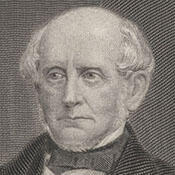
Charles Francis Adams Sr. was born on August 18, 1807, in Boston, Massachusetts, into one of the most prominent political families in the United States. He was the grandson of John Adams, the second President of the United States, and the son of John Quincy Adams, the sixth President of the United States. Growing up in this distinguished household, he was immersed from an early age in public affairs, diplomacy, and political discourse, experiences that helped shape his later career in law, politics, and international service.
Adams received a rigorous education befitting his family’s status. He attended the Boston Latin School and then Harvard College, from which he graduated in 1825. After completing his undergraduate studies, he read law and was admitted to the bar, beginning a legal practice in Boston. His early professional life combined legal work with growing involvement in public issues, particularly those related to slavery and the evolving party system in the United States.
Before entering national office, Adams became active in Massachusetts politics and in the broader antislavery movement. Initially associated with the Whig Party, he was drawn increasingly to antislavery causes and became a leading figure in the Free Soil Party, which opposed the expansion of slavery into the western territories. His writings and speeches during this period reflected a strong moral and political opposition to slavery, and he emerged as one of New England’s notable reform-minded politicians. This background positioned him well for the transition into the newly formed Republican Party in the 1850s, which united many former Whigs, Free Soilers, and antislavery Democrats.
Charles Francis Adams served as a Representative from Massachusetts in the United States Congress from March 4, 1859, to March 3, 1863. A member of the Republican Party, he contributed to the legislative process during two terms in office, representing the interests of his Massachusetts constituents in the House of Representatives. His service in Congress occurred during a significant period in American history, spanning the final years before the Civil War and the opening phase of the conflict. In this role, Adams participated in the democratic process at a time of intense national division, aligning with the Republican majority on issues related to the Union and the containment of slavery.
Adams’s congressional service coincided with the secession crisis and the outbreak of the Civil War, and his experience and family background made him a respected voice in debates over the future of the Union. In 1861, during his second term, he was selected by President Abraham Lincoln for a critical diplomatic assignment. Although his formal tenure in the House concluded in 1863, his transition from legislator to diplomat began earlier, as he was appointed United States Minister (often styled ambassador) to the Court of St. James’s in London in 1861. In that capacity, he played a central role in preventing British recognition of the Confederacy and in managing delicate issues such as the Trent Affair and British shipbuilding for Confederate use. His work in London is widely regarded as one of the most important American diplomatic efforts of the Civil War era.
Beyond his own career, Adams was the patriarch of a line of notable public figures who carried the family name and influence into subsequent generations. His son, Charles Francis Adams Jr. (1835–1915), served as a general in the American Civil War and later became president of the Union Pacific Railroad, reflecting the family’s continued engagement in both military and economic affairs. His nephew, Charles Francis Adams III (1866–1954), served as Secretary of the Navy of the United States, further extending the Adams legacy in federal service. The next generation included Charles Francis Adams IV (1910–1999), son of Charles Francis Adams III, who became president of the defense contractor Raytheon, demonstrating the family’s shift into leadership in modern industry and technology. Another member of the extended family, Charles Adams (1876–1947), became a prominent grocery magnate and founder of the Boston Bruins hockey team, illustrating the diversification of the Adams family’s influence into business and professional sports.
Charles Francis Adams Sr. lived to see the post–Civil War transformation of the United States and the continued prominence of his family in public life. He died on November 21, 1886, in Boston, Massachusetts. Remembered as a U.S. congressman and ambassador, as well as the grandson of John Adams and son of John Quincy Adams, he occupies a distinctive place in American history as both a key figure in the Civil War–era political and diplomatic arena and as a central link in one of the nation’s most enduring political dynasties.
Congressional Record