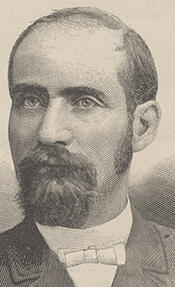
Chapman Levy Anderson (March 15, 1845 – April 27, 1924) was an American lawyer and Democratic politician who served two terms as a U.S. Representative from Mississippi from 1887 to 1891. A Confederate Army veteran, he represented his state in the Fiftieth and Fifty-first Congresses during a significant period in American history, participating in the legislative process and representing the interests of his constituents in the U.S. House of Representatives.
Anderson was born near Macon, Noxubee County, Mississippi, on March 15, 1845. He was the son of Thomas Salmond Anderson (born 1819) and Flora E. (Levy) Anderson (born 1823), and was related to Chapman Levy, a prominent Jewish lawyer and planter in South Carolina, from whom he derived his middle name. He attended the common schools in Jackson, Mississippi, receiving a basic formal education typical of the era. His family was deeply affected by the Civil War: his eldest brother, Edward Henry Anderson, served in the Confederate Army and was killed at the First Battle of Bull Run in 1861.
In the midst of the Civil War, Anderson himself entered Confederate service. He enlisted in the Confederate States Army on March 5, 1862, as a private in the Thirty-ninth Regiment, Mississippi Volunteer Infantry. Over the course of the conflict he was promoted through successive grades of noncommissioned officer, reflecting both experience and responsibility gained in the field. In July 1864 he was transferred to Bradford’s cavalry corps of scouts with the rank of second lieutenant, in which capacity he served until the close of the war in 1865.
Following the war, Anderson turned to higher education and the law. In January 1866 he entered the University of Mississippi, where he pursued a partial course of study in law and literature until the summer of 1867. He was admitted to the bar on February 14, 1868, and soon thereafter commenced the practice of law in Kosciusko, Attala County, Mississippi. Establishing himself as an attorney in the Reconstruction-era South, he built a legal career that would underpin his later public service.
Anderson’s entry into public office began at the local level. He served as mayor of Kosciusko in 1875, gaining administrative and political experience in municipal government. He then advanced to state office, serving as a member of the Mississippi House of Representatives in 1879 and 1880. As a Democratic Party officeholder in the post-Reconstruction period, he participated in state legislative affairs during a time of political realignment and the reassertion of white Democratic control in Mississippi.
In national politics, Anderson was elected as a Democrat to the U.S. House of Representatives, serving in the Fiftieth and Fifty-first Congresses from March 4, 1887, to March 3, 1891. During his two terms in Congress, he contributed to the legislative process and took part in the broader democratic governance of the nation, representing Mississippi’s interests in Washington. In the 1888 election, his Republican opponent, Marsh Cook, unsuccessfully contested the election results, reflecting the contentious and often violent political climate of the era. Cook was later ambushed and murdered by a gang of white supremacists in 1890 while campaigning to be a delegate to Mississippi’s 1890 Constitutional Convention, an event emblematic of the period’s intense struggles over political power and voting rights. Anderson was an unsuccessful candidate for renomination in 1890, bringing his congressional service to a close in March 1891.
After leaving Congress, Anderson continued his legal and public service career. He was appointed United States district attorney for the northern district of Mississippi, serving in that federal prosecutorial post in 1896 and 1897. Following his tenure as U.S. district attorney, he returned to private practice in Kosciusko, where he maintained his law office and remained an active member of the local bar for the remainder of his life.
In his personal life, Anderson was an Episcopalian. He married Nancy Cunningham Johnson of Kirkwood, Madison County, Mississippi, on December 22, 1870. The couple had three children: Jenny Flora; Chapman Levy, who died on September 25, 1883; and Mary Ellen, who later married lawyer James E. Teat on June 22, 1904. Anderson lived and worked in Kosciusko until his death on April 27, 1924. He was interred in Kosciusko Cemetery, closing a life that spanned the antebellum, Civil War, Reconstruction, and early twentieth-century eras in Mississippi and national public life.
Congressional Record