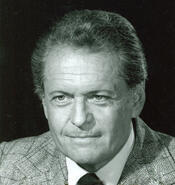
Cecil Landau Heftel (September 30, 1924 – February 4, 2010) was an American politician, broadcasting executive, and businessman from Hawaiʻi. A member of the Democratic Party, he represented Hawaiʻi’s First Congressional District, encompassing most of urban Honolulu, in the United States House of Representatives from 1977 until his resignation in 1986, serving five terms in Congress. His congressional service occurred during a significant period in American history, and he participated actively in the legislative process while representing the interests of his constituents.
Heftel was born in Chicago, Illinois, where he grew up in the Albany Park neighborhood. His maternal grandparents were immigrants from Russia and his paternal grandparents were from Poland, reflecting the Eastern European Jewish roots of his family. He attended Roosevelt High School in Albany Park. During World War II, from 1943 to 1946, he served in the United States Army. After his military service, he pursued higher education, obtaining a bachelor’s degree from Arizona State University in 1951. He then undertook graduate work at the University of Utah and at New York University. Heftel was a member of the Church of Jesus Christ of Latter-day Saints (Latter-day Saint), a religious affiliation that remained an important part of his personal life.
Following his studies, Heftel embarked on a career in broadcasting that would make him a prominent figure in the industry. He eventually settled in Honolulu, Hawaiʻi, where he established Heftel Broadcasting. In Hawaiʻi he owned KGMB-AM-FM-TV, building it into a leading media outlet, and he expanded his holdings to include several other radio and television stations across the United States. In 1957, he became a pioneer of what was then called Top 30 programming when he purchased KIMN in Denver, Colorado. Operating in one of the nation’s most competitive radio markets, he turned KIMN into the dominant, number-one-rated radio station. He sold KIMN in 1960 and returned to Hawaiʻi, but he continued to move in and out of station ownership over subsequent decades, demonstrating a keen sense of timing in a business whose revenues were closely tied to ratings and advertising cycles.
In the 1970s and 1980s, Heftel broadened his broadcasting ventures on the U.S. mainland. In 1973, he purchased WHYI-FM in Fort Lauderdale, Florida, branding it as Y-100. In 1974, he hired consultant John Rook, who brought in programmer Bill Tanner. Tanner crafted a Top 40 format he described as “predictable unpredictability,” which propelled the station to the top of the South Florida ratings for several years before it was eventually sold. Heftel also purchased WJAS in Pittsburgh, which he later sold, and assembled a mostly AM group of Top 40 stations that he divested in the late 1970s. As FM radio came into its own in the early 1970s, he acquired FM stations such as WZPL, moved into Indianapolis, and WLLT in Cincinnati, selling these properties in the 1980s. In 1986–1987, he partnered with Scott Ginsburg in H & G Communications, a group that included WLUP-AM-FM in Chicago and stations in Miami and other cities. His final major accumulation of stations included outlets in New York, Los Angeles, Chicago, Dallas, Las Vegas, and Miami. These properties were taken over by Clear Channel Communications in a 1996 tender offer and subsequently merged with Mac Tichenor’s Tichenor Media System into a new Heftel Broadcasting, which later became Hispanic Broadcasting Corporation, now part of Univision Radio.
Heftel’s success in broadcasting provided the platform for his entry into electoral politics. Upon returning to his business interests in Honolulu, he decided to seek public office. In 1970, he was the Democratic nominee for the United States Senate from Hawaiʻi, narrowly losing to incumbent Republican Senator Hiram Fong. Remaining active in party affairs, he served as a delegate to the 1972 Hawaiʻi State Democratic Convention, where he was elected in caucus to become a delegate to the 1972 Democratic National Convention. Building on this experience and his growing public profile, he ran for the U.S. House of Representatives in 1976.
In 1976, Heftel was elected to Congress from Hawaiʻi’s First Congressional District and was reelected four more times, serving from January 3, 1977, until his resignation on July 19, 1986. During his tenure in the House of Representatives, he contributed to the legislative process on a wide range of issues and was involved in foreign policy oversight. He was part of a U.S. fact-finding mission to the Philippines that played a significant role in the events leading to the forced ouster of longtime dictator Ferdinand Marcos in 1986, a key moment in the restoration of democratic governance in that country. In domestic policy, his voting record reflected both support for economic stimulus and concern about budget priorities. Heftel voted for the Economic Recovery Tax Act of 1981, landmark legislation intended to stimulate economic growth by significantly reducing individual income tax rates; the bill passed the House by a vote of 323–107, passed the Senate by voice vote, and was signed into law by President Ronald Reagan on August 13, 1981. However, he voted against the Omnibus Budget Reconciliation Act of 1981, which reduced federal domestic spending while increasing military funding; despite his opposition, that measure also passed the House by a vote of 232–193, passed the Senate by voice vote, and was signed by President Reagan the same day.
In 1986, Heftel resigned from Congress on July 19 to run for governor of Hawaiʻi. Seeking the Democratic nomination, he mounted a vigorous campaign but lost the primary election to Lieutenant Governor John Waiheʻe. Heftel attributed his defeat to what he described as a smear campaign against him. Many Democrats in Hawaiʻi have long asserted that the smear originated with Republicans who believed that running against Waiheʻe would provide an easier path to the governorship. Others in Hawaiʻi political circles have suggested that the attacks were orchestrated by a more powerful political machine that viewed Heftel’s reputation for a no-nonsense, honest approach as a threat to entrenched interests. After this loss, he stepped back from elective office but remained engaged in public affairs.
In the years following his congressional service, Heftel continued to express strong views on political reform and national issues. In 1992, he was a supporter of the independent presidential campaign of Ross Perot, reflecting his concern with fiscal responsibility and government accountability. In 1998, he briefly returned to the political arena as an author, publishing the book End Legalized Bribery. In this work, he argued that the existing system of campaign finance corrupted politicians, discouraged qualified individuals from seeking office, and cost taxpayers billions of dollars in pork-barrel spending and corporate welfare. He advocated for a national Clean Elections law and mandatory free commercial airtime for political candidates as mechanisms to reduce the influence of money in politics and to strengthen democratic participation.
After nearly two decades largely out of the electoral spotlight, Heftel made a late-career return to public service in Hawaiʻi. At age 80, he successfully ran for the Hawaiʻi State Board of Education, winning election in November 2004 to the Oʻahu At-Large seat. His election to the Board of Education marked a renewed commitment to public life and allowed him to influence education policy in the state, drawing on his long experience in business, media, and government.
Cecil Heftel died of natural causes on February 4, 2010, in San Diego, California, at the age of 85. Although some sources reported his death as occurring on February 5, his widow stated that he died on February 4. His public service was later commemorated at the federal level: on June 13, 2011, U.S. Representative Colleen Hanabusa of Hawaiʻi introduced legislation to designate the post office at 4354 Pahoa Avenue in Honolulu as the “Cecil L. Heftel Post Office Building,” honoring his contributions as a businessman, broadcaster, and five-term Representative from Hawaiʻi.
Congressional Record