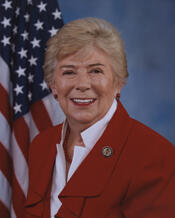
Carolyn McCarthy (née Cook; January 5, 1944 – June 26, 2025) was an American politician and nurse who served as a Democratic member of the United States House of Representatives from 1997 to 2015, representing New York’s 4th congressional district. Over nine consecutive terms, she became one of the nation’s most prominent advocates for gun control and also played an active role in education, health, and financial services policy. Her congressional service occurred during a significant period in American history, and she participated fully in the legislative process while representing the interests of her Long Island constituents.
McCarthy was born Carolyn Cook in Brooklyn, New York, on January 5, 1944, and was raised in Mineola, a suburban community on Long Island. Her father worked as a boilermaker and her mother was employed at Woolworth. An athlete in her youth, she initially aspired to become a physical education teacher, but she struggled with reading and was later diagnosed with dyslexia, an experience that would inform her later advocacy on behalf of individuals with learning disabilities. She studied at the Glen Cove Nursing School and, after caring for a boyfriend who had been injured in a car accident and being impressed by the dedication of the nursing staff, decided to pursue a career as a Licensed Practical Nurse.
In 1967, she married Dennis McCarthy, and the couple settled in Mineola, where they raised their son, Kevin. Before entering politics, Carolyn McCarthy worked as a nurse and was a registered Republican, reflecting the political leanings of many in her community. By 1993, both her husband and son were employed by Prudential Securities in Manhattan and commuted daily on the Long Island Rail Road. On December 7, 1993, Dennis McCarthy was killed and Kevin was severely wounded when gunman Colin Ferguson opened fire on a Long Island Rail Road train at the Merillon Avenue station in Garden City, New York, killing six people and wounding 19 others. The tragedy transformed McCarthy into a public advocate for stricter gun control laws and set her on a path toward elective office. Her story and the events surrounding the shooting were later dramatized in the 1998 television movie “The Long Island Incident,” in which she was portrayed by actress Laurie Metcalf.
Motivated by the Long Island Rail Road shooting and dissatisfied with the political response to gun violence, McCarthy launched a campaign for Congress in 1996. Although she had been a registered Republican, she ran for office as a Democrat and challenged freshman Republican Representative Dan Frisa in New York’s 4th congressional district. Centering her campaign on gun safety and public security, she defeated Frisa by a large margin and entered the 105th Congress in January 1997. Over time, she “evolved” into a reliable Democratic vote, aligning closely with her party’s positions and voting with House Democrats 98.1 percent of the time during the 111th Congress. She served a total of nine terms, from January 3, 1997, to January 3, 2015, and was succeeded by fellow Democrat Kathleen Rice after announcing on January 8, 2014, that she would not seek re-election that November, citing health concerns.
During her congressional career, McCarthy quickly became known as one of the most vocal and persistent advocates of gun control in the United States. She was frequently described as “the doyenne of anti-gun advocates in the House” and “the fiercest gun-control advocate in Congress.” In 1997, she sponsored legislation requiring trigger locks on firearms, and after a shooting at the Empire State Building that same year, she introduced a bill to ban the sale of guns to tourists visiting the United States, a stance that led to threats serious enough to require police protection at many of her public appearances. She opposed provisions in a Treasury appropriations bill that permitted the importation of weapons modified to comply with the federal assault weapons ban. Following the Columbine High School massacre in 1999, she proposed legislation to require child-resistant firearms, tighten gun purchasing rules for young adults, and regulate gun shows. After the Federal Assault Weapons Ban expired in September 2004, she introduced the Assault Weapons Ban and Law Enforcement Protection Act of 2007 in an effort to reauthorize and strengthen the ban. In the wake of the Virginia Tech shootings on April 16, 2007, she called for legislation to prevent further acts of gun violence and introduced the NICS Improvement Amendments Act of 2007 (H.R. 2640), designed to improve the sharing of mental health and other disqualifying records with the National Instant Criminal Background Check System. With the support of the National Rifle Association, the bill passed Congress and was signed into law by President George W. Bush. She later focused on closing the so‑called “gun show loophole,” and in January 2012, working with Senator Dianne Feinstein of California, she proposed legislation to ban the sale, transfer, manufacture, or importation of 150 specified firearms, including semiautomatic rifles and pistols with detachable or fixed magazines holding more than ten rounds and featuring certain military-style characteristics such as pistol grips and grenade or rocket launchers. Acknowledging that she was widely viewed as a one-issue lawmaker, McCarthy remarked in 2009 that although she was also known for her work on education and district issues, she remained, in the public eye, “the gun lady.”
Beyond gun policy, McCarthy served on several key House committees and caucuses and worked to broaden her legislative portfolio. She was a member of the Committee on Education and the Workforce, where she served as Ranking Member of the Subcommittee on Early Childhood, Elementary and Secondary Education and also sat on the Subcommittee on Higher Education and Workforce Training. On the Committee on Financial Services, she served on the Subcommittee on Financial Institutions and Consumer Credit and the Subcommittee on Housing and Insurance. She co-chaired the Congressional Hearing Health Caucus and participated in the Congressional Glaucoma Caucus, the Financial Literacy Caucus, the International Conservation Caucus, the U.S.-Israel Security Caucus, and the Congressional Women’s Caucus. Drawing on her nursing background, she became one of Congress’s strongest advocates for hearing loss detection, prevention, and treatment, repeatedly championing the Hearing Aid Tax Credit Act to make hearing aids more affordable. In 2003, she introduced legislation to prohibit companies from forcing older employees into retirement and denying them pensions and benefits, reflecting her interest in labor and retirement security.
McCarthy’s personal experiences with dyslexia and disability shaped her work on education and civil rights. She testified in support of the Individuals with Disabilities Education Act and co-sponsored legislation to fund early detection of dyslexia, emphasizing the importance of early intervention and educational support for children with learning disabilities. She consistently supported abortion rights, voting against a ban on late-term abortions in 1997, earning a 100 percent rating from NARAL Pro-Choice America in 2003, and receiving a 0 percent rating from the National Right to Life Committee in 2006, signaling a firmly pro-choice record. In her initial 1996 campaign, she stated that she personally opposed the death penalty but would not support its repeal because a majority of her constituents favored capital punishment. On foreign and defense policy, she voted in favor of the Iraq War Resolution in 2002 and, in 2006, supported a Republican resolution backing the continuation of the war.
Carolyn McCarthy announced on January 8, 2014, that she would not seek re-election, citing health reasons, and she retired from Congress at the conclusion of her ninth term in January 2015. She died on June 26, 2025. Throughout her 18 years in the House of Representatives, she was recognized both for her steadfast commitment to gun control in the aftermath of personal tragedy and for her broader work on education, health, disability rights, and financial services, representing New York’s 4th congressional district during a transformative era in national politics.
Congressional Record