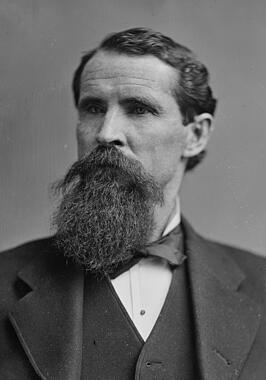
Campbell Polson Berry (November 7, 1834 – January 8, 1901) was a Democratic politician from California who served in both the California State Assembly and the United States House of Representatives. He represented California’s 3rd Congressional District in the U.S. Congress from 1879 to 1883, serving two terms during a significant period in American political and economic development. Over the course of his public career, he was closely identified with the interests of his constituents in Sutter County and the broader agricultural regions of northern California.
Berry was born on November 7, 1834, in Jackson County, Alabama. In his youth he moved west with his family, part of the broader mid-nineteenth-century migration that brought many settlers to California. He eventually settled in Sutter County, California, where he engaged in agricultural pursuits. His experience as a farmer and resident of a rural community helped shape his later political priorities and his understanding of the needs of local constituents.
Although detailed records of Berry’s formal education are limited, his subsequent public service indicates that he was well versed in the legal and political issues of his time. Like many nineteenth-century American politicians who emerged from frontier and agricultural communities, he appears to have acquired much of his education through practical experience, self-study, and active participation in local civic affairs. This background prepared him for leadership roles in state and national government.
Berry’s political career began in state government. A member of the Democratic Party, he was elected to the California State Assembly from Sutter County, first serving from 1869 to 1873. After a brief interval out of office, he returned to the Assembly and served again from 1875 to 1880. During this second period of service he rose to a position of particular prominence when he was chosen Speaker of the California State Assembly for the 1877–1878 session. In that role he presided over legislative deliberations at a time when California was grappling with issues of economic development, transportation, and the regulation of emerging industries.
Building on his state-level experience, Berry was elected as a Democrat to the United States House of Representatives, representing California’s 3rd District. He served in the Forty-sixth and Forty-seventh Congresses, from March 4, 1879, to March 3, 1883. As a member of the House of Representatives, Campbell Polson Berry participated in the democratic process and contributed to the legislative work of the period, which included debates over monetary policy, federal land issues, and the regulation of commerce in the post–Civil War era. His tenure in Congress coincided with a significant period in American history marked by Reconstruction’s aftermath, rapid industrialization, and the expansion of the railroads, and he represented the interests of his California constituents within that broader national context.
After completing his two terms in Congress, Berry did not return to federal office. He resumed his private pursuits in Sutter County, remaining associated with the agricultural and local community life that had first brought him into public service. Although he no longer held elective office, his earlier work in the State Assembly and in Congress left a record of sustained engagement with the legislative process at both the state and national levels.
Campbell Polson Berry died on January 8, 1901, in Wheatland, Yuba County, California. He was interred in the local cemetery, leaving behind a legacy as a nineteenth-century California Democrat who rose from rural beginnings to hold leadership positions in the state legislature and to represent his district in the United States Congress during a formative era in the nation’s development.
Congressional Record