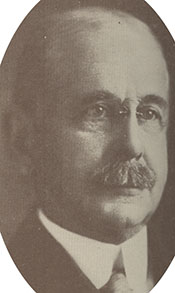
Calvin DeWitt Paige (May 20, 1848 – April 24, 1930) was a Republican member of the United States House of Representatives from Massachusetts who served six consecutive terms in Congress from 1913 to 1925. He was born in Southbridge, Worcester County, Massachusetts, where he spent much of his life and built a career in manufacturing, banking, and public service before and after his tenure in the national legislature.
Paige received his early education in the public schools of Southbridge, a growing industrial community in central Massachusetts. Coming of age in the post–Civil War period, he entered the local business world at a time when textile and related manufacturing were expanding rapidly in New England. His early experiences in commerce and industry laid the groundwork for his later leadership roles in several prominent Southbridge enterprises.
In his business career, Paige became a leading figure in the industrial and financial life of Southbridge. He served as president of the Central Cotton Mills Company, a significant local textile concern, and also held the presidency of the Edwards Company, an important manufacturer in the community. In addition to his industrial interests, he was president of the Southbridge Savings Bank, reflecting his influence in regional banking and finance. These positions established him as a prominent businessman whose economic activities were closely tied to the development and prosperity of his hometown.
Paige’s public career began at the state level in Massachusetts. He was elected to the Massachusetts House of Representatives and served as a member of the state house in 1878 and 1879, participating in the legislative affairs of the Commonwealth during a period of industrial growth and political realignment. He remained active in Republican Party politics and was chosen as a delegate to the Republican National Convention in 1884, taking part in the national deliberations of his party. Later, he advanced to higher state office as a member of the Massachusetts Governor’s Council in 1906 and 1907, where he advised the governor and participated in the confirmation of appointments and other executive matters.
Paige entered national politics in the second decade of the twentieth century. A member of the Republican Party, he was elected to the United States House of Representatives in a special election to the Sixty-third Congress, held to fill the vacancy caused by the death of Representative William H. Wilder. Taking his seat in 1913, he was subsequently reelected to the five succeeding Congresses, serving continuously from 1913 to 1925. His twelve years in the House of Representatives coincided with a significant period in American history that included the Progressive Era, World War I, and the early years of the postwar decade. As a member of the House, Paige participated in the democratic process, contributed to the legislative work of Congress, and represented the interests of his Massachusetts constituents during these transformative years.
After leaving Congress in 1925, Paige withdrew from public life and returned to his longstanding business pursuits. He resumed active engagement in banking and related enterprises in Southbridge, continuing to be associated with the financial institutions and companies he had helped lead before his congressional service. He remained a respected figure in the community where he had been born, built his career, and maintained his principal residence.
Calvin DeWitt Paige died on April 24, 1930. His life reflected the trajectory of a nineteenth-century New England businessman who rose from local industry and finance to state office and ultimately to the national legislature, serving six terms in the U.S. House of Representatives while maintaining close ties to the industrial and civic life of Southbridge, Massachusetts.
Congressional Record