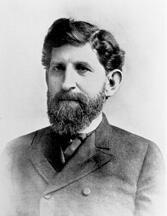
Calvin Stewart Brice (September 17, 1845 – December 15, 1898) was an American businessman, railroad executive, and Democratic politician from Ohio. A leading Bourbon Democrat, he is best remembered for his formative role in the American rail industry, his service as chairman of the Democratic National Committee, and his single term as a United States Senator from Ohio from 1891 to 1897. During his one term in the Senate, he contributed to the legislative process as a member of the Democratic Party and represented the interests of his constituents during a significant period in American history.
Brice was born on September 17, 1845, in Denmark, Morrow County, Ohio, to William Kirkpatrick Brice and Elizabeth Stewart Brice. His father, a Presbyterian minister of modest means, provided him with an early home education before he entered the public schools at Columbus Grove in Putnam County, Ohio. Showing promise as a student, Brice gained admission to Miami University in Oxford, Ohio, in 1859. His education was interrupted by the Civil War, but he later returned to complete his studies and graduated from Miami University with high honors in 1863. After graduation he briefly worked as a schoolmaster before turning to military and legal pursuits.
At the outbreak of the Civil War, Brice first attempted to enlist in 1861 but was refused because of his youth. In the summer of 1862 he successfully enlisted and served three months in the 86th Regiment of the Ohio Volunteer Infantry, seeing action in West Virginia. After returning to Miami University and completing his degree, he again entered the Union Army in 1864, this time as captain of a company of volunteers he personally recruited for the 180th Ohio Infantry. Brice rose rapidly through the ranks, and by the end of the war he had attained the position of lieutenant colonel. Although he advanced quickly, he later stated he had “no desire for an army career,” and he left military service at the close of the conflict to pursue law.
Brice studied law at the University of Michigan Law School, earning his law degree in 1865. He was admitted to the Ohio bar in 1866 and began practicing law in Ohio. His early legal practice was not notably successful, and it was through a combination of legal work and business opportunity that he found his path into finance and railroads. Around 1880, when his mother’s home faced foreclosure, Brice approached the mortgage holder, former Ohio governor Charles Foster, offering his legal services. Foster declined the legal assistance but instead paid Brice $500 to negotiate a financial transaction on Wall Street. Ignoring Foster’s conservative instructions and following his own judgment, Brice returned with a profit of $40,000. This success launched his reputation as a shrewd businessman and began a long association with Foster, who later called him “the most remarkable man [he] ever met” and “the most successful borrower [he] ever saw.”
Brice’s business career developed in tandem with his legal work. He joined the legal department of the Lake Erie and Louisville Railroad, where he gained his first practical experience in railroad operations, finance, and expansion. In 1871 he traveled to Europe to secure funding for a struggling railway running from Toledo to Ohio’s coal fields, again impressing Foster and other backers. With Foster’s support, Brice guided the line through the Panic of 1873 and extended it into Lima and the surrounding region. His most notable railroad achievement was his central role in the creation of the New York, Chicago and St. Louis Railroad—popularly known as the Nickel Plate Road—constructed in 1882 to run from New York to St. Louis. Brice later sold the Nickel Plate to William Henry Vanderbilt at a substantial profit, as Vanderbilt viewed it as a dangerous competitor to his own lines. By 1887 Brice had become president of what was then known as the Lake Erie and Western Railroad, and over time he amassed a considerable fortune, holding interests in as many as ten railroads and branching into other enterprises such as the National Telegraph Company and the Chase National Bank of New York. Unlike many contemporaneous magnates, he was often described as personally frugal and publicly minded, and historian James White noted that Brice frequently minimized his own compensation and “stripp[ed] a proposition of every incumbrance and lay[ed] it bare for inspection.”
Alongside his business activities, Brice became increasingly active in Democratic politics at both the state and national levels. A conservative Bourbon Democrat, he first entered national politics as a presidential elector for Samuel J. Tilden in 1876. He later worked on the successful 1884 presidential campaign of Grover Cleveland, helping to organize and finance Democratic efforts. After Cleveland’s election, Brice’s influence within the party grew, and he was elected a delegate-at-large to the 1888 Democratic National Convention in St. Louis. In 1889 he was chosen to succeed William H. Barnum as chairman of the Democratic National Committee. His wealth, organizational skill, and extensive connections made him a powerful party leader and fundraiser, earning him the nickname “Calvin $ellars Brice.” He served as DNC chairman until 1892, when he was replaced by William Harrity of Pennsylvania after expressing doubts about nominating Grover Cleveland for a third presidential run.
In 1890, Brice sought election to the United States Senate from Ohio as the Democratic candidate to succeed Senator Henry B. Payne. He won the Democratic nomination over John A. McMahon, but his candidacy was controversial. Critics charged that he was not truly an Ohio resident because he had spent much of his recent career in New York, and his substantial campaign expenditures drew scrutiny. Heavy Democratic spending helped secure a Democratic majority in the Ohio General Assembly, which at that time elected U.S. Senators, and the legislature chose Brice for the Senate. Because of lingering suspicion surrounding Payne’s earlier selection to the Senate and concerns about money in politics, Brice’s credentials were closely examined by the Senate before he was seated. Nevertheless, he took office on March 4, 1891, and served one full term until March 3, 1897. During his tenure, he gained a reputation as a hard-working and intelligent legislator. He served as chairman of the Senate Committee on Pacific Railroads and sat on the Committee on Appropriations as well as the Democratic Steering Committee. Although he sponsored few measures that became widely remembered, he was active in debates over railroad regulation and fiscal policy. His reversal on the key Democratic issue of tariff reform, however, alienated many in his party’s base, and his close ties to New York financial and business interests led some Ohioans to deride him as “New York’s Third Senator.” He narrowly avoided a formal censure at the 1894 Ohio Democratic state convention but was unable to overcome the political damage, and in 1896 he lost his bid for reelection to Republican Joseph B. Foraker. After leaving the Senate in 1897, Brice withdrew from active participation in Ohio politics.
In his later years, Brice continued to pursue large-scale railroad and commercial projects, increasingly with an international focus. He became involved in railroad development in China and was a founding member of the American Asiatic Association, an organization formed to advance American trade interests in China under the emerging Open Door Policy. In the late 1890s he undertook an ambitious effort to construct a railroad between Canton and Hankou on the Chinese mainland, a project that reflected both his longstanding expertise in rail finance and his interest in expanding American commercial influence abroad. He did not live to see the project completed. Brice remained devoted to his alma mater, Miami University, throughout his life. His efforts in 1885 and 1888 to secure financial support for the institution were instrumental in ensuring its survival during a period of serious financial difficulty, and the university honored him by naming a science building, Brice Hall, after him; the building has since been demolished. The mining town of Briceville, Tennessee, which he helped connect to railroad service, was also named in his honor.
Calvin Stewart Brice died suddenly and unexpectedly in New York City on December 15, 1898, from an acute attack of pneumonia. His career spanned military service in the Civil War, a distinguished record as a railroad builder and financier, and prominent roles in Democratic Party leadership and the United States Senate, marking him as a significant figure in the political and economic life of the late nineteenth century.
Congressional Record