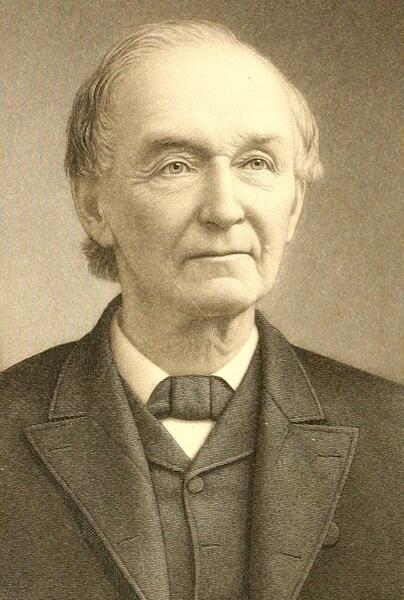
Caleb Newbold Taylor (July 27, 1813 – November 15, 1887) was an American politician who served two terms as a Republican member of the U.S. House of Representatives from Pennsylvania from 1867 to 1871. He was born near Newportville, Bucks County, Pennsylvania, where he spent his early years engaged primarily in agricultural pursuits. Raised in a rural environment, Taylor developed an early familiarity with farming and land management that would shape both his livelihood and later financial activities.
Taylor’s formal education is not extensively documented, but his early involvement in politics indicates that he was an informed and active participant in public affairs from a young age. By 1832, at the age of nineteen, he had aligned himself with the Whig Party and served as a delegate to the Whig State convention at Harrisburg, Pennsylvania. This early role in party politics reflected both his interest in national issues and his emerging prominence within local political circles in Bucks County.
Before achieving national office, Taylor pursued a political career marked by persistence despite repeated setbacks. He was an unsuccessful candidate for election to the U.S. House of Representatives in 1848, 1850, and again in 1852. During this period he continued his agricultural pursuits while remaining active in party affairs. With the realignment of American politics in the 1850s, Taylor joined the newly formed Republican Party and rose to further prominence as a delegate to the 1860 Republican National Convention, which nominated Abraham Lincoln for the presidency. His participation in that convention underscored his standing within the party and his engagement with the major political issues of the era.
Taylor’s congressional service came during the tumultuous years following the Civil War, a significant period in American history marked by Reconstruction and the redefinition of federal and state relationships. As a member of the Republican Party representing Pennsylvania, he contributed to the legislative process during two terms in office, participating in the democratic process and representing the interests of his constituents. He was elected as a Republican to the Fortieth Congress, serving from March 4, 1867. In the subsequent election, he successfully contested the election of John R. Reading to the Forty-first Congress, thereby securing a second term that extended his service through March 3, 1871. During these years he took part in the work of a Republican-controlled Congress that addressed issues of Reconstruction, civil rights, and the postwar economic order, although specific committee assignments and legislative initiatives associated with him are not extensively recorded in surviving summaries.
In addition to his public career, Taylor played a central role in managing the finances of his extended family, reflecting both his business acumen and the trust placed in him by relatives. He was the older brother of Franklin Taylor, making him the uncle of Frederick Winslow Taylor, the noted mechanical engineer and management consultant often regarded as the father of scientific management. Through this family connection, Caleb Taylor stood at the head of a family line that would exert considerable influence on American industrial and management practices in the late nineteenth and early twentieth centuries.
After leaving Congress, Taylor turned increasingly to financial and business pursuits. He became engaged in banking and, in 1875, assumed the presidency of the Farmers’ National Bank of Bristol, Pennsylvania. Under his leadership, he continued to expand his interests in land and property. By the time of his death, he owned 1,335 acres of land divided among nine farms, as well as thirty houses, reflecting substantial success as a landowner and investor. His combined assets were valued at $315,617.73, a considerable fortune for the period and a testament to his long-standing involvement in agriculture, real estate, and banking.
Taylor spent his later years at his home, “Sunbury Farm,” near his birthplace of Newportville in Bucks County. He remained president of the Farmers’ National Bank of Bristol from 1875 until his death, maintaining an active role in local economic life. He died at Sunbury Farm on November 15, 1887. His life encompassed the transformation of the United States from a predominantly agrarian republic through the crisis of civil war and into the early stages of industrialization, and his career reflected both the political realignments and the economic opportunities of nineteenth-century Pennsylvania.
Congressional Record