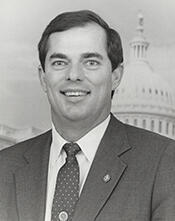
Bruce Reynolds Alger (June 12, 1918 – April 13, 2015) was an American politician, real estate agent and developer, and Republican member of the United States House of Representatives from Texas. The first Republican to represent a Dallas-area district in Congress since Reconstruction, he served five consecutive terms from January 3, 1955, to January 3, 1965, representing Texas’s 5th congressional district. Over a decade in Congress, Alger contributed to the legislative process during a significant period in American political history, participating in the democratic process and representing the interests of his constituents during the era of House Speaker Sam Rayburn and Senate Majority Leader Lyndon B. Johnson.
Alger was born in Dallas, Texas, on June 12, 1918, the son of David Bruce Alger, a bank representative, and the former Clare Freeman, an aspiring poet and writer. Shortly after his birth, the family moved, and he was raised in Webster Groves, Missouri, a small suburb of St. Louis. His upbringing in the Midwest preceded an education that would combine academic study with athletic achievement. Awarded a scholarship to Princeton University in Princeton, New Jersey, he studied philosophy, art, and music, and played center on the university’s football team. He completed his undergraduate work with an A.B. in philosophy in 1940, writing a 73-page senior thesis titled “Chinese Painting.” Following graduation, Alger went to work for the Radio Corporation of America (RCA) as a field representative, entering the then-developing field of television production.
With the onset of World War II, Alger left civilian employment and joined the United States Army. He was assigned to Squadron 5 at the Army Air Corps Advanced Flying School at Kelly Field in San Antonio, Texas, where he trained as a bomber pilot. During the war he flew bombers in the Pacific theater, attained the rank of captain, and later claimed to be among the first U.S. troops to enter Japan after the conclusion of hostilities in August 1945. For his wartime service he received the Distinguished Flying Cross. In 1943, during the war years, he married his first wife, Lucille “Lynn” Antoine. After returning to civilian life at the end of the war, Alger sought to resume his career with RCA, but the company declined to rehire him on the grounds that he had been away from television production for too long. Decades later, in April 2013, he self-published a memoir of his wartime experiences titled The Crew Book – Miss America ’62, named for the B-29 bomber he piloted, “Miss America ’62,” so called in honor of his daughter, who would turn eighteen in 1962. The book recounted his crew’s experience through training, combat, and the surrender of Japan.
In 1945, Alger returned to his native Dallas and entered the real estate and development business, forming his own real estate and land development company. He quickly became active in local civic affairs and was chosen as the first president of the White Rock Chamber of Commerce. In 1950, he announced the development of a 180-lot subdivision in Far East Dallas off Peavy Road that was to bear his name; the neighborhood, known as Alger Park, became one of his notable development projects. Even after his election to Congress, he continued to support the subdivision’s growth and appeared at ceremonies for the neighborhood, maintaining a visible presence in the local business community.
Alger’s formal political career began in the context of Texas’s long-standing Democratic dominance. In 1954 he became the Republican candidate for the U.S. House of Representatives from Texas’s 5th congressional district. His victory was considered unexpected given the state’s Democratic tradition. In the general election he received 27,982 votes (52.9 percent) to Democrat Wallace H. Savage’s 24,904 (47.1 percent), thereby becoming the first Republican to represent a Dallas district in Congress since Reconstruction. For eight years, until 1963, he was the only Republican in the Texas congressional delegation, a status that changed only when Ed Foreman of Odessa, later of Dallas, joined him in the House for the final two years of Alger’s tenure. Alger was reelected in 1956, 1958, 1960, and 1962. In 1956 he defeated Dallas County District Attorney Henry Wade, later a central figure in the Roe v. Wade abortion case, by a vote of 102,380 (55.6 percent) to 81,705 (44.4 percent). In 1958, a heavily Democratic year nationally, he prevailed over Democrat Barefoot Sanders, later a federal district judge, with 62,722 votes (52.6 percent) to 56,566 (47.4 percent). In 1962 he won his final term with 89,938 votes (56.3 percent) to Democrat Bill Jones’s 69,813 (43.7 percent).
During his decade in the House of Representatives, Alger served at the height of the Lyndon B. Johnson and Sam Rayburn era, when Texas Democrats dominated national and state politics. A strongly conservative Republican, he was often viewed as an “odd man out” in the Texas delegation. He described himself as an individualist, a constitutionalist, and a man of principle, although critics equated his adherence to principle with stubbornness. Alger opposed the prevalent congressional practice of trading votes for local projects and resisted what he saw as the expansion of federal power. He believed in limited national government, arguing that Washington should concentrate on defense and foreign affairs, while social programs and many domestic responsibilities should remain at the local level. Reflecting these views, he was the only member of the House to oppose the popular federal school lunch program. Although he joined the majority of the Texas delegation in declining to sign the 1956 Southern Manifesto, which opposed the Supreme Court’s decision in Brown v. Board of Education, he voted against the Civil Rights Acts of 1957, 1960, and 1964, as well as the 24th Amendment to the U.S. Constitution, which abolished the poll tax in federal elections. In a January 6, 1958, assessment of the upcoming second session of the 85th Congress, quoted in Time magazine, Alger predicted “bitterness and hatefulness” and warned of “bigger and bigger budgets, higher taxes, more government spending at home and abroad, and more inflation accompanied by deficit financing.”
Alger’s political style and activism extended beyond the House floor. In 1960, during the presidential campaign, he organized a protest at the Adolphus Hotel in Dallas against Lyndon B. Johnson, then the U.S. Senate majority leader and Democratic vice-presidential nominee on the ticket with John F. Kennedy. Alger himself carried a placard reading, “LBJ Sold Out to Yankee Socialists.” The demonstration turned unruly; Lady Bird Johnson was spat upon by a protester, and her white gloves were pulled off and thrown into a gutter. The incident, widely publicized and sometimes referred to as the “Mink Coat Mob” episode, was later cited by Vice President Richard M. Nixon as a factor in his narrow loss of Texas’s twenty-four electoral votes in 1960. Columnists Rowland Evans and Robert Novak argued that the protest also influenced white southern voters in other states. Nixon is reported to have remarked, “Well, we lost Texas in 1960 because of that a**hole congressman in Dallas.” Within the Texas delegation, Alger’s confrontational stance and suspicion of senior Democrats such as Rayburn and Johnson contributed to strained relationships. Senator John Tower later recalled that he and Alger got along well personally, and that Tower would have deferred to Alger in the 1961 special U.S. Senate election had Alger chosen to run. However, Tower also described Alger as “a very inflexible man and a suspicious man” who questioned the intellectual honesty of figures like Rayburn and Johnson and “just didn’t make any friends,” contrasting this with Tower’s own refusal to criticize fellow Texans publicly.
Alger’s congressional career ended in the Democratic landslide of 1964. In that year’s general election he was unseated by Democrat Earle Cabell, the former mayor of Dallas. Although Alger increased his raw vote total compared to 1962, receiving 127,568 votes (42.5 percent), Cabell prevailed with 172,287 votes (57.5 percent) amid a greatly expanded turnout. Several factors contributed to Alger’s defeat: the broader Democratic trend among Dallas voters in 1964, which also swept out the six-member Republican state legislative delegation from Dallas County; the political climate following the assassination of President John F. Kennedy in Dallas in November 1963; Texas’s enduring Democratic tradition; the presence of a native Texan, President Lyndon B. Johnson, at the top of the Democratic ticket; and the relative weakness of Alger’s preferred presidential candidate, Republican Senator Barry Goldwater of Arizona, in Texas that year.
After leaving Congress in January 1965, Alger returned to the real estate business in the Dallas area. In 1973 he formed Bruce Alger Real Estate, which maintained offices in Dallas’s One North Park building. He moved for a period to Florida but returned to Dallas in 1976 and took up residence in Carrollton, a community spanning three Dallas-area counties. Although he largely withdrew from active politics, he made occasional public appearances and remained a figure of interest in discussions of Texas Republican history. His congressional papers were deposited in the archives of the Dallas Public Library, where they form the Bruce Alger Collection and document his legislative career and political activities.
Alger’s personal life was marked by two long marriages and a large extended family. His first marriage, to Lucille “Lynn” Antoine in 1943, ended in divorce in 1961. She later stated that politics had caused an estrangement in the marriage, leaving them with little in common apart from a shared enjoyment of gin rummy. The couple had three children: a daughter, Jill Alger of The Villages in Sumter County, central Florida, and two sons, David and Steven, who died in 1964 and 2012, respectively. Alger later married his second wife, the former Priscilla Jones, with whom he shared thirty-six years of marriage until her death in 2012. Through this marriage he had two stepchildren, Robert Jones of Amherst, Massachusetts, and Laura Jones of Chatham, Massachusetts. Alger was the grandfather of seven grandchildren and great-grandfather of seven great-grandchildren. He retired from active business in 1990, and he and Priscilla spent a decade traveling throughout the United States in a recreational vehicle before settling in 2000 in Barefoot Bay in Brevard County, near Melbourne on Florida’s central Atlantic coast.
In his later years, Alger continued to write and reflect on his wartime and political experiences, including the 2013 publication of The Crew Book – Miss America ’62. He spent his final years in Brevard County, Florida. On April 13, 2015, Bruce Reynolds Alger died of heart disease at the age of ninety-six at an assisted living facility in Palm Bay, Florida.
Congressional Record