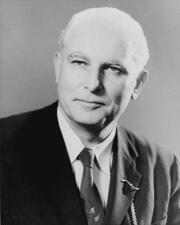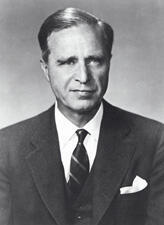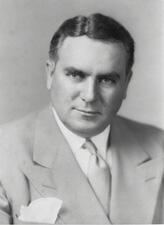
Brien McMahon (born James O’Brien McMahon) (October 6, 1903 – July 28, 1952) was an American lawyer and Democratic politician who represented Connecticut in the United States Senate from 1945 until his death in 1952. Over the course of two terms in office, he became a central figure in the shaping of U.S. atomic energy policy, most notably through his authorship of the Atomic Energy Act of 1946, commonly known as the McMahon Act. His Senate service occurred during a pivotal era marked by the end of World War II, the advent of the atomic age, and the early Cold War, and he played a prominent role in debates over civilian versus military control of nuclear development.
McMahon was born in Norwalk, Connecticut, on October 6, 1903. He attended local schools before enrolling at Fordham University, from which he graduated in 1924. He then studied law at Yale Law School, earning his degree in 1927. That same year he was admitted to the bar and formally changed his name from James O’Brien McMahon to Brien McMahon, the name under which he would practice law and pursue his political career.
After his admission to the bar, McMahon began practicing law in Norwalk. His abilities and local reputation led to his appointment as a judge of the Norwalk city court by Connecticut Governor Wilbur L. Cross. McMahon soon resigned that judgeship in 1933 to accept a position in Washington, D.C., as special assistant to the Attorney General of the United States, Homer Cummings, who was also from Connecticut. In 1935 he was appointed United States Assistant Attorney General in charge of the Department of Justice’s Criminal Division. In that capacity he was associated with several high-profile prosecutions, including the case against Louis Piquette, attorney for notorious bank robber John Dillinger, who was charged with harboring a criminal, and trials of gangsters linked to “Baby Face” Nelson. McMahon’s national prominence, however, was most significantly advanced by his role in the Harlan County Coal Miners’ case, the first major attempt to enforce the Wagner Act’s protections for labor unions. Although the government ultimately lost the case, the proceedings, marked by violence and scandal, brought McMahon wide public recognition and a reputation as a courageous and honest defender of the law, helping to lay the groundwork for his later political ambitions.
In 1939 McMahon left federal service and returned to private law practice. On February 24, 1940, he married Rosemary Turner (June 21, 1917 – October 11, 1986). The couple had one daughter, Patricia. Through this marriage McMahon became connected to British public life as well, as Rosemary was the half-sister of British politician and best-selling novelist Jeffrey Archer. During these years McMahon remained active in Democratic politics in Connecticut, positioning himself for a bid for higher office as international tensions mounted on the eve of U.S. entry into World War II.
McMahon ran for the United States Senate from Connecticut in 1944. In a campaign that highlighted the national debate between internationalism and isolationism, he defeated incumbent Republican Senator John A. Danaher, with McMahon advocating an internationalist approach to postwar affairs. He took his seat in the Senate in January 1945 and would serve there until his death in 1952. Throughout his Senate tenure he was a member of the Democratic Party and served as Secretary of the Senate Democratic Conference, participating actively in party leadership and legislative strategy while representing the interests of his Connecticut constituents.
McMahon’s most enduring legislative legacy arose from his involvement with atomic energy policy in the immediate aftermath of World War II. Following the first successful test of an atomic bomb at Alamogordo, New Mexico, on July 16, 1945, he famously described the event as “the most important thing in history since the birth of Jesus Christ.” Later that year he was appointed chairman of the Senate Special Committee on Atomic Energy, which was charged with examining alternatives to the War Department–backed May–Johnson bill governing postwar control of atomic energy. Although he initially had little technical knowledge of atomic science, McMahon recognized that the issue offered an opportunity to shape national policy and assert himself as a freshman senator at a time when scientists and, increasingly, the Truman administration were turning against the May–Johnson proposal.
On December 20, 1945, McMahon introduced into the Senate an alternative atomic energy bill that quickly became known as the McMahon Bill. The measure, which placed primary control of atomic research and development in civilian hands and gave scientists a central role in oversight, won broad support within the scientific community. McMahon framed the legislative struggle as a fundamental choice between military and civilian control of atomic energy, even though the War Department’s proposal also contained significant civilian elements. Under his leadership, the Senate Special Committee on Atomic Energy held extensive hearings in late 1945 and early 1946, airing competing arguments over how best to regulate atomic energy in the postwar period. To secure passage, the McMahon Bill underwent substantial revisions in the spring of 1946 to address concerns of more conservative senators. The final compromise passed both chambers of Congress, and on August 1, 1946, President Harry S. Truman signed it into law as the Atomic Energy Act of 1946. The act created the Atomic Energy Commission and established a framework for civilian control of nuclear energy in the United States.
The Atomic Energy Act of 1946 also created the Joint Committee on Atomic Energy, a special congressional body with broad oversight authority. McMahon served as the committee’s first chairman in 1946 and again from 1949 to 1952, making him one of the most influential legislators in the early nuclear era. He appointed William L. Borden as the committee’s executive staff director; Borden would later play a significant role in the committee’s work and, after McMahon’s death, in the security proceedings involving physicist J. Robert Oppenheimer. Following the Soviet Union’s first atomic bomb test in August 1949, which occurred earlier than most American experts had predicted, McMahon urged a substantial increase in U.S. atomic weapons production. He became a leading advocate for development of the hydrogen bomb, then referred to as “the Super,” and pressed his case in a series of letters to President Truman. Rejecting moral arguments against the hydrogen bomb based on its destructive potential, McMahon questioned whether any valid ethical distinction could be drawn between the mass casualties inflicted by conventional bombing campaigns in Hamburg and Tokyo and the atomic bombing of Hiroshima, and those that might result from future raids using more advanced weapons.
Connecticut voters returned McMahon to the Senate in 1950, giving him a second term that was scheduled to run until 1957. During this period he continued to influence national security and atomic policy and remained active in Democratic Party affairs as Secretary of the Senate Democratic Conference. In 1952 he advanced a proposal for an “army” of young Americans who would serve abroad as “missionaries of democracy,” an idea aimed at promoting U.S. values and development assistance overseas. This concept is widely regarded as an early precursor to what later became the Peace Corps, established in the 1960s. That same year, as the 1952 presidential election approached, McMahon was mentioned as a possible candidate in the Democratic primaries. His prospective campaign, built around the slogan “The Man is McMahon,” emphasized the pursuit of global peace through strength in atomic weaponry. However, he hesitated to make a full commitment to the race.
In March 1952 McMahon fell seriously ill and spent a week at Bethesda Naval Hospital, where he was diagnosed with lung cancer. From his hospital bed he sent a message to the Democratic state convention in Hartford, Connecticut, declaring that if elected president he would direct the Atomic Energy Commission to manufacture thousands of hydrogen bombs, underscoring his continued belief in nuclear deterrence as the cornerstone of U.S. security. By the time of the Democratic National Convention in July 1952, his health had deteriorated to the point that he could no longer be considered an active candidate, though the Connecticut delegation cast its 16 votes for him on the first ballot as a symbolic gesture. Brien McMahon continued to serve in the Senate until his death at Georgetown University Hospital in Washington, D.C., on July 28, 1952, at the age of 48, leaving more than four years remaining in his second term. His death, occurring while in office, was noted prominently in the national press; The New York Times carried his obituary on the front page, above the fold. He was buried in St. Mary’s Cemetery in his hometown of Norwalk, Connecticut.
In the years following his death, McMahon’s contributions to atomic energy policy and public service were commemorated in various ways. On July 28, 1962, the United States Post Office issued a commemorative stamp in Norwalk honoring his role in opening the way to the peaceful uses of atomic energy; the stamp depicted his portrait alongside an atomic symbol. Educational institutions in Connecticut also bear his name, including Brien McMahon High School in Norwalk and Brien McMahon Hall, a residence hall at the University of Connecticut in Storrs. His image and oratory later appeared in the 1982 documentary film “The Atomic Cafe,” which included footage of McMahon delivering a speech urging a reasoned response to the advent of atomic weapons, in contrast to more strident, McCarthy-era rhetoric from figures such as Republican Senators Owen Brewster and Richard Nixon and Democratic Representative Lloyd Bentsen.
Congressional Record