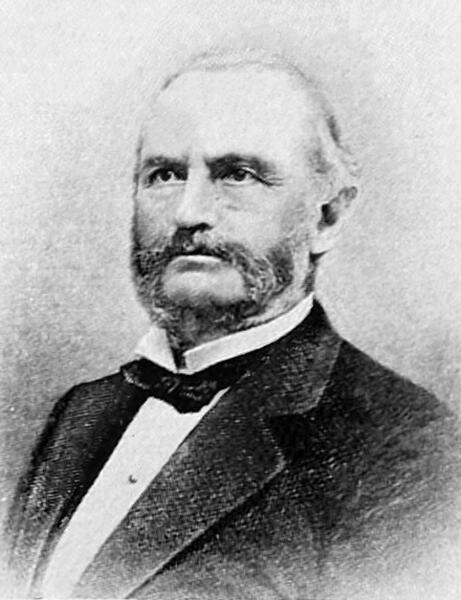
Bradley Barlow (May 12, 1814 – November 6, 1889) was a nineteenth-century banker and politician who served as a U.S. Representative from Vermont for one term from 1879 to 1881. He was born in Fairfield, Vermont, the son of Colonel Bradley Barlow and Deborah (Sherman) Barlow. He attended the common schools of his native town and, as a young man, entered mercantile pursuits in Philadelphia, Pennsylvania, where he worked in partnership with his father. This early commercial experience in a major city helped establish the foundation for his later career in banking and business.
In 1837 Barlow married Caroline Farnsworth. The couple had six children. By the late 1850s he had returned to Vermont, and in 1858 he moved to St. Albans, where he began his long association with the banking industry. In St. Albans he started as a cashier and later rose to become president of the Vermont National Bank. His growing prominence in local affairs coincided with an expanding role in public service and state politics.
Originally a Democrat and later a Republican, Barlow became active in Vermont’s political life well before the Civil War. He served as a delegate to the Vermont state constitutional conventions of 1843, 1850, and 1857, acting as assistant secretary in the 1843 convention. He was elected to the Vermont House of Representatives in 1845, again from 1850 to 1852, and later in 1864 and 1865, participating in state legislative affairs over several distinct periods. From 1860 to 1883 he was engaged in both banking and the railroad business, reflecting the close relationship between finance and transportation in the post–Civil War economy. In St. Albans he also held a series of important local positions, serving as chairman of the school committee and president of the village corporation, and acting as treasurer of Franklin County from 1860 to 1867. He advanced to the Vermont Senate, where he served from 1866 to 1868, further solidifying his influence in state government.
Barlow’s prominence in business extended beyond Vermont. He became one of the most successful mail contractors in the United States and was implicated in the star routes mail scandal of the 1870s, which involved allegations of fraud and corruption in the awarding of postal delivery contracts in the western territories. He was called to testify before Congress several times regarding the scandal. In testimony beginning in 1876, he faced accusations that in 1872 he had used $40,000 to bribe members of the Forty-second Congress in an effort to halt an early investigation into the star route contracts. These allegations and investigations unfolded alongside his continuing activities in banking and railroads.
Barlow’s bid for national office came in the late 1870s, at a time when Vermont was effectively a one-party Republican stronghold. In 1878 he sought the Republican nomination for the U.S. House of Representatives but lost to William W. Grout. He then mounted an independent campaign, running as a “National Republican” with the backing of Democrats and members of the Greenback movement, who were aligned with the National Greenbacker Party. As a member of the National Greenbacker Party representing Vermont, Bradley Barlow contributed to the legislative process during one term in office. He was elected to the Forty-sixth Congress and served from March 4, 1879, to March 3, 1881. His service in Congress occurred during a significant period in American history, as debates over currency, economic policy, and post–Reconstruction issues shaped national politics. Barlow participated in the democratic process and represented the interests of his constituents during this term. He did not seek renomination in 1880, and his insurgent candidacy had lasting political repercussions, as many in Vermont’s dominant Republican business and banking circles, including former Governor J. Gregory Smith, resented his challenge to the established hierarchy.
After leaving Congress, Barlow’s business fortunes declined sharply. Still serving as president of the Vermont National Bank in St. Albans, he became deeply involved in efforts to develop and dispose of the South Eastern Railway of Canada. An unsuccessful attempt to sell this railway, combined with a broader economic downturn, led to the failure of the Vermont National Bank in 1883. The collapse had severe repercussions for the town of St. Albans and for Barlow personally. He declared bankruptcy, assigned all of his personal property to the bank, and reported that he was penniless. In the same period he was accused of refusing to pay Vermont state taxes. His financial difficulties extended across the border: in 1885 a judge in Montreal, Quebec, Canada, rendered a judgment against Barlow and others for $1,550,929 on unrecovered promissory notes related to the South Eastern Railway.
The unraveling of Barlow’s finances also affected his real estate holdings. His St. Albans residence, known as Villa Barlow, was taken over by the Congregation of Notre Dame, a religious community based in Montreal that had established a convent and school in St. Albans in 1869. The property became part of the convent complex and later gained additional historical interest when, in 1903, Eliza Healy—an American-born woman of mixed race whose mother had been enslaved in Georgia—was appointed mother superior of the convent and school, positions she held for fifteen years.
In his later years, Barlow left Vermont and went west. He lived in Denver, Colorado, with one of his daughters as his health and fortunes declined. Bradley Barlow died in Denver on November 6, 1889. His remains were returned to Vermont, and he was interred in Greenwood Cemetery in St. Albans, closing the life of a figure who had been at various times a prominent merchant, banker, railroad entrepreneur, state legislator, and one-term U.S. Representative from Vermont.
Congressional Record