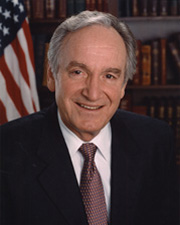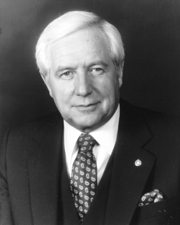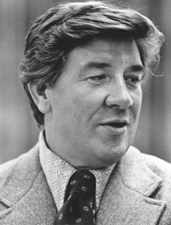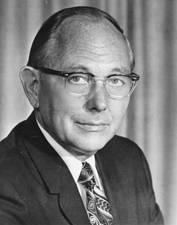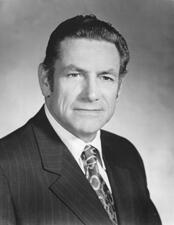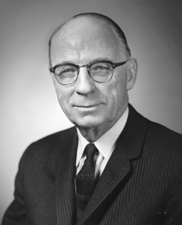
Bourke Blakemore Hickenlooper (July 21, 1896 – September 4, 1971) was an American politician and member of the Republican Party who rose from state office in Iowa to serve four terms as a United States Senator from Iowa from 1945 to 1969. Over the course of his career he was first elected to statewide office as lieutenant governor, then became the 29th Governor of Iowa, and ultimately a prominent and influential conservative voice in the U.S. Senate, where he represented the interests of his constituents during a significant period in American history.
Hickenlooper was born on July 21, 1896, in Blockton, Taylor County, Iowa, to Nathan O. and Margaret A. Hickenlooper. He was raised in Iowa and began his higher education at Iowa State College in Ames. His studies were interrupted by the outbreak of World War I, during which he entered military service. On returning from the war, he resumed his education and completed his degree at Iowa State in 1919. He then enrolled in the University of Iowa College of Law, receiving his law degree in 1922. That same year he was admitted to the bar and commenced the practice of law in Cedar Rapids, Iowa, where he established himself professionally and began to build the connections that would support his later political career. In 1927, he married Verna Eilene Bensch; the couple had two children.
During World War I, Hickenlooper served in the United States Army from May 1917 to March 1919. He was commissioned a second lieutenant in the 339th Field Artillery Regiment of the 85th Infantry Division and served in France. His wartime experience, which interrupted his college education, helped shape his views on national defense and international affairs, themes that would recur throughout his later public life. After the war, he returned to Iowa, completed his education, and entered legal practice, becoming an active participant in civic and Republican Party affairs in Cedar Rapids and the surrounding region.
Hickenlooper’s formal political career began with his election to the Iowa House of Representatives in 1934. He served in the state legislature from 1935 to 1939, where he gained experience in lawmaking and party leadership during the difficult years of the Great Depression. In 1938, he was elected lieutenant governor of Iowa, taking office in 1939 and serving until 1943. As lieutenant governor he presided over the Iowa Senate and became a familiar figure in state government, positioning himself as a leading Republican contender for higher office.
In the 1942 gubernatorial election, Hickenlooper ran to succeed Governor George A. Wilson, who chose to seek a seat in the U.S. Senate. Hickenlooper defeated former Democratic governor Nelson Kraschel by a margin of 63 percent to 37 percent and served one term as the 29th Governor of Iowa from 1943 to 1945. His governorship coincided with World War II, and he directed state funding to support the war effort, aligning Iowa’s resources with national defense and production needs. During his tenure, he oversaw the state’s rejection of the federal government’s soldier vote ballot, reflecting tensions between state and federal authority in wartime administration. He also publicly endorsed American participation in a postwar world peace international organization, indicating his support for a structured international order after the conflict. Choosing not to seek another term as governor in 1944, he instead ran for the U.S. Senate.
In the 1944 election, Hickenlooper narrowly defeated incumbent Democratic Senator Guy Gillette and took office in January 1945 as a United States Senator from Iowa. His service in Congress extended through four terms, as he won reelection in 1950, 1956, and 1962, serving until January 1969. During this period he participated actively in the legislative process at a time marked by the end of World War II, the onset and height of the Cold War, the Korean and Vietnam conflicts, and the civil rights movement. Gillette, whom he had unseated, later returned to the Senate by defeating George A. Wilson in 1948 to occupy Iowa’s other Senate seat, serving alongside Hickenlooper for six years. Over the course of his Senate career, Hickenlooper became known as one of the most conservative and, particularly in foreign policy, one of the more isolationist members of the Republican Party, and indeed one of the most conservative members of Congress.
Hickenlooper’s influence within the Senate grew steadily, and from 1962 to 1969 he served as chairman of the Senate Republican Policy Committee, a key leadership position that made him one of the most powerful Republicans in the chamber. In this role he helped shape party strategy and legislative priorities and developed an intense rivalry with Senate Republican Leader Everett Dirksen over direction and control of party policy. His legislative record reflected both his conservatism and his complex stance on civil rights. He voted in favor of the Civil Rights Acts of 1957 and 1960, supported the 24th Amendment to the U.S. Constitution abolishing the poll tax in federal elections, and voted for the Voting Rights Act of 1965. At the same time, he joined fellow conservative Senator Barry Goldwater in voting against the Civil Rights Act of 1964, reflecting concerns among some conservatives about federal power and the scope of the legislation.
Hickenlooper was particularly active on foreign policy issues. In 1962, he sponsored what became known as the Hickenlooper Amendment to the foreign aid bill, which required the United States to cut off aid to any country that expropriated U.S.-owned property without prompt, adequate, and effective compensation. The amendment was aimed primarily at Fidel Castro’s Cuba, which had expropriated U.S.-owned and U.S.-controlled sugar plantations and refineries, but it also signaled a broader effort to protect American economic interests abroad during the Cold War. Later in his Senate career, he was outspoken about the 1967 attack on the USS Liberty during the Six-Day War. One of the few members of Congress to call vigorously for an investigation, he expressed deep skepticism about Israel’s explanation that the attack was a case of mistaken identity, stating that he found it “inconceivable” that the ship could not have been identified as American and describing the official account as “not at all satisfactory.” His comments reflected his insistence on accountability in foreign relations, even with close U.S. allies.
Hickenlooper did not seek reelection in 1968 and left the Senate at the conclusion of his term in January 1969. He was succeeded by Democratic Governor Harold E. Hughes, marking a shift in Iowa’s representation during a period of political and social change. After his retirement from public office, Hickenlooper largely withdrew from national political life, though his long tenure and leadership roles left a lasting imprint on Republican policy debates and on Iowa’s political history.
On September 4, 1971, while visiting friends in Shelter Island, New York, Hickenlooper suffered a heart attack and died at the age of 75. He was buried at Cedar Memorial Park Cemetery in Cedar Rapids, Iowa, returning to the community where he had begun his legal and political career. His wife, Verna Eilene Hickenlooper, had died the year before, in 1970.
Congressional Record