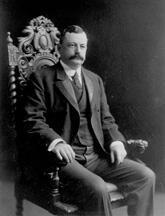
Boies Penrose (November 1, 1860 – December 31, 1921) was an American politician from Philadelphia, Pennsylvania, who became one of the most powerful Republican leaders of his era and served as a United States Senator from Pennsylvania from 1897 to 1921. Born in Philadelphia on November 1, 1860, he was one of seven sons of Dr. Richard Alexander Fullerton Penrose, a prominent physician, and Sarah Hannah Boies. Penrose was born into a distinguished Old Philadelphian family of Cornish descent that traced its American origins to Bartholomew Penrose, a Bristol shipbuilder invited by William Penn to establish a shipyard in the Province of Pennsylvania. He was a grandson of Charles B. Penrose, Speaker of the Pennsylvania Senate, and a brother of gynecologist Charles Bingham Penrose and mining entrepreneurs Richard and Spencer Penrose. Through his mother’s line he was also descended from the influential Biddle family of Philadelphia, further anchoring him in the city’s political and social elite.
Penrose received his early education at the Episcopal Academy in Philadelphia before attending Harvard University. His academic performance was initially poor, and he came close to expulsion, but he improved markedly and ultimately graduated second in his class in 1881. After college he read law in Philadelphia with the firm of Wayne MacVeagh and George Tucker Bispham and was admitted to the Pennsylvania bar in 1883. Although he qualified as a lawyer, he quickly gravitated toward politics and public affairs, drawing on his family connections and his own growing interest in municipal and state government. In the 1880s he also authored several works on Philadelphia’s governmental structure and land tenure, including “Philadelphia 1681–1887: A History of Municipal Development” (1887), “The City Government of Philadelphia” (Volume 5, 1887), and “Ground Rents in Philadelphia” (1888), which reflected an early engagement with questions of urban reform and public administration.
Penrose’s formal political career began in the Pennsylvania House of Representatives, where he served as a Republican member for Philadelphia County in 1885. The following year he was elected to the Pennsylvania State Senate for the 6th district, taking office in 1886. At age 26 he was the youngest member of the state senate, and in 1889 he became President pro tempore of the Pennsylvania Senate, serving in that leadership role until 1891 and becoming, at age 29, the youngest person to hold that position. Although he had written on political reform, Penrose soon aligned himself with the powerful Republican machine led by U.S. Senator Matthew Quay. His early statewide ambitions included a run for mayor of Philadelphia in 1895, but he was forced to withdraw from the race after his Democratic opponent publicized a photograph of Penrose leaving a brothel in the early morning hours, a scandal that damaged his reformist image but did not end his political ascent.
In 1897, the Pennsylvania state legislature elected Penrose to the United States Senate over former Postmaster General and merchant John Wanamaker, beginning a federal legislative career that would span nearly a quarter-century. A member of the Republican Party, he served continuously from March 4, 1897, until his death on December 31, 1921, completing four terms in office and making significant contributions to the legislative process during a period that encompassed the Progressive Era, World War I, and the early postwar years. In the Senate he became a dominant member of the powerful Committee on Finance, where he was a staunch advocate of high protective tariffs and consistently supported pro-business policies. He also served on several other key committees, including the Committee on Banking, the Committee on Naval Affairs, the Committee on Post Office and Post Roads, the Committee on Education and Labor, and the Committee on Immigration, giving him broad influence over economic, military, infrastructural, and social legislation. One of his most consequential legislative actions was the insertion of the oil depletion allowance into the Revenue Act of 1913, a provision that significantly benefited oil producers, including prominent Pennsylvania interests such as the Mellon and Pew families. Penrose opposed many labor reforms and women’s rights measures, reflecting his conservative, business-oriented outlook.
Parallel to his formal legislative work, Penrose emerged as one of the foremost political bosses in the country. He became the fourth leader of the Pennsylvania Republican political machine—often referred to as the “Penrose machine”—following the earlier dominance of Simon Cameron, Donald Cameron, and Matthew Quay. Elected chairman of the Pennsylvania Republican Party in 1903, he succeeded Quay as the state’s Republican National Committeeman after Quay’s death in 1904. For the next 17 years he was widely regarded as the most powerful political operative in Pennsylvania, using patronage and party discipline to maintain control and advancing loyalists such as Richard Baldwin within the organization. He perfected the use of so‑called “squeeze bills” in the state legislature, having allies introduce hostile measures against major industries like railroads and banks and then arranging for their withdrawal in exchange for substantial political contributions. Although temporarily forced out of power in 1912 by a progressive faction led by William Flinn, Penrose regained his national committee post after Flinn bolted to support Theodore Roosevelt’s Progressive Party and remained a central figure in Republican national politics until his death.
Penrose’s influence extended to presidential politics. In the 1912 election he strongly supported incumbent President William Howard Taft against former President Theodore Roosevelt. Seeking to damage Roosevelt’s candidacy, Penrose cooperated with Progressive Senator Robert M. La Follette to establish a Senate committee to investigate the sources of campaign contributions to Roosevelt’s 1904 and 1912 campaigns. Despite Penrose’s efforts and the heavy attacks directed at him by Roosevelt, the former president carried Pennsylvania in the three‑way race, although Democrat Woodrow Wilson won the national contest. Penrose remained a key power broker in the party and later became a major supporter of Warren G. Harding. His backing was instrumental in Harding’s securing the 1920 Republican presidential nomination, and Penrose’s role in that victory helped pave the way for fellow Pennsylvanian Andrew W. Mellon to be appointed Secretary of the Treasury. In 1914, following the ratification of the Seventeenth Amendment and the introduction of direct election of senators, Penrose faced the electorate for the first time in a statewide Senate race. He campaigned publicly—something he had rarely done before—and won a decisive victory over Democrat A. Mitchell Palmer and Progressive candidate Gifford Pinchot, reaffirming his hold on Pennsylvania politics. During World War I, he also took part in national patriotic activities, accompanying the Liberty Bell on its 1915 nationwide tour to the Panama-Pacific International Exposition in San Francisco to help raise funds and morale.
Beyond politics, Penrose cultivated a distinctive public persona. Standing six feet four inches tall and of considerable girth, he was widely known by the nickname “Big Grizzly.” He was famous for his prodigious appetite, reportedly consuming a dozen eggs at breakfast and an entire turkey at lunch. He once won a $1,000 wager in an eating contest by finishing 50 oysters and a quart of bourbon, an ordeal that sent his opponent to the hospital. Disliking being watched while he ate, he had screens placed around his table at the Bellevue-Stratford Hotel in Philadelphia to ensure privacy. An avid outdoorsman, Penrose enjoyed mountain exploration and big‑game hunting and was one of the 100 original members of the Boone and Crockett Club, an early conservation and hunting organization. His hunting guide, W. G. “Bill” Manson, recalled the difficulty of finding a horse large enough to carry Penrose and his custom saddle; the animal they finally selected was nicknamed “Senator” and was retired once Penrose stopped riding because no standard saddle would fit it. He never married and was candid about his private life, boasting of his patronage of prostitutes and declaring that he did not “believe in hypocrisy.” In addition to his political and literary pursuits, he and his father and brothers invested in western mining ventures, including the formation of the Utah Copper Company in 1903, which contributed to the family’s substantial wealth.
Boies Penrose died in office on December 31, 1921, in his penthouse suite at the Wardman Park Hotel in Washington, D.C., after suffering a pulmonary thrombosis in the final hour of the year. He was interred in the Penrose family section of Laurel Hill Cemetery in Philadelphia. At the time of his death he had served in the United States Senate for nearly 25 years, making him the longest-serving U.S. Senator from Pennsylvania until Arlen Specter surpassed his record in 2005. After Penrose’s passing, his lieutenant Joseph Grundy emerged as one of the principal leaders of the state Republican organization, but no single figure ever again dominated the party in Pennsylvania as Penrose and his predecessors had. His memory was commemorated geographically and artistically: Mount Penrose in the Dickson Range of southwest‑central British Columbia was named in his honor, and in September 1930 a bronze statue by Philadelphia sculptor Samuel Murray was erected in Capitol Park in Harrisburg, Pennsylvania, reflecting his enduring, if controversial, place in the political history of both his state and the nation.
Congressional Record