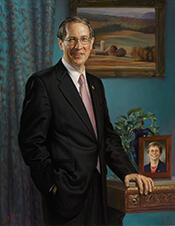
Robert William Goodlatte (born September 22, 1952) is an American politician, attorney, and lobbyist who represented Virginia’s 6th congressional district in the United States House of Representatives from January 3, 1993, to January 3, 2019. A member of the Republican Party, he served 13 consecutive terms in Congress and became a prominent figure in House leadership as chair of the House Judiciary Committee. His district, based in Virginia’s Shenandoah Valley, included the cities of Harrisonburg, Lexington, Lynchburg, Roanoke, and Staunton, and was widely regarded as an overwhelmingly conservative constituency.
Goodlatte was born in Holyoke, Massachusetts, on September 22, 1952. He grew up in that region before leaving New England to pursue higher education. He attended Bates College in Lewiston, Maine, where he studied political science and graduated with a Bachelor of Arts degree in 1974. His early interest in law and public affairs led him to Washington, D.C., where he enrolled at the Washington and Lee University School of Law in Lexington, Virginia. He earned his Juris Doctor degree in 1977, a credential that would underpin his subsequent legal and political career in the Commonwealth of Virginia.
After law school, Goodlatte began his professional career in public service as a staff member for Republican Congressman M. Caldwell Butler of Virginia’s 6th district, working in Butler’s office from 1977 to 1979. He then entered private legal practice in Roanoke, Virginia, where he established himself as an attorney and became active in local Republican politics. His legal background and experience in a congressional office helped position him as a viable candidate when the 6th district seat opened in the early 1990s.
Goodlatte first ran for Congress in 1992, when Democratic Representative Jim Olin opted not to seek reelection. He secured the Republican nomination at the Republican district convention and faced Democrat Stephen Musselwhite in the November 1992 general election. Musselwhite had defeated Olin’s preferred successor at the district Democratic convention, but Goodlatte prevailed with 60 percent of the vote. He took office on January 3, 1993, beginning a congressional tenure that would span 26 years. Over the course of his service, he was reelected ten times, often without significant opposition. In 1996 he faced Democrat Jeff Grey and won with 67 percent of the vote; in 1998 he defeated Roanoke mayor David Bowers with 69 percent. In 2008, he was challenged by Democrat Sam Rasoul of Roanoke and received 62 percent of the vote. In 2010, running against Independent Jeffrey Vanke and Libertarian Stuart Bain, he secured 76.26 percent of the vote. In 2012, he confronted his first contested Republican primary when Karen Kwiatkowski of Mount Jackson challenged him; Goodlatte won the primary with 66 percent to Kwiatkowski’s 34 percent, and later that year defeated Democratic nominee Andy Schmookler in the general election with 66 percent of the vote.
During his years in the House of Representatives, Goodlatte played a central role in the legislative process and in shaping Republican policy priorities. He served on the House Judiciary Committee for much of his tenure and ultimately became its chair, a position that gave him jurisdictional influence over legislation affecting the federal courts, administrative agencies, and federal law enforcement entities. His committee work extended to high-profile constitutional matters. In 2009, he was appointed to serve as a co-lead impeachment manager (prosecutor), alongside Representative Adam Schiff, in the Senate impeachment trial of U.S. District Judge Samuel B. Kent. The following year, he again served as a House co-lead impeachment manager, also with Schiff, in the impeachment trial of Judge G. Thomas Porteous Jr. These assignments underscored his standing within the House Republican Conference on issues of judicial conduct and constitutional accountability.
Goodlatte’s congressional service coincided with major national debates over immigration, national security, and the scope of federal power. He was a consistent conservative voice on these issues and supported President Donald Trump’s 2017 executive order imposing a temporary ban on entry to the United States by citizens of seven Muslim-majority countries. He stated that “The primary duty of the federal government is to keep Americans safe. Today, President Trump has begun to fulfill this responsibility by taking a number of critical steps within his authority to strengthen national security and the integrity of our nation’s immigration system.” Also in 2017, he presided over a Republican conference effort, conducted in a closed session, to weaken the independent Office of Congressional Ethics. The proposal passed the conference by a 119–74 vote but was withdrawn the following day after widespread public criticism and opposition from House leaders and Democrats.
On November 9, 2017, Goodlatte announced that he would not seek reelection in 2018, bringing his 13-term congressional career to a close at the end of the 115th Congress. Republican state delegate Ben Cline was elected as his successor in the 6th district and took office on January 3, 2019. After leaving Congress, Goodlatte transitioned to work in the private sector and advocacy. In February 2020, he registered as a lobbyist representing the Project for Privacy & Surveillance Accountability, a nonprofit organization focused on issues of privacy, surveillance, and civil liberties in the context of federal intelligence and law-enforcement activities.
Congressional Record