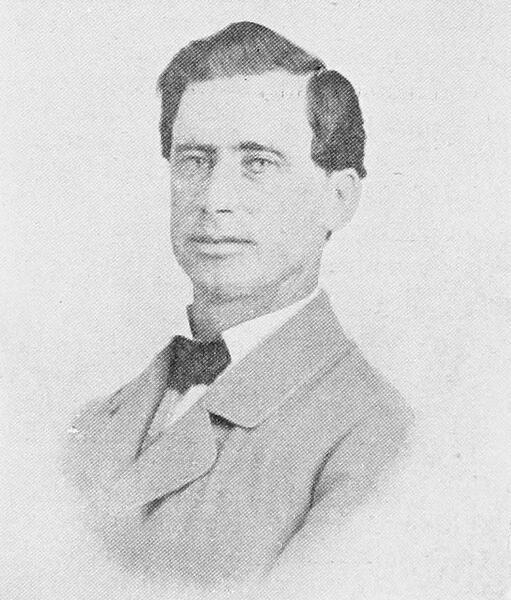
Bird Beers Chapman (August 24, 1821 – September 21, 1871) was an American lawyer, newspaper editor, and Democratic politician associated with the early political development of the Nebraska Territory. He was born in Salisbury, Connecticut, on August 24, 1821. Chapman attended the public schools in his native state, where he received a basic formal education typical of the period. After completing his schooling, he pursued the study of law, preparing for a professional career at a time when legal training was commonly obtained through apprenticeship and independent study rather than through formal law schools.
Upon completing his legal studies, Chapman was admitted to the bar and commenced the practice of law in Elyria, Lorain County, Ohio. His move to Elyria placed him in a growing community in the Western Reserve region, where he established himself professionally and became part of the legal and civic life of the town. Elyria served as his principal base during his early career, and his later burial there underscores the lasting nature of his ties to the community.
In the 1850s, Chapman moved westward to the newly organized Territory of Nebraska and settled in Omaha, Nebraska. His relocation coincided with the rapid political and economic development of the territory following the Kansas-Nebraska Act of 1854. In Omaha he continued his legal work and became active in public affairs. From 1855 to 1859 he served as editor of the Omaha Nebraskan, a newspaper that played a role in shaping public opinion and territorial politics. Through this position he participated in the broader debates of the era, including issues surrounding territorial governance, party organization, and the future of slavery in the western territories.
Chapman entered national politics as a member of the Democratic Party representing the Nebraska Territory. He was elected as a Democrat to the Thirty-fourth Congress and served as a Delegate from the Territory of Nebraska from March 4, 1855, to March 3, 1857. As a territorial delegate, he did not possess a vote on the House floor but could serve on committees, introduce legislation, and advocate for the interests of his constituents. His service in Congress occurred during a significant and turbulent period in American history, marked by sectional conflict and the realignment of national political parties. During his single term, he participated in the legislative process and worked to represent the needs and priorities of the Nebraska Territory as it sought infrastructure, recognition, and eventual statehood.
After the expiration of his term in the Thirty-fourth Congress, Chapman remained engaged in territorial politics. He unsuccessfully contested the election of Fenner Ferguson to the Thirty-fifth Congress, reflecting the competitive and often contentious nature of elections in the frontier territories. Although this challenge did not restore him to congressional service, it underscored his continuing ambition to influence the political direction of Nebraska and to maintain a role in national affairs on behalf of the territory.
In his later years, Chapman appears to have divided his time between Nebraska and Ohio, maintaining connections to both regions shaped by his legal and political career. He died at Put-in-Bay, Ottawa County, Ohio, on September 21, 1871. Following his death, his remains were interred in Ridgelawn Cemetery in Elyria, Ohio, returning him to the community where he had first established himself as a lawyer. His career, spanning law practice, newspaper editing, and service as a territorial delegate to Congress, placed him among the early figures involved in the political formation and representation of the Nebraska Territory in the mid-nineteenth century.
Congressional Record