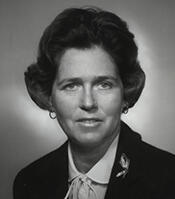
Beverly Barton Butcher Byron (née Butcher; July 27, 1932 – February 9, 2025) was an American politician and member of the Democratic Party who served as the U.S. Representative for Maryland’s 6th congressional district from January 3, 1979, to January 3, 1993. Over seven terms in office, she contributed to the legislative process during a significant period in American history, participating in the democratic process and representing the interests of her constituents as a conservative Democrat with a particular focus on military and national security issues.
Byron was born Beverly Barton Butcher in Baltimore, Maryland, on July 27, 1932, to Ruth (née Barton) and Harry C. Butcher. Her father was a CBS radio broadcaster and later a naval aide to General Dwight D. Eisenhower during World War II. During her childhood, the family lived in the Wardman Park Hotel in Washington, D.C., where her father’s professional and political connections exposed her to national leaders at an early age. Through these connections she met and befriended President Franklin D. Roosevelt, First Lady Eleanor Roosevelt, and Dwight and Mamie Eisenhower. Her godfather was the prominent political operative George E. Allen, further situating her upbringing within the orbit of national politics and public affairs.
Byron was educated at the National Cathedral School for Girls in Washington, D.C., from which she graduated in 1950. She later continued her education in Maryland, earning a two‑year degree from Hood College in Frederick in 1962. On June 1, 1952, she married Goodloe Edgar Byron, an attorney and future member of Congress from Maryland. During the early years of her marriage and while raising their three children, she became active in civic and political life, involving herself in several nonprofit organizations and in fundraising efforts for the Democratic Party. These activities helped establish her reputation in local and state political circles and provided a foundation for her later electoral career.
Byron’s entry into Congress came under sudden and tragic circumstances. Her husband, Representative Goodloe Byron, died of a heart attack on October 11, 1978, roughly a month before the general election in which he was seeking another term. She was selected to run in his place and was elected to the U.S. House of Representatives in November 1978, succeeding him as the representative for Maryland’s 6th congressional district. Reflecting on that moment, she later observed, “Within 24 hours I was a widow, a single parent, unemployed and a candidate for Congress.” Initially, many observers assumed she would serve only a single term, but she went on to win re‑election six times, serving a total of fourteen years in the House from January 3, 1979, to January 3, 1993.
During her congressional service, Byron emerged as a leading Democratic voice on defense and national security. A conservative Democrat, she opposed abortion and supported many of the fiscal policies of the Reagan administration, positioning herself toward the right flank of her party on several key issues. She served on the House Armed Services Committee, the Interior and Insular Affairs Committee, and the Select Committee on Aging. Within the Armed Services Committee, she developed particular expertise in personnel, compensation, and arms control matters. From 1983 to 1986, she chaired the House Special Panel on Arms Control and Disarmament, where she backed the development of the MX missile system and took an active role in debates over strategic weapons and U.S.–Soviet relations. In 1987, she became chairwoman of the Military Personnel and Compensation Subcommittee, defeating the more liberal Representative Patricia Schroeder for the post despite Schroeder being the preferred choice of Armed Services Committee Chairman Les Aspin. Byron was the first woman to chair an Armed Services subcommittee, marking a significant milestone for women in the House of Representatives. She also became the first woman ever to fly aboard the U.S. Air Force’s SR‑71 Blackbird (checkout #429), taking part in a VIP flight in November 1985 as part of her oversight responsibilities on defense matters.
Byron’s tenure in Congress concluded following the 1992 election cycle. In that year’s Democratic primary, she was defeated by State Delegate Thomas Hattery, a somewhat more liberal challenger who capitalized on changing political currents within the district and the party. Hattery subsequently lost the general election to Republican nominee Roscoe Bartlett, who then succeeded Byron as the representative for Maryland’s 6th district. After leaving Congress in January 1993, she continued to serve in public and advisory roles related to defense and national policy. In 1993, she was appointed a commissioner on the Base Realignment and Closure (BRAC) Commission, which was charged with evaluating and recommending changes to the structure and location of U.S. military installations. In 1995, President Bill Clinton appointed her to the United States Naval Academy Board of Visitors, where she helped oversee and advise on the Academy’s operations and policies. She also served on the Board of Regents of the Potomac Institute for Policy Studies, contributing her experience in defense and national security to that policy research organization.
In her personal life, Beverly and Goodloe Byron had three children, and the Byron family became a well‑known political family in Maryland. Following Goodloe Byron’s death and her subsequent congressional career, she remarried in 1986 to B. Kirk Walsh, an official who had worked in the United States Department of Housing and Urban Development. Walsh remained her husband until his death in 2019. Beverly Barton Butcher Byron died from heart failure at her home in Frederick, Maryland, on February 9, 2025, at the age of 92, closing a life that spanned from the New Deal era through the end of the Cold War and into the twenty‑first century, and that was marked by sustained engagement in public service, national defense, and the legislative process.
Congressional Record