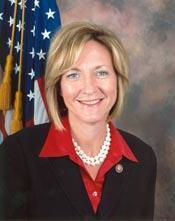
Betty Sue Sutton (born July 31, 1963) is an American politician and jurist who has served in local, state, and federal office and currently serves as a judge of Ohio’s Ninth District Court of Appeals. A member of the Democratic Party, she represented Ohio’s 13th congressional district in the U.S. House of Representatives from January 3, 2007, to January 3, 2013, serving three terms in Congress. Her tenure in the House coincided with a period of significant national debate over economic recovery, health care, and energy policy, during which she became particularly noted for her work on consumer protection and industrial policy.
Sutton was born in Barberton, Ohio, and grew up in the Akron area in a working-class family closely tied to organized labor and the region’s industrial economy. She attended public schools and went on to the University of Akron, where she earned her bachelor’s degree. She continued at the University of Akron School of Law, receiving her Juris Doctor and gaining admission to the bar. Her early legal career and community involvement reflected a focus on labor, consumer, and working-family issues that would later define much of her public service.
Before her election to Congress, Sutton built a substantial record in Ohio politics and public service. She served on the Barberton City Council, where she gained her first experience in municipal governance, and later was elected to the Ohio House of Representatives. In the state legislature, she developed a reputation as an advocate for workers’ rights and consumer protections and worked closely with organized labor, which became a core base of her political support. She also practiced law in northeast Ohio, further grounding her in the concerns of local businesses, unions, and families.
Sutton entered national politics after Representative Sherrod Brown of Ohio’s 13th congressional district announced his candidacy for the U.S. Senate in 2006. She ran in the Democratic primary for the open House seat and prevailed over several notable opponents, including former U.S. Representative Thomas C. Sawyer and Capri Cafaro, who had previously run in Ohio’s 14th District. Capitalizing on an anti-corruption theme that was central to Ohio’s 2006 elections and drawing strong backing from organized labor and pro-choice political action committee EMILY’s List, Sutton secured the Democratic nomination. In the November 2006 general election she defeated Republican Craig L. Foltin, the mayor of Lorain, Ohio, by a margin of 61.22 percent to 38.78 percent (135,639 votes to 85,922 votes), and took office in January 2007. She subsequently won re-election, defeating Republican nominee David Potter in one cycle and Republican businessman Tom Ganley in another, with Ganley notably having benefited from one of her signature legislative initiatives, the “Cash for Clunkers” program, through which his dealerships sold 876 cars.
During her three terms in the U.S. House of Representatives, Sutton played an active role in legislative efforts related to economic recovery, consumer protection, health care, and energy policy. She was recognized as a key House architect of the American Clean Energy and Security Act that passed the House in June 2009. Sutton received wide national attention for her lead sponsorship of the Consumer Assistance to Recycle and Save (CARS) Act, which created the “Cash for Clunkers” program, a federal initiative that provided incentives for consumers to trade in older, less fuel-efficient vehicles for new, more efficient models during the summer of 2009. She also sponsored the Josh Miller HEARTS Act, named for a 15-year-old constituent from Barberton who died from sudden cardiac arrest on a football field; the bill mandated that the Department of Education provide funding to local schools for the purchase of automated external defibrillators. Among other measures, she sponsored the Protect Consumers Act of 2009, calling for stronger protections in the event of mandatory FDA product recalls; the Disability Equity Act, which sought to eliminate the five-month waiting period for Social Security disability benefits; and the Contractor Accountability Act, aimed at tightening public oversight of federal expenditures. Sutton supported the federal government bailout of the auto industry in 2009, reflecting the importance of automobile manufacturing and related industries to her district. She publicly endorsed a public option in any health care reform package on July 16, 2009, and later participated in an Occupy Wall Street rally in New York in October 2011, signaling her alignment with populist economic concerns. She also took part in the bipartisan, all-female congressional softball team organized in 2009 by Representatives Debbie Wasserman Schultz and Jo Ann Emerson, which played charity games benefiting the Young Survival Coalition, a foundation dedicated to young women with breast cancer. During the 2008 Democratic presidential primaries, Sutton endorsed Hillary Clinton after Clinton’s victory in the Ohio primary, stating that she was following the lead of her constituents, and she campaigned for Barack Obama after he secured the nomination.
Sutton’s congressional service also drew scrutiny for internal office management. The Sunlight Foundation found that from 2009 to 2011 she had the highest staff turnover rate in the House of Representatives, with only 19 percent of her staff remaining over that period, compared with an average retention rate of 64.2 percent in House offices. Former staffers described her in interviews with The Plain Dealer as a demanding employer who could be harsh when expectations were not met. Nonetheless, she remained an influential Democratic voice on manufacturing, consumer, and labor issues throughout her tenure. Her service in Congress occurred during a significant period in American history marked by the Great Recession, the debate over the Affordable Care Act, and major shifts in energy and environmental policy, and she consistently framed her legislative work as representing the interests of her northeast Ohio constituents.
Following the 2010 census, Ohio’s congressional districts were redrawn, and The Plain Dealer reported in September 2011 that the new map would dismantle Sutton’s 13th District and place her home in a largely Republican district designed to favor the re-election of freshman Republican Representative Jim Renacci of Wadsworth. In December 2011 Sutton filed to run in the newly configured 16th District against Renacci. A poll reported by Roll Call indicated the race was highly competitive, with each candidate at 45 percent support. The Washington Post listed the contest as one of the top ten House races of 2012, ranking it eighth. In the November 2012 general election, however, Renacci defeated Sutton by a margin of 52 percent to 48 percent in the Republican-leaning district, ending her service in the House on January 3, 2013.
After leaving Congress, Sutton continued her public service in the executive branch and later the judiciary. On July 24, 2013, the White House announced that she would be appointed administrator of the Saint Lawrence Seaway Development Corporation, a U.S. government-owned corporation headquartered in Washington, D.C., responsible for operating and maintaining the U.S. portion of the St. Lawrence Seaway between the Port of Montreal and Lake Erie. In this role she oversaw a critical segment of North American maritime infrastructure. Remaining active in Ohio politics, on March 7, 2017, Sutton announced that she would seek the Democratic nomination for governor of Ohio to succeed term-limited Republican Governor John Kasich. On January 10, 2018, she ended her gubernatorial bid and instead became the Democratic nominee for lieutenant governor as the running mate of former Consumer Financial Protection Bureau director Richard Cordray. The Cordray–Sutton ticket was defeated in the November 2018 general election by the Republican ticket of Mike DeWine and Jon Husted. Sutton subsequently assumed her role as a judge on Ohio’s Ninth District Court of Appeals, continuing a career in public life that has spanned local government, the state legislature, the U.S. Congress, a federal executive appointment, and the state judiciary.
Congressional Record