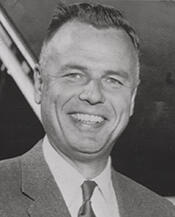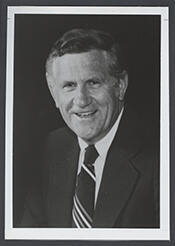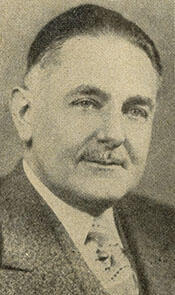
Bertrand Wesley “Bud” Gearhart (May 31, 1890 – October 11, 1955) was an American lawyer and Republican politician who served seven consecutive terms as a United States Representative from California from 1935 to 1949. Representing California’s 9th congressional district, he participated in the legislative process during a significant period in American history, spanning the Great Depression, World War II, and the early postwar era, and represented the interests of his constituents in the House of Representatives.
Gearhart was born in Fresno, California, on May 31, 1890, the son of John Wesley Gearhart and Mary Elizabeth Johnson Gearhart. He attended the public schools of Fresno before continuing his education at Boone’s University School in Berkeley, California, from which he graduated in 1910. He then enrolled at the University of Southern California Law School in Los Angeles, where he pursued legal studies and was active in campus life as a member of the Phi Delta Phi legal fraternity and the Zeta Psi social fraternity.
Gearhart completed his Bachelor of Laws degree at the University of Southern California in 1914. He had been admitted to the California bar the previous year and commenced the practice of law in Fresno, establishing himself as a young attorney in his home community. His early legal career was soon interrupted by national service during World War I, but it laid the foundation for his later work as a prosecutor and legislator.
During World War I, Gearhart served overseas in the United States Army as a second lieutenant in the 609th Aero Squadron from 1917 to 1919. Following his return from military service, he was among the founders in 1919 of the American Legion, the national organization of war veterans, reflecting his continuing engagement with veterans’ issues and public affairs. He resumed his legal career in Fresno and entered public service at the local level, first as assistant district attorney and then as district attorney of Fresno County, positions he held until 1923. Maintaining his connection to veterans’ causes, he later served in 1932 as a member of the board of directors of the California Veterans’ Home.
Gearhart’s congressional career began with the election of 1934. In that year he ran for the United States House of Representatives from California’s 9th congressional district to the Seventy-fourth Congress. The incumbent Democrat, Denver S. Church, was not a candidate for renomination, and Gearhart faced no opposition in the general election. He captured all 77,650 votes cast, beginning a long tenure in Congress. A member of the Republican Party, he was reelected repeatedly and, in 1936, 1938, 1940, 1942, and 1944, ran unopposed and received nearly 100 percent of the vote in each of those elections. His service in Congress extended from January 3, 1935, to January 3, 1949, encompassing seven terms.
In the House of Representatives, Gearhart was known as a staunch Republican conservative. His opposition to much of the New Deal and to various Democratic initiatives drew national attention. President Harry S. Truman characterized him as “one of the worst obstructionists in Congress,” and, in a pointed criticism delivered in Gearhart’s district, Truman told listeners, “You have got a terrible Congressman here. He has done everything he possibly could do to cut the throats of the farmer and the laboring man.” Despite this sharp partisan conflict, Gearhart was a strong supporter of certain measures, notably the Merchant Seamen’s Bill of Rights, reflecting his interest in veterans’ and service-related legislation. His congressional service occurred during a transformative era in American political and economic life, and he consistently aligned with the conservative wing of his party.
Gearhart’s electoral dominance began to narrow after World War II. In the 1946 United States House elections, he faced his first Democratic challenger, Hubert Phillips. Gearhart was reelected, but by a reduced margin, receiving 53.7 percent of the vote to Phillips’s 46.3 percent. Two years later, in the 1948 elections, amid a national resurgence of the Democratic Party, he was defeated by Cecil F. White, a 47-year-old Democratic cotton rancher and political newcomer. In that contest, White received 51.3 percent of the vote, while the seven-term incumbent Gearhart obtained 46.9 percent, bringing his congressional career to a close at the end of the Eightieth Congress in January 1949.
After leaving Congress, Gearhart returned to Fresno, California, where he resumed the practice of law. He continued his professional work there until his death. Bertrand Wesley Gearhart died at the age of 65 on October 11, 1955, in a hospital in San Francisco, California. He was interred in Mountain View Cemetery in Fresno, the city of his birth and the center of his long legal and political career.
Congressional Record