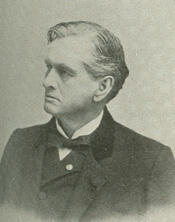
Benson Wood (March 31, 1839 – August 27, 1915) was a Republican U.S. Representative from Illinois who served one term in the United States Congress from 1895 to 1897. Born near Bridgewater, Susquehanna County, Pennsylvania, he spent his early years in rural northeastern Pennsylvania, where he attended the common schools. He continued his education at Montrose Academy in Montrose, Pennsylvania, and at Wyoming Seminary in Kingston, Pennsylvania, institutions that provided him with a classical and preparatory education suited to professional and civic pursuits.
In 1859 Wood moved west to Illinois, joining the stream of migration into the developing Midwest. Settling in Lee County, he worked in education and for two years served as principal of a village school, gaining early experience in administration and public leadership. With the outbreak of the Civil War, he entered military service in the Union Army. On September 7, 1861, he enlisted as first lieutenant of Company C, Thirty-fourth Regiment, Illinois Volunteer Infantry. He was promoted to captain on May 1, 1862, and served until he was honorably discharged on January 29, 1863, reflecting a period of active duty during some of the war’s most formative years.
After leaving the Army, Wood turned to the study of law. He enrolled at the Union College of Law in Chicago, then a leading Midwestern law school, and graduated in 1864. That same year he was admitted to the bar and commenced the practice of law in Effingham, Illinois. Establishing himself as an attorney in Effingham, he became a prominent figure in the local legal community and laid the foundation for a long career in public service and civic affairs.
Wood entered state politics as a member of the Illinois House of Representatives, serving in 1872. His legislative experience at the state level helped to build his reputation within the Republican Party. He was chosen as a delegate to the Republican National Convention in 1876, a pivotal convention that nominated Rutherford B. Hayes for the presidency, and again in 1888, when the party nominated Benjamin Harrison. In local government, Wood served as mayor of Effingham from 1881 to 1883, further demonstrating his engagement in municipal issues and his leadership within the community.
Building on his record in state and local office, Wood was elected as a Republican to the Fifty-fourth Congress, representing Illinois in the U.S. House of Representatives from March 4, 1895, to March 3, 1897. His service in Congress occurred during a significant period in American history marked by economic and political realignments in the aftermath of the Panic of 1893 and amid debates over tariffs, currency, and industrial regulation. As a member of the House of Representatives, Benson Wood participated in the democratic process, contributed to the legislative work of the chamber, and represented the interests of his Illinois constituents during his single term in office. He was an unsuccessful candidate for reelection in 1896 to the Fifty-fifth Congress.
Following his congressional service, Wood returned to Effingham and resumed the practice of law, continuing to be an influential figure in the town’s professional and civic life. Expanding his activities into finance, he served as president of the Effingham State Bank from 1903 to 1912. After stepping down from the presidency, he remained closely involved with the institution as chairman of the board of directors from 1912 until his death in 1915, reflecting his sustained role in local economic development and financial oversight.
Benson Wood died in Effingham, Illinois, on August 27, 1915. He was interred in Oakridge Cemetery, leaving a legacy as a Civil War officer, lawyer, state legislator, mayor, banker, and one-term U.S. Representative who participated in the political and civic life of Illinois over the course of several decades.
Congressional Record