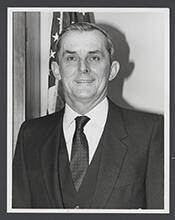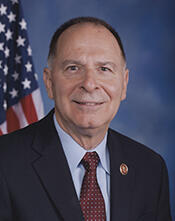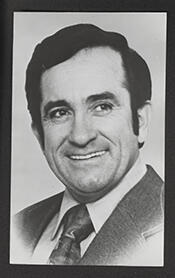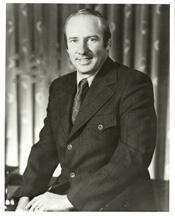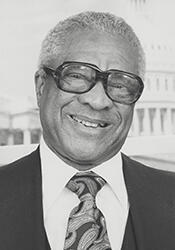
Bennett McVey Stewart (August 6, 1912 – April 26, 1988) was an American politician and educator who, as a member of the Democratic Party, served as a U.S. Representative from Illinois from 1979 to 1981 and as a member of the Chicago City Council from 1971 to 1979. His single term in Congress and his years in municipal government reflected a broader career devoted to public service, urban affairs, and civic leadership during a significant period in American political and social history.
Stewart was born in Huntsville, Alabama, to Bennett Stewart Sr. and Cathleen Jones. He was baptized at Meridianville Primitive Baptist Church and attended the public schools of Huntsville and Birmingham, Alabama. Pursuing higher education at a time when opportunities for African Americans in the South were limited, he enrolled at Miles College in Birmingham, a historically Black institution, and received a Bachelor of Arts degree in 1936. While at Miles College, he became a member of Alpha Phi Alpha fraternity, an organization that played an important role in the development of African-American professional and political leadership.
Upon completing his college education, Stewart began his career in education. In 1936 he became assistant principal of Irondale High School in Alabama. Two years later, in 1938, he returned to his alma mater, Miles College, as an associate professor of sociology, reflecting both his academic training and his interest in the social conditions affecting African-American communities. By 1940 he had transitioned into the insurance business, working as an insurance executive, a move that would shape the next major phase of his professional life.
In 1950 Stewart was appointed Illinois director for the Atlanta Life Insurance Company, one of the largest Black-owned insurance firms in the United States. The following year, in 1951, he and his family relocated to Chicago, Illinois, when the company opened a Chicago branch. Stewart remained with Atlanta Life Insurance Company for seventeen years, gaining extensive experience in business administration, community relations, and urban issues. In 1968 he entered municipal service in Chicago, first as an inspector in the Chicago Building Department and then as a rehabilitation specialist for the Chicago Department of Urban Renewal, where he was involved in efforts to address housing conditions and neighborhood redevelopment.
Stewart’s formal political career began in Chicago’s 21st Ward. In 1971 he was elected to the Chicago City Council as alderman, unseating incumbent Wilson Frost. The following year, in 1972, he was also elected the ward’s Democratic committeeman, consolidating his influence in local party affairs. He was re-elected as alderman in 1975 and as Democratic committeeman in 1976. During this period he was active in party politics beyond his ward, serving as a delegate to several Illinois State Democratic conventions between 1971 and 1978 and as a delegate to the Democratic National Conventions in 1972 and 1976. His work on the City Council and within the Democratic Party established him as a significant figure in Chicago’s African-American political community.
In 1978 Stewart was elected as a Democrat to the 96th Congress and served as a U.S. Representative from Illinois from January 3, 1979, to January 3, 1981. During his one term in the House of Representatives, he participated in the legislative process at the federal level and represented the interests of his constituents from Chicago and the surrounding area at a time of economic challenges and shifting national priorities. His service in Congress occurred during a significant period in American history, and as a member of the House of Representatives he took part in the democratic process and contributed to the work of the legislative branch. In 1980 he failed in his bid for renomination, losing the Democratic primary to Harold Washington, who subsequently won the general election and later became the first African-American mayor of Chicago.
After leaving Congress, Stewart returned to municipal service in Chicago. From 1981 to 1983 he served as an administrative assistant to Mayor Jane Byrne, working within the city’s executive branch during her mayoral administration. This role allowed him to draw on his combined experience in business, urban renewal, and legislative affairs to assist in the management of Chicago’s governmental operations and policy initiatives.
Bennett McVey Stewart died on April 26, 1988, at the University of Chicago Hospital in Chicago, Illinois, at the age of 75. Funeral services were held on April 30, 1988, at St. Paul Christian Methodist Episcopal Church in Chicago. At the time of his death, he was survived by his wife since 1938, Pattye Crittenden, with whom he had two sons, Bennett Jr. and Ronald, and a daughter, Miriam Stewart Early. Stewart’s career, spanning education, business, city government, and the United States Congress, placed him among the notable African-American public officials who helped shape local and national politics in the mid-20th century.
Congressional Record