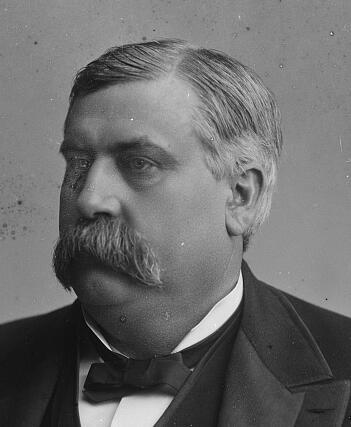
Benjamin Le Fevre (October 8, 1838 – March 7, 1922) was a nineteenth-century American politician, Civil War veteran, and four-term Democratic Representative from Ohio. He served in the United States House of Representatives from 1879 to 1887, representing his Ohio constituents during a significant period in American political and economic development in the post–Civil War era.
Le Fevre was born on October 8, 1838, in Ohio, where he spent his early years in a region shaped by rapid growth, transportation expansion, and increasing political engagement in the decades before the Civil War. Growing up in this environment, he was exposed to the issues that would later define his public life, including questions of national unity, economic development, and the role of the federal government in everyday life. His early experiences in Ohio helped form the local and regional connections that would underpin his later political career.
As a young man, Le Fevre pursued his education in Ohio, attending local schools at a time when formal schooling was becoming more widely available in the state. His education provided him with the grounding in law, government, and public affairs that would prove essential in his later service. Like many aspiring public figures of his generation, he combined formal study with practical experience, preparing himself for both military and political responsibilities in a nation on the brink of conflict.
With the outbreak of the Civil War in 1861, Le Fevre entered military service and became part of the vast citizen army raised by the Union. As a Civil War veteran from Ohio, he shared in the experiences of many men of his generation who saw active duty in defense of the Union. His wartime service placed him in the midst of the defining national crisis of the nineteenth century and helped establish his credentials as a public figure committed to the preservation of the United States. The discipline, leadership, and sense of national purpose forged during the war would later inform his approach to public office.
After the war, Le Fevre returned to Ohio and entered public life as a member of the Democratic Party. He became active in local and state political affairs during the Reconstruction and post-Reconstruction years, a period marked by intense debate over the reintegration of the Southern states, veterans’ issues, economic policy, and the expansion of railroads and industry. His standing as a veteran and his familiarity with the concerns of his community contributed to his emergence as a viable candidate for national office.
Le Fevre was elected as a Democrat to the United States House of Representatives and served four consecutive terms from 1879 to 1887. During these eight years in Congress, he participated in the legislative process at a time when the nation was grappling with questions of monetary policy, tariffs, civil service reform, and the regulation of interstate commerce. As a member of the House of Representatives, he represented the interests of his Ohio constituents, engaged in debate, and contributed to the formulation of federal policy in the late nineteenth century. His service coincided with the Forty-sixth through Forty-ninth Congresses, a period that saw shifting party majorities and evolving national priorities in the aftermath of Reconstruction.
Leaving Congress in 1887, Le Fevre concluded his formal legislative career but remained identified with the Democratic Party and with the generation of Civil War veterans who had helped shape national policy in the Gilded Age. In his later years, he continued to be regarded as a figure of public experience and historical significance in Ohio, reflecting both his military record and his four terms in the House. Benjamin Le Fevre died on March 7, 1922, closing a life that spanned from the antebellum era through the First World War and leaving a record of service as a Civil War veteran and long-serving Representative from Ohio.
Congressional Record