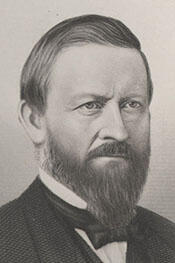
Benjamin Eggleston (January 3, 1816 – February 9, 1888) was a Republican politician and merchant who served two terms as a U.S. Representative from Ohio during the Reconstruction era, representing his state in the Thirty-ninth and Fortieth Congresses from 1865 to 1869. Over the course of his career, he held a variety of local and state offices, including service in the Ohio Senate, and played a role in the early organization and growth of the Republican Party in Ohio.
Eggleston was born on January 3, 1816, in Corinth, Saratoga County, New York. He completed preparatory studies in his youth before his family relocated to Ohio. In 1831 he moved with his parents to Hocking County, Ohio, part of the broader westward migration of the period. As a young man, he sought economic opportunity in the developing transportation networks of the state, which would shape his early professional life.
After settling in Ohio, Eggleston moved to Cleveland, where he worked on a canal boat at a time when canal transportation was central to the region’s commerce. Through experience and enterprise, he advanced from laborer to owner of boats and became interested in several companies connected with canal and mercantile activity. In 1845 he settled permanently in Cincinnati, Ohio, where he engaged in mercantile pursuits. His business activities in Cincinnati helped establish him as a figure of local prominence and provided the foundation for his entry into public life.
Eggleston’s political career began at the municipal level in Cincinnati. He was elected to the city council and rose to become its presiding officer, reflecting the confidence placed in him by his colleagues and constituents. As the Republican Party emerged in the 1850s, he aligned himself with the new political organization. He served as a delegate to the Republican National Convention in 1860 and was chosen as a presidential elector on the Republican ticket that year, casting his electoral vote for Abraham Lincoln and Hannibal Hamlin. His growing stature within the party led to his election to the Ohio Senate, where he served from 1862 to 1865, participating in state governance during the Civil War.
Building on his state legislative experience, Eggleston was elected as a Republican to the United States House of Representatives, serving in the Thirty-ninth and Fortieth Congresses from March 4, 1865, to March 3, 1869. His tenure in Congress coincided with the immediate aftermath of the Civil War and the beginning of Reconstruction, a significant period in American history. As a member of the House of Representatives from Ohio, he contributed to the legislative process, participated in the democratic governance of the nation, and represented the interests of his constituents in debates over postwar policy and national reconstruction. A member of the Republican Party throughout his congressional service, he completed two full terms in office. He was an unsuccessful candidate for reelection in 1868 to the Forty-first Congress.
After leaving Congress in 1869, Eggleston returned to Ohio and resumed his mercantile pursuits in Cincinnati. He remained active in public affairs and again served in the Ohio Senate in 1880 and 1881, returning to the state legislature more than a decade after his service in Washington. This later period of legislative work reflected his continued engagement with state politics and the Republican Party in Ohio.
Benjamin Eggleston died in Cincinnati, Ohio, on February 9, 1888. He was interred in Spring Grove Cemetery, one of the city’s principal burial grounds. His career spanned local, state, and national office, and his service in Congress from 1865 to 1869 placed him among the Ohio Republicans who helped shape federal policy during the critical years of Reconstruction.
Congressional Record