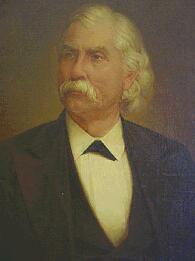
Benjamin Thomas Biggs (October 1, 1821 – December 25, 1893) was an American politician from Middletown in New Castle County, Delaware. A veteran of the Mexican–American War and a member of the Democratic Party, he served two terms as a U.S. Representative from Delaware and later as the 46th Governor of Delaware. His public career spanned the tumultuous decades before and after the Civil War, and he was a prominent figure in the state’s political realignment in the late nineteenth century.
Biggs was born near Bohemia Manor in Cecil County, Maryland, the son of John and Diana Bell Biggs. He spent his early years in the rural border region between Maryland and Delaware, an area whose agricultural economy and social ties would shape his later pursuits. As a young man, he pursued formal education beyond what was typical for the period, reflecting both family support and his own ambition for professional advancement.
For his education, Biggs attended the Methodist Pennington Seminary in Pennington, New Jersey, an institution associated with the Methodist Episcopal Church and known for preparing students for higher learning and the ministry. He subsequently studied at Wesleyan University in Middletown, Connecticut, one of the early Methodist-affiliated colleges in the United States. This combination of religiously influenced secondary and collegiate education helped cultivate his skills as a public speaker and contributed to the moral and political outlook that informed his later public life.
During the Mexican–American War, Biggs was appointed a major of the Delaware militia, marking his principal military service. Although Delaware did not send large numbers of troops compared with some other states, his commission as a major reflected both local standing and a willingness to participate in national military affairs. After the war, he returned to civilian life and established himself as a teacher and a farmer. He devoted much of his time to tending peach orchards in central New Castle County and the adjacent portion of Maryland, becoming part of the region’s important peach-growing economy. His reputation as a talented public speaker drew him into civic affairs, and through this avocation he began what became a lifelong involvement in public life.
Biggs’s early political affiliation was with the Whig Party, then one of the two major national parties. He emerged as an influential figure in Delaware’s constitutional reform efforts, playing an instrumental role in the Delaware Constitutional Convention of 1852. Although the work of that convention was ultimately rejected by the voters, his participation established him as a significant voice in state politics. When the Whig Party disintegrated in the 1850s, Biggs, like many former Whigs in the border states, shifted his allegiance to the Democratic Party. At the time, the Democrats in Delaware were generally Southern-leaning, anti-abolitionist, and strongly supportive of states’ rights and opposed to the policies of Abraham Lincoln and the emerging Republican Party, and Biggs presumably was in general agreement with these positions. His younger brother, Sewell C. Biggs (1823–1911), followed a similar trajectory, identifying first as a Whig and later as a Democrat, and was elected to the Delaware House of Representatives in 1872, serving as speaker that same year.
Biggs first sought national office as the Democratic candidate for the U.S. House of Representatives in the 1860 election. In a closely contested race, he was narrowly defeated by George P. Fisher, the candidate of the People’s Party, a local coalition that combined elements of the Republican Party and the Constitutional Union Party at a time when many voters’ positions on secession and slavery were not yet fully defined. The Civil War and Reconstruction transformed Delaware’s political landscape. By 1868, after the state had experienced federal supervision of its polling places and the forced emancipation of its small enslaved population, a large majority of Delaware voters turned decisively and, for a time, permanently to Democratic candidates. In this changed environment, Biggs ran again for the U.S. House and was easily elected, defeating Republican Alfred T. Torbert in the 1868 election and Republican Joshua T. Heald in the 1870 election.
As a member of the Democratic Party representing Delaware, Benjamin Thomas Biggs contributed to the legislative process during two terms in office. He served in the 41st and 42nd Congresses from March 4, 1869, until March 3, 1873, during the administration of President Ulysses S. Grant. Elections for U.S. Representatives were held on the Tuesday after the first Monday of November, and members took office on March 4 for two-year terms. In Washington, Biggs joined a small and largely powerless Democratic minority in the postwar Republican-dominated Congress, limiting his influence on national legislation. Nonetheless, he participated in the democratic process and represented the interests of his Delaware constituents during a significant period in American history, particularly as the federal government implemented Reconstruction policies and debated civil rights and economic issues. After completing his second term, he retired from Congress and returned to his agricultural pursuits and peach orchards in Delaware and Maryland.
Over the next two decades, Delaware’s politics resembled those of many states in the Deep South. Despite a substantial Republican minority in New Castle County, hostility toward the Republican Party and its policies of racial equality remained strong throughout much of the rest of the state. There were years when Republicans failed to elect any members to the General Assembly and even years when they did not nominate a candidate for governor. In this context, Biggs was nominated by the Democrats to run for governor in 1886. That election marked the final year in which such a pronounced partisan disparity existed in Delaware; there was no Republican candidate for governor, and Biggs faced only token opposition from Temperance Reform Party candidate James R. Hoffecker, whom he easily defeated. Under Delaware law, elections were held on the Tuesday after the first Monday in November, and the governor took office on the third Tuesday in January for a four-year term. Biggs served as governor from January 18, 1887, until January 20, 1891.
As governor, Biggs followed the pattern of many of his predecessors by urging the General Assembly to enact a broad range of reforms. He called for improved representation for the more populous New Castle County and advocated changes to the state’s voting procedures, seeking to modernize and regularize the electoral system. In the racially charged and deeply partisan environment of the late nineteenth century, his appeals met with limited success. Most of his reform proposals were ignored by the legislature, which remained resistant to altering the existing balance of political power. One notable exception was the enactment of a provision establishing a State Hospital for the Insane, later known as the Delaware State Hospital at Farnhurst, which became an important institution in the state’s public health and social welfare system. His tenure thus combined ambitious, if largely unrealized, calls for structural reform with at least one significant institutional achievement.
In his personal life, Biggs married Mary Beekman. The couple had five children—John, Elizabeth, Benjamin T. Jr., Jennie, and Willard—of whom only three, John, Jennie, and Willard, survived to adulthood. The family resided at 210 North Cass Street in Middletown, Delaware, and were active members of the Methodist Church, reflecting both his educational background and the religious character of much of Delaware’s civic leadership in that era. His son John Biggs pursued a legal and public career of his own and was appointed deputy attorney general of Delaware in 1885 and attorney general in 1887, during his father’s gubernatorial term, further entrenching the family’s influence in state affairs. The family’s farm, associated with his long career as a peach grower and agriculturalist, was later recognized for its historical significance; the Gov. Benjamin T. Biggs Farm was listed on the National Register of Historic Places in 1987.
Benjamin Thomas Biggs died at his home in Middletown, Delaware, on December 25, 1893. He was initially buried in the Bethel Church Cemetery at Chesapeake City, Maryland, near the region of his birth. In 1965, as part of a project to widen the nearby Chesapeake and Delaware Canal, his remains were removed from the cemetery and reinterred at an unknown location. His life and career, spanning service as a militia officer, teacher, farmer, constitutional reformer, congressman, and governor, left a lasting imprint on Delaware’s political and institutional development in the nineteenth century.
Congressional Record