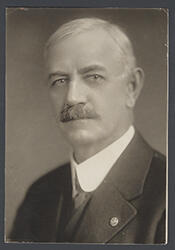
Atkins Jefferson McLemore (March 13, 1857 – March 4, 1929) was an American newspaper publisher, state legislator, and United States Representative from Texas. A member of the Democratic Party, he served two terms in the U.S. House of Representatives from 1915 to 1919, representing one of Texas’s at-large congressional districts during a pivotal era that included the nation’s entry into World War I.
McLemore was born on a farm near Spring Hill, Tennessee, on March 13, 1857. He was educated in local schools and by private tutors, receiving a basic but solid education typical of rural Southern communities in the post–Civil War period. In 1878 he moved to Texas, where he worked in a variety of occupations that reflected the state’s developing economy. He was employed as a cowboy, printer, and newspaper reporter, gaining firsthand experience with frontier life and the growing influence of the press. Seeking additional opportunities, he later worked as a miner in Colorado and Mexico before returning to Texas to pursue a more permanent career in journalism.
Upon his return to Texas, McLemore settled in San Antonio and became involved in the newspaper business, also working in Kyle, Texas. In 1889 he moved to Corpus Christi, where he established the Gulf News, further solidifying his role as a newspaper publisher. His prominence in local affairs and his engagement with public issues led to his election to the Texas House of Representatives, in which he served from 1892 to 1896. After his legislative service, McLemore moved to Austin and was elected to the city’s Board of Aldermen, serving one term and continuing to build his reputation as a civic leader. Within the Democratic Party, he rose to a position of statewide influence as Secretary of the Democratic State Executive Committee from 1900 to 1904.
McLemore’s interest in public discourse and political affairs was closely tied to his publishing activities. In 1903 he founded a weekly magazine entitled State Topics, which later evolved into Texas Monthly Review and State Topics, providing commentary on state politics and public issues. In 1911 he relocated to Houston, where he again engaged in the newspaper publishing business. His combined experience in journalism, party leadership, and state and local office positioned him for national office, and in 1915 he was elected as a Democrat to the United States House of Representatives to represent one of Texas’s two at-large districts.
As a U.S. Representative, McLemore served in the Sixty-fourth and Sixty-fifth Congresses from March 4, 1915, to March 3, 1919. His service in Congress occurred during a significant period in American history, as the nation debated its role in World War I and confronted major domestic and international challenges. McLemore was an ardent opponent of America’s entry into the war, a stance he believed was consistent with President Woodrow Wilson’s 1916 reelection slogan, “He kept us out of war.” When Wilson, less than ninety days after his reelection, asked Congress to declare war on Germany in 1917, McLemore was one of only fifty Representatives to vote against the declaration and the only member of Congress from Texas to do so. His outspoken opposition to the war and his break with the president placed him at odds with much of his party’s leadership.
The political consequences of McLemore’s antiwar position were significant. The Democratic-dominated Texas Legislature redrew the state’s congressional districts, eliminating the statewide at-large district he represented and creating eighteen geographically based districts. This redistricting forced McLemore into the same district—the Eighth District—as fellow Houston incumbents Joe H. Eagle and Daniel E. Garrett. Garrett withdrew from the race, and McLemore was defeated in the ensuing contest by Eagle, bringing his congressional career to a close in 1919. Nonetheless, during his two terms he had participated fully in the legislative process and represented the interests of his Texas constituents during a time of national transformation.
After leaving Congress, McLemore moved from Houston to Hebbronville in 1919 and resumed his work in the newspaper publishing business in South Texas. He later took up residence in Laredo, continuing his long association with journalism and public affairs. In 1928 he made one final bid for elective office, seeking an open United States Senate seat from Texas. He was defeated by Thomas T. Connally, who went on to a long Senate career. McLemore died in Laredo on March 4, 1929, one day after the date on which he would have taken office had he won the Senate race. He was interred in Oakwood Cemetery in Austin, Texas, closing a career that combined journalism, party leadership, state legislative service, and two terms in the United States Congress.
Congressional Record