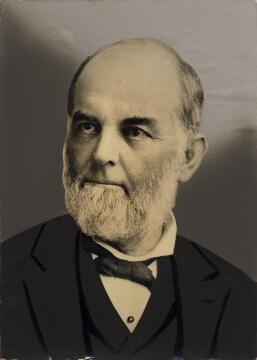
Asa Hoxie Willie (October 11, 1829 – March 16, 1899) was an American lawyer, judge, and politician who served as a United States Representative from Texas and later as chief justice of the Supreme Court of Texas. A Democrat, he held an at-large seat in the U.S. House of Representatives for one term from 1873 to 1875, and his public career spanned the antebellum period, the American Civil War, Reconstruction, and the late nineteenth century.
Willie was born on October 11, 1829, in Washington, Wilkes County, Georgia, to James Willie and Caroline Willie (née Hoxie). He attended private schools in Wilkes County until the age of sixteen. In 1846 he moved to Brenham, Texas, where he read law in the office of his older brother, James. He was admitted to the bar in 1848 and commenced the practice of law in Brenham, beginning a legal career that would lead him into both public office and judicial service.
Willie entered public life relatively early. In 1852 he was elected district attorney of the Third Judicial District of Texas, serving in that capacity until 1854. In 1858 he moved to Marshall, Texas, where he formed a law partnership with Alexander Pope. The following year, in 1859, he married Bettie Johnson of Brandon, Mississippi. By the eve of the Civil War, Willie had established himself as a prominent attorney in East Texas.
With the outbreak of the American Civil War, Willie joined the Confederate cause. He was commissioned a major in the Seventh Texas Infantry of the Confederate Army, serving on the staff of Colonel John Gregg. In February 1862 he was captured along with most of his regiment at Fort Donelson in Tennessee. The captured officers and men, including Willie, were confined at Johnson’s Island for approximately nine months before being exchanged. After the exchange, the regiment returned to service in time to participate in the Battle of Chickamauga in September 1863. Willie continued to serve with the Army of Tennessee and took part in its subsequent campaigns until the army’s surrender near the end of the war.
Following the Civil War, Willie relocated to Galveston, Texas, where he resumed his legal career. In 1866 he was elected an associate justice of the Supreme Court of Texas, reflecting his standing in the state’s legal community. His tenure was cut short in 1867 when Reconstruction military authorities removed him from the bench as part of the broader federal reorganization of Southern state governments. After leaving the court, he returned to private practice in Galveston while remaining active in Democratic Party politics.
Willie’s principal period of congressional service came in the early 1870s, during a significant phase of Reconstruction and readjustment in Texas. Following the 1870 federal census, Texas gained two additional seats in the U.S. House of Representatives through reapportionment. The state legislature did not immediately redraw the existing four congressional districts and instead provided that the two new members would be elected at large. Running as a Democrat, Willie was elected in 1872 as one of these at-large representatives and served in the Forty-third Congress from 1873 to 1875. During his single term, he participated in the legislative process at a time when Texas was reasserting its role in national affairs and when questions of Reconstruction policy, economic development, and the reintegration of former Confederate states were central to congressional deliberations. He did not seek reelection in 1874.
After leaving Congress, Willie returned to Galveston and again took up the practice of law. He was elected city attorney of Galveston in 1875 and was reelected in 1876, further cementing his role in local public affairs. His judicial career reached its peak in 1882, when Governor Oran Milo Roberts appointed him chief justice of the Supreme Court of Texas. Willie served as chief justice from 1882 until his retirement in 1888, presiding over a period of significant development in Texas jurisprudence as the state’s legal system adapted to postwar economic growth and social change.
In retirement, Willie remained in Galveston, where he continued to be regarded as a leading figure in the state’s legal and political history. He died in Galveston on March 16, 1899. Asa Hoxie Willie was interred in the cemetery of Trinity Episcopal Church in Galveston, closing a life that had encompassed service as a Confederate officer, state supreme court justice, member of Congress, and chief justice of Texas’s highest court.
Congressional Record