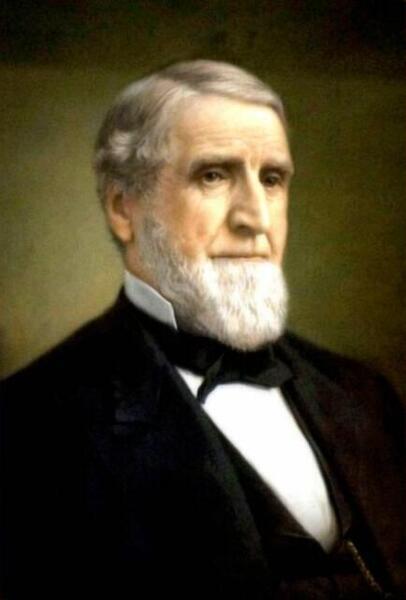
Asa Packer (December 29, 1805 – May 17, 1879) was an American businessman, transportation pioneer, philanthropist, and Democratic politician who played a central role in the development of the anthracite coal industry and railroad infrastructure in Pennsylvania and founded Lehigh University in Bethlehem, Pennsylvania. A conservative and religious man who reflected the image of the typical Connecticut Yankee, he also served two terms in the United States House of Representatives from 1853 to 1857, representing Pennsylvania during a significant and turbulent period in American history.
Packer was born on December 29, 1805, in Mystic, Connecticut. In his youth he moved to Pennsylvania, where he apprenticed as a carpenter under his cousin Edward Packer in Brooklyn Township, Pennsylvania. He worked seasonally as a carpenter in New York City, gaining practical experience in construction and trades, and later continued his carpentry work in Springville Township, Pennsylvania. It was in Springville that he met Sarah Minerva Blakslee, daughter of Zophar and Clarinda Whitmer Blakslee, whom he later married. The couple eventually settled on a farm in northeastern Pennsylvania, where Packer combined agricultural life with seasonal work tied to the region’s growing transportation economy.
During the winter months, Packer traveled to Tunkhannock, Pennsylvania, on the Susquehanna River, where he used his carpentry skills to build and repair canal boats. He pursued this work for approximately eleven years, gaining familiarity with inland navigation and the movement of goods, particularly coal, along Pennsylvania’s waterways. In 1833 he moved to Mauch Chunk—present-day Jim Thorpe, Pennsylvania—where he became the owner of a canal boat transporting anthracite coal from Pennsylvania’s Coal Region to markets in Philadelphia. Building on this success, he established the firm A. & R. W. Packer, which constructed canal boats and locks for the Lehigh Coal & Navigation Company, further entrenching him in the region’s coal and transportation industries.
Packer was an early advocate of steam railways as a more efficient means of transporting coal, urging the Lehigh Coal & Navigation Company to adopt rail transport, though his proposals were initially rejected as impractical. Undeterred, he became in 1851 the major stockholder of the Delaware, Lehigh, Schuylkill & Susquehanna Railroad Company, which was reorganized as the Lehigh Valley Railroad in January 1853. Under his leadership, the company constructed a railway line from Mauch Chunk to Easton between November 1852 and September 1855, racing to complete the project as his five-year charter approached expiration. Packer directed the building of branch lines connecting the main railroad to coal mines in Luzerne and Schuylkill Counties and planned and executed extensions into the Susquehanna Valley and onward into New York State, where the line connected at Waverly with the Erie Railroad. Among his clerks and associates during this period was George Washington Helme, who later became a prominent businessman and soldier. Through these efforts, Packer became one of the leading figures in the development of the Lehigh Valley as an industrial corridor.
Parallel to his business career, Packer became increasingly active in Pennsylvania politics. A Democrat, he served in the Pennsylvania House of Representatives in 1842 and 1843, representing his region during a period of expanding internal improvements and party realignments. In 1843 and 1844 he served as county judge in Carbon County under Governor David R. Porter, gaining experience in local administration and judicial affairs. His political reputation and business prominence led to his election to the United States House of Representatives, where he served two terms as a Democratic member from 1853 to 1857. In Congress, he participated in the legislative process during a critical decade preceding the Civil War, representing the interests of his Pennsylvania constituents and the broader concerns of a rapidly industrializing region.
Packer’s prominence within the Democratic Party extended beyond his congressional service. At the 1868 Democratic National Convention, Pennsylvania jurist George Washington Woodward entered Packer’s name as a favorite-son candidate for the presidential nomination, even though Packer was not present and did not actively campaign. He received a nearly consistent 26 delegates through the 14th ballot. His relative obscurity outside Pennsylvania prompted one delegate’s remark, “Who in the hell is Packer?”, a line widely quoted in New York newspapers, which nonetheless began to view him as an inoffensive moderate who might enhance the party’s electability. Despite this brief surge of attention, the convention ultimately turned to Horatio Seymour, who was perceived as offering similar advantages with greater national name recognition. Woodward had attempted to promote a Packer–Blair ticket, but Francis Preston Blair Jr. was instead nominated as Seymour’s running mate. Packer thus made an unsuccessful bid for the Democratic presidential nomination in 1868. The following year, in 1869, he secured the Democratic nomination for governor of Pennsylvania but narrowly lost to Republican incumbent John W. Geary by 4,596 votes, one of the closest statewide elections in Pennsylvania’s history.
Beyond politics and railroads, Packer devoted substantial resources to education and philanthropy. Recognizing the need for technically trained engineers in the industrial Lehigh Valley of eastern Pennsylvania, he undertook to found a university on South Mountain in Bethlehem, then a Moravian religious community that would later become the global manufacturing and corporate headquarters of Bethlehem Steel, for many decades the second-largest steel producer in the world. In 1865 he donated $500,000 and 60 acres of land—later expanded to 115 acres—for the establishment of a technical trade school for engineers. The institution, named Lehigh University, was chartered in 1866, the year after the end of the Civil War, and began instruction soon thereafter. The university’s first main building, Packer Hall, was completed in 1869. Thanks to Packer’s generosity, Lehigh was able to offer tuition-free education for its first twenty years, from 1871 to 1891, until economic difficulties in the 1890s forced the abandonment of this policy. After his initial half-million-dollar gift, Packer continued to support the university and took an active role in its management. In his will he bequeathed $1,500,000 as an endowment, $500,000 specifically to the university library, and granted Lehigh an interest of nearly one-third in his estate upon its final distribution, securing the institution’s long-term financial foundation.
In his personal life, Packer was married to Sarah Minerva Blakslee (1807–1882). The couple had seven children: Lucy Packer Linderman (1832–1873); Catherine Packer (1836–1837); Mary Hannah Packer Cummings (1839–1912); Malvina Fitzrandolph Packer (1841–1841); Robert Asa Packer (1842–1883); Gertrude Packer (1846–1848); and Harry Eldred Packer (1850–1884). His family life was marked by both prominence and tragedy, as several of his children died young, while others married into influential circles and continued the family’s social and philanthropic legacy.
Asa Packer died in Philadelphia, Pennsylvania, on May 17, 1879, at the age of 73. By the time of his death, he had become one of the most influential figures in Pennsylvania’s industrial development, a notable Democratic leader, and a major benefactor of higher education whose name remains closely associated with the growth of the Lehigh Valley and the institution he founded.
Congressional Record