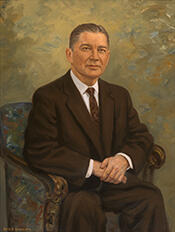
Asa Hodges (January 22, 1822 – June 6, 1900) was an American lawyer, slaveholder, and Republican politician who served one term as a U.S. Representative for Arkansas’s 1st congressional district from 1873 to 1875. He was born near Moulton in Lawrence County in northern Alabama, where he spent his early years before moving west as a young man. In time he settled in Marion, in Crittenden County in northeastern Arkansas, a region that would remain his home base for much of his adult life and political career.
Hodges pursued higher education at La Grange Male and Female College in LaGrange, Missouri, an institution that later became part of Hannibal-LaGrange University in Hannibal, Missouri. After completing his studies there, he read law and was admitted to the bar in 1848. He established a legal practice and worked as an attorney until 1860, building a professional standing in the years leading up to the Civil War. On April 17, 1858, he married Caroline Sarah Turpin Chick, the widow of his relative, John W. Hodges, thereby strengthening family and social ties that were significant in the antebellum South.
Before the outbreak of the American Civil War, Hodges was a substantial slaveholder, owning many slaves near Memphis, Tennessee. His status as a slaveholding lawyer and landowner placed him among the planter-professional class that dominated the economy and politics of the Mississippi Valley region in the 1850s. Although details of his activities during the Civil War itself are not extensively documented in the surviving record, his prewar and postwar roles indicate that he remained a figure of local influence through this turbulent period.
Hodges emerged as an important political actor in Arkansas during Reconstruction. In 1867 he served as a delegate to the Arkansas constitutional convention, participating in the reorganization of state government and law following the Confederacy’s defeat. He subsequently held legislative office at the state level, serving a partial term in the Arkansas House of Representatives in 1868 and then as a member of the Arkansas Senate from 1870 to 1873. In these positions he took part in shaping Reconstruction-era policy in Arkansas, aligning himself with the Republican Party that then dominated state politics under federal oversight.
In 1872 Hodges was elected as a Republican to the 43rd United States Congress to represent Arkansas’s 1st congressional district. His term in the U.S. House of Representatives ran from March 4, 1873, to March 3, 1875. Serving during a significant period in American history, he contributed to the legislative process as a member of the Republican Party, participating in the democratic process and representing the interests of his constituents in northeastern Arkansas during the closing phase of Reconstruction. He chose not to seek reelection in 1874 to the Forty-fourth Congress and was succeeded by Democrat Lucien C. Gause, reflecting the broader political shift in the South as Reconstruction waned and Democratic “Redeemers” regained control of many state governments.
After leaving Congress, Hodges withdrew from national politics and engaged in farming, returning to the agricultural pursuits that underpinned much of the regional economy. He continued to reside near Marion in Crittenden County, maintaining his ties to the community where he had long lived and worked. Hodges died near Marion on June 6, 1900. He was interred next to his wife, Caroline Sarah Turpin Chick Hodges, at Elmwood Cemetery in Memphis, in Shelby County, Tennessee, a major regional burial ground that reflected the cross-border connections of families living along the Mississippi River.
Congressional Record