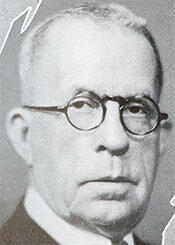
Archibald Hill Carmichael (June 17, 1864 – July 15, 1947) was an American Democratic politician who represented Alabama’s 8th congressional district in the United States House of Representatives from November 1933 to January 1937. Born in the mid-nineteenth century, he came of age during the Reconstruction era in the American South, an experience that shaped his later involvement in public affairs and Democratic Party politics in Alabama.
Carmichael’s early years unfolded in a region undergoing political, social, and economic transformation following the Civil War. Although detailed records of his childhood and formal education are limited, his subsequent professional and political activities indicate that he attained the education and legal or civic training typical of Southern Democratic leaders of his generation. By the late nineteenth or early twentieth century, he had established himself as a figure of some standing in his community, positioning himself for a role in state and, eventually, national politics.
Before entering Congress, Carmichael was aligned with the Democratic Party, which dominated Alabama’s political landscape during this period. His work in local and state affairs, combined with his party loyalty, helped build the reputation and connections that later supported his election to the U.S. House of Representatives. As the nation moved into the early decades of the twentieth century, he was part of a political environment increasingly concerned with economic modernization, agricultural issues, and the evolving role of the federal government in public life.
Carmichael’s congressional service began in November 1933, when he took office as the Representative from Alabama’s 8th congressional district. A member of the Democratic Party, he served two terms in the United States Congress, remaining in office until January 1937. His tenure coincided with a significant period in American history, as the country grappled with the Great Depression and the implementation of President Franklin D. Roosevelt’s New Deal. During these years, Carmichael contributed to the legislative process in the House of Representatives, participating in debates and votes on measures intended to address economic hardship, support recovery, and reform financial and regulatory systems.
As a member of the House of Representatives, Carmichael represented the interests of his North Alabama constituents at a time when federal policy was rapidly expanding in scope. He took part in the democratic process by engaging in committee work, floor deliberations, and constituent services, ensuring that the concerns of his district were heard in Washington. His role in Congress placed him among the many Southern Democrats who were central to shaping and supporting much of the New Deal legislative agenda, even as they balanced national priorities with regional economic and social considerations.
After leaving Congress in January 1937, Carmichael concluded his brief but notable period of national service and returned to private life in Alabama. In his later years, he remained identified with the Democratic Party and with the generation of Southern leaders who had guided their states through the early twentieth century and the crisis of the Great Depression. Archibald Hill Carmichael died on July 15, 1947, closing a life that spanned from the immediate post–Civil War era into the aftermath of World War II, and that included service in the United States House of Representatives during one of the most consequential periods in modern American political and economic history.
Congressional Record