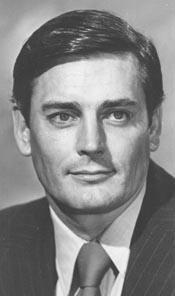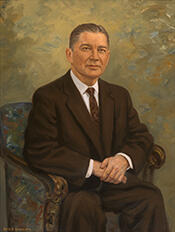
Anthony Astley Cooper Rogers (February 14, 1821 – July 27, 1899) was an American politician who served one term in the United States House of Representatives from Arkansas from 1869 to 1871. A member of the Democratic Party, he represented Arkansas during a pivotal period of Reconstruction, participating in the legislative process and advocating for the interests of his constituents in the post–Civil War Congress.
Rogers was born on February 14, 1821, in Clarksville, Tennessee. He received only a limited formal education in his youth, a common circumstance on the early nineteenth-century frontier. Despite this, he entered mercantile pursuits at a young age, gaining practical experience in business and trade that would shape much of his later professional life. His early years in Tennessee established him in commercial activity and prepared him for the opportunities he would later seek in the expanding American South and West.
In 1854, Rogers moved from Tennessee to Arkansas, where he continued his involvement in mercantile enterprises. By the eve of the Civil War, he had become sufficiently prominent in his adopted state to be drawn into its turbulent political life. An opponent of secession, Rogers aligned himself with supporters of the Union at a time when Arkansas was moving toward joining the Confederacy. In 1861, he was put forward as a candidate of Union supporters for election as a delegate to the Arkansas state convention called to consider secession, reflecting his public identification with the Unionist cause.
Rogers’s Unionist stance during the Civil War brought him under suspicion by Confederate authorities. He was arrested for his loyalty to the United States, imprisoned, and compelled to give bond to answer a charge of “treason against the Confederate Government.” During the later years of the conflict, he was elected to the Thirty-eighth Congress of the United States; however, he was not permitted to take his seat because Arkansas, as a former Confederate state, had not yet been readmitted to representation in Congress. In 1864, amid the continuing upheaval of war, Rogers left Arkansas and moved to Chicago, Illinois, where he entered the real estate business. He remained there until 1868, when he returned to Arkansas as the state moved more fully into the Reconstruction era.
With Arkansas restored to representation in the national legislature, Rogers successfully sought federal office. He was elected as a Democrat to the Forty-first Congress and served from March 4, 1869, to March 3, 1871. His term coincided with a critical phase of Reconstruction, during which Congress grappled with the reintegration of the Southern states, the rights of newly freed African Americans, and the redefinition of federal–state relations. As a member of the Democratic Party representing Arkansas, Rogers contributed to the legislative process during his single term, participating in debates and votes that shaped the postwar settlement. He was an unsuccessful candidate for reelection in 1870 to the Forty-second Congress, bringing his formal congressional service to a close after one term in office.
After leaving Congress, Rogers remained active in public and commercial life in Arkansas. He was appointed postmaster at Pine Bluff, Arkansas, serving from January 7, 1881, to July 24, 1885, a federal position that placed him at the center of local communications and commerce during a period of regional growth. Following his tenure as postmaster, he again engaged in mercantile pursuits, returning to the business activities that had characterized much of his earlier career and maintaining his standing as a local businessman and former congressman.
In 1888, Rogers moved to Los Angeles, California, reflecting the broader westward movement of many Americans in the late nineteenth century. He lived there only briefly before his death on July 27, 1899, at the age of 78. Anthony Astley Cooper Rogers was interred in Angelus-Rosedale Cemetery in Los Angeles, closing a life that had spanned the antebellum era, the Civil War, Reconstruction, and the nation’s westward expansion, and that included notable service to Arkansas and the United States in both war and peace.
Congressional Record