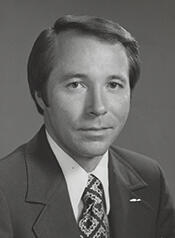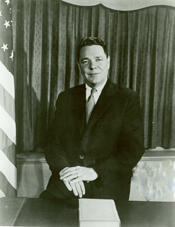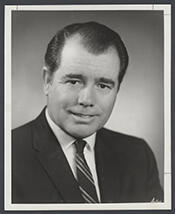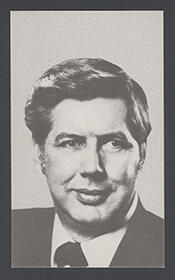
Anthony Claude Leach Jr., known as Buddy Leach (March 30, 1934 – August 6, 2022), was an American businessman, lawyer, military veteran, and Democratic politician from Louisiana. From 1979 to 1981, he served one term as a U.S. Representative from Louisiana in the United States Congress, representing Louisiana’s 4th congressional district. A member of the Democratic Party, he contributed to the legislative process during his single term in office and later served in the Louisiana House of Representatives and as chairman of the Louisiana Democratic Party. In 2003, he was an unsuccessful candidate for governor of Louisiana in an election won by Kathleen Blanco.
Leach was born on March 30, 1934, in Leesville, Vernon Parish, in western Louisiana. He graduated from Leesville High School in 1951 and that same year entered Louisiana State University. While a student, he was diagnosed with polio in 1954 and suffered temporary paralysis, but he eventually recovered from the disease. He completed his undergraduate studies at Louisiana State University, earning a Bachelor of Science degree, and remained closely tied to his home region throughout his life and career.
After college, Leach served in the United States Army from 1956 to 1959. Following his military service, he returned to higher education to study law. He enrolled at the Louisiana State University Law Center in Baton Rouge, where he obtained his Juris Doctor in 1963. The following year, in 1964, he was admitted to the Louisiana State Bar Association and began practicing law in his hometown of Leesville. After the death of his father, Anthony Leach Sr., he assumed responsibility for the family plumbing business, which he managed until selling it, taking care to secure new jobs for all of the employees before completing the sale.
In addition to his legal practice, Leach developed substantial business interests in the energy and land sectors. He became president and chief executive officer of Sweet Lake Land and Oil Company and North American Land Company, both based in Lake Charles in Calcasieu Parish in southwestern Louisiana. His business career complemented his growing involvement in public affairs and the Democratic Party, which in mid-20th-century Louisiana was dominated by conservative white members and functioned as the primary vehicle for statewide political advancement.
Leach entered elective office in 1968, when he was elected to the Louisiana House of Representatives. In his first term, he represented a two-member district alongside fellow Democrat E. Holman Jones of Oakdale in Allen Parish. He was reelected to the state House in 1972 and again in 1976, building a reputation as an influential legislator. In 1979, he gave up his seat in the Louisiana House to run for the U.S. House of Representatives from Louisiana’s 4th congressional district. He won the election and served in the Ninety-sixth Congress from 1979 to 1981. His election campaign drew controversy when it was disclosed that he had purchased hundreds of votes with moon pies and RC Colas, but the Democratic majority in the U.S. House of Representatives certified him as a member nonetheless. During this significant period in American history, he participated in the democratic process at the national level and represented the interests of his northwestern Louisiana constituents. In 1980, he was unseated by fellow Democrat Buddy Roemer of Bossier Parish, who later switched to the Republican Party, reflecting a broader realignment of conservative white voters in Louisiana.
After leaving Congress, Leach returned to state politics. In 1983, he sought to regain his former seat in the Louisiana House of Representatives and defeated the incumbent Democrat, William H. West. In this final term as a state legislator, he served on the House Ways and Means Committee, where he recommended the imposition of a tax on foreign oil processed within Louisiana, reflecting his ongoing engagement with fiscal and energy policy. His legislative service at both the state and federal levels spanned a period of major political and economic change in Louisiana, particularly in the oil and gas sector and in the partisan composition of the state’s electorate.
In 2003, Leach launched a campaign for governor of Louisiana in a crowded, statewide field. He campaigned on changing the operations of state government and advocated a more rigorous approach to public finances, memorably suggesting that the state use a “brillo pad” to “scrub the budget.” Having experienced polio as a young man, he made health care in Louisiana one of his central priorities. His campaign attracted many younger voters, and he organized volunteer teams in Shreveport, Baton Rouge, and New Orleans. Among his principal opponents were Democrats Kathleen Blanco, the sitting lieutenant governor, and Richard Ieyoub, the outgoing state attorney general, while Republicans rallied behind Bobby Jindal. In the blanket primary, Leach finished fourth, behind Blanco, Jindal, and Ieyoub. Blanco and Jindal advanced to the runoff, and Blanco ultimately won the general election over Jindal.
Leach remained active in party leadership into the next decade. In 2010, he was elected chairman of the Louisiana Democratic Party in a special election. His tenure coincided with a period of steep decline for Democrats in the state, in sharp contrast to the overwhelmingly Democratic landscape that had existed when he first entered politics. During his chairmanship, the party struggled to recruit and fund competitive candidates for statewide office, and it was unable to field a well-funded challenger to Governor Bobby Jindal in the 2011 election. For the first time since Reconstruction, Democrats lost control of both houses of the Louisiana Legislature to Republicans. On April 28, 2012, Leach lost his bid for reelection as state party chair to State Senator Karen Carter Peterson of New Orleans.
Leach’s family was also notable in public service. His younger sister, Carolyn Leach Huntoon, served as director of NASA’s Johnson Space Center from 1994 to 1996 and later as an assistant secretary in the U.S. Department of Energy from 1999 to 2001. His eldest daughter, Mary Leach Werner, born in January 1968, followed him into politics. She ran unsuccessfully in 2016 for the Louisiana Public Service Commission seat previously held by the late Clyde C. Holloway, a former U.S. Representative from Louisiana’s now-defunct 8th congressional district, losing to Mike Francis of Lafayette, a former chairman of the Louisiana Republican Party.
Anthony Claude “Buddy” Leach Jr. died from heart failure in Baton Rouge, Louisiana, on August 6, 2022, at the age of 88. His life encompassed service as a soldier, attorney, businessman, state legislator, member of the U.S. House of Representatives, gubernatorial candidate, and state party chairman, reflecting more than four decades of engagement in Louisiana’s political and civic life.
Congressional Record