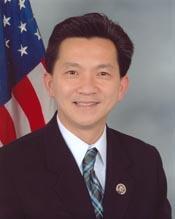
Ánh Quang “Joseph” Cao (Vietnamese: Cao Quang Ánh; born March 13, 1967) is a Vietnamese-American attorney and politician who represented Louisiana’s 2nd congressional district in the U.S. House of Representatives from January 3, 2009, to January 3, 2011. A member of the Republican Party, he was the first Vietnamese American and the first native of Vietnam to serve in the United States Congress, and the first Republican to represent his New Orleans–based district since 1890. During his single term in office, Anh Cao contributed to the legislative process at a significant period in American history and participated actively in the democratic process on behalf of his constituents.
Cao was born in Saigon, South Vietnam, in 1967, the fifth of eight children of My Quang Cao (1930–2010), a lieutenant in the Army of the Republic of Vietnam, and Khang Thi Tran (born 1935). His father was captured by the North Vietnamese Army in 1975 at the end of the Vietnam War and imprisoned for seven years in a Communist “re-education” camp, during which time Cao’s mother was permitted to visit her husband only five times. In 1975, when Cao was eight years old, his mother arranged for him and two of his siblings to flee South Vietnam with their uncle, while she remained behind with five of the children. The three children and their uncle arrived in the United States as refugees and were resettled in Houston, Texas. After his release from prison camp in 1982, Cao’s father joined the family in Houston, suffering from post-traumatic stress disorder and diabetes as a result of his imprisonment. Raised in a devout Catholic family, Cao’s early life was shaped by both his refugee experience and his religious upbringing.
Cao attended public schools in the Houston area and graduated from Jersey Village High School. He went on to earn a Bachelor of Science degree in physics from Baylor University in Waco, Texas. Deeply influenced by his Catholic faith, he entered the Society of Jesus and studied as a Jesuit seminarian for six years, during which he pursued advanced studies in philosophy. Ultimately concluding that the priesthood was not his vocation, he left the seminary and continued his academic work, earning a Master of Arts degree in philosophy from Fordham University in New York City. He later moved to New Orleans to study law, receiving his Juris Doctor from Loyola University New Orleans College of Law in 2000. While in law school, he taught undergraduate philosophy courses at Loyola, combining academic work with growing interest in legal advocacy.
After law school, Cao used his legal training primarily in the field of immigration law and community advocacy. For a period he taught at a parochial school in Virginia, and he became active with Boat People SOS (BPSOS), a nonprofit organization serving Vietnamese refugees and immigrants. As a volunteer and later as a board member of BPSOS from September 1996 to March 2002, he helped organize Vietnamese-American communities and worked to promote their social and economic self-sufficiency. After working with the New Orleans law firm Waltzer & Associates, he opened his own law practice in New Orleans specializing in immigration law. The devastation of Hurricane Katrina in 2005 and what he viewed as an inadequate governmental response drew him more deeply into civic and political life. He emerged as a community leader in New Orleans East, notably helping organize residents in opposition to a proposed landfill in their area and advocating for more effective disaster recovery policies.
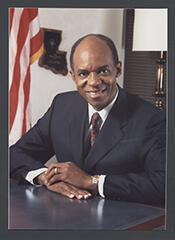
Cao entered electoral politics as a Republican in a district that had long been overwhelmingly Democratic and majority African American. In the 2008 election for Louisiana’s 2nd congressional district, he defeated incumbent Representative William J. Jefferson, who had been indicted on federal corruption charges. His victory made him the first Vietnamese American and first native of Vietnam to serve in Congress, and the first Republican to hold the seat since the nineteenth century. Sworn into office on January 6, 2009, he took the oath of office on the House floor from Speaker Nancy Pelosi, and then again in a ceremonial re-administration by Jefferson Parish Judge Robert Murphy in his new office, with his family and a group of Vietnamese Americans in attendance. Because of the late date of his election, he inherited Jefferson’s former office, Room 2113 in the Rayburn House Office Building, notable as the only congressional office ever raided by the FBI. By mid-February 2009, he had hired most of his staff, including Democrat and former Louisiana state representative Rosalind Peychaud as his deputy chief of staff, and in April 2009 his district staff opened what was described as the first congressional office in Kenner, Louisiana, in a converted storeroom at 624 Williams Boulevard.
During his term in the 111th Congress, Cao served on the Committee on Homeland Security and the Committee on Transportation and Infrastructure, and later on the Committee on Oversight and Government Reform. Within Homeland Security, he sat on the Subcommittee on Emergency Communications, Preparedness, and Response and the Subcommittee on Management, Investigations, and Oversight. On Transportation and Infrastructure, he served on the Subcommittee on Economic Development, Public Buildings and Emergency Management and the Subcommittee on Railroads, Pipelines, and Hazardous Materials. On Oversight and Government Reform, he was assigned to the Subcommittee on the Federal Workforce, Postal Service, and the District of Columbia. He also participated in the Congressional Asian Pacific American Caucus and the American Engagement Caucus. From the outset of his service, he explored joining the Congressional Black Caucus as a gesture of outreach to his heavily African-American district; although some observers, such as political scientist Michael K. Fauntroy, praised this as a “very smart move,” the caucus ultimately rebuffed his attempt to join.
Cao quickly established himself as an active legislator and advocate for post-Katrina recovery. Eleven weeks after being sworn in, on March 24, 2009, he delivered his first speech on the House floor in support of a bill by Representative Linda Sánchez to express congressional support for “Welcome Home Vietnam Veterans Day.” In that speech, broadcast on C‑SPAN, he noted that he was a “direct beneficiary” of the service of Vietnam War veterans, and the bill passed the House. With the backing of House Republican leadership, which collectively controlled 40 percent of earmarks for federal projects, Cao aggressively pursued federal funding for his district, requesting projects totaling approximately $1.2 billion—about three times the average of the other six members of Louisiana’s House delegation. Working with Democratic Senator Mary Landrieu and former Representative and lobbyist Bob Livingston, he secured approval for several key projects. He also expressed concern about environmental issues, publicly acknowledging the need to address global warming in an April 16, 2009, meeting at Loyola University New Orleans.
A central focus of Cao’s congressional work was oversight of the Federal Emergency Management Agency (FEMA) and the broader federal response to Hurricane Katrina. On February 25, 2009, he announced that his staff was investigating the FEMA office in New Orleans, citing complaints of discrimination, sexual harassment, ethics violations, nepotism, and cronyism. He conveyed his concerns directly to Homeland Security Secretary Janet Napolitano, who pledged to follow up. The next day, he called for the resignation of Doug Whitmer, head of FEMA’s New Orleans office, a demand soon echoed by Senator Landrieu. Acting FEMA Director Nancy L. Ward subsequently replaced Whitmer with Tony Russell, formerly of FEMA’s Denver office, and reassigned Jim Stark, FEMA’s assistant administrator for Gulf Coast recovery, stripping him of immediate responsibilities for Louisiana. Cao also criticized John Connolly, FEMA’s chief for Gulf Coast public assistance, questioning his experience with hurricane-related disasters. In early March 2009, Cao joined Napolitano, Louisiana Governor Bobby Jindal, Housing and Urban Development Secretary Shaun Donovan, Lieutenant Governor Mitch Landrieu, Representative Charlie Melancon, and others on a tour of damaged areas in New Orleans, including Southern University at New Orleans (SUNO). He returned to SUNO on March 16, 2009, pledging full support for rebuilding the campus, an effort later praised by the Times-Picayune in an editorial that commended both SUNO President Victor Ukpolo and Cao.
Cao’s voting record in Congress reflected both his Republican affiliation and his willingness to break with party leadership. He voted against the Obama administration’s economic stimulus package, citing dissatisfaction that Louisiana’s 2nd district ranked last among all 435 districts in projected outlays despite its severe hurricane damage. His vote prompted a recall petition launched on February 16, 2009, which gathered more than 13,000 signatures on its first day but fell far short of the more than 100,000 required under Louisiana law. State officials, including Secretary of State Jay Dardenne, regarded the effort as unlikely to succeed, and Louisiana Attorney General Buddy Caldwell later opined that federal officials cannot be recalled under state law. A separate recall effort against New Orleans City Councilwoman Stacy Head, a Democrat who had supported Cao’s election, also failed. In contrast to his stimulus vote, Cao supported the $410 billion omnibus spending bill for the remainder of fiscal year 2009, becoming one of 16 Republicans to vote in favor, stating that it would provide important benefits to his district. He publicly gave President Barack Obama a letter grade of “A” for his first 100 days in office, citing the administration’s cooperation in the recovery of New Orleans.
Cao gained national attention in health care and civil rights debates. In November 2009, he was the only Republican member of the House to vote for the initial draft of the Patient Protection and Affordable Care Act (“Obamacare”), though he later opposed the final version. In June 2010, he was one of only two Republicans to vote in favor of the DISCLOSE Act, legislation intended to increase transparency in corporate and union spending on political campaigns following the Supreme Court’s Citizens United decision. In December 2010, he was one of fifteen House Republicans who voted to repeal the U.S. military’s “Don’t Ask, Don’t Tell” policy, thereby allowing openly gay individuals to serve in the armed forces. He also joined a small group of Republicans in 2009 in voting to formally rebuke Representative Joe Wilson of South Carolina for shouting “You lie!” during President Obama’s address to a joint session of Congress. A 2011 National Journal survey subsequently rated Cao as the most liberal Republican in the House during his term. Financial disclosures indicated that, as of 2009, he was the least affluent member of Louisiana’s congressional delegation, with assets not exceeding $195,000 and potential liabilities of about $215,000, including student loans for himself and his wife.
After losing his bid for reelection in 2010 in a district that remained strongly Democratic, Cao continued to seek public office in Louisiana. In April 2011, he announced his candidacy for Attorney General of Louisiana, but he withdrew from the race in September 2011. In December 2015, he declared his candidacy for the U.S. Senate seat being vacated by retiring Republican Senator David Vitter in the 2016 election. Running in a crowded field, Cao finished eleventh in the primary and did not advance to the general election. Outside of elective office, he has remained active in legal practice, community affairs, and issues affecting Vietnamese Americans and the broader New Orleans community.
Congressional Record