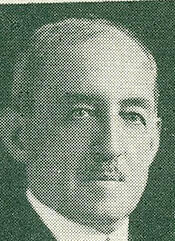
Andrew Jackson Montague (October 3, 1862 – January 24, 1937; nickname “Jack”) was a Virginia lawyer and American politician who served as the 44th governor of Virginia from 1902 to 1906 and as a Democratic Representative from Virginia in the United States Congress from 1913 to 1939. A member of the Democratic Party, he contributed to the legislative process during 13 terms in office and was a prominent figure in Virginia and national politics in the late nineteenth and early twentieth centuries. He was the first Virginia governor since the American Civil War not to have served in the Confederate military. Initially a Progressive who championed public education, infrastructure, and political reform, he later became a Conservative Democrat and supporter of the Byrd Organization during his long congressional career.
Montague was born on October 3, 1862, in Campbell County near Lynchburg, Virginia, the son of Robert Latane Montague, a prominent Confederate politician who later became a state judge and who had succeeded John Janney as presiding officer of the Virginia Secession Convention in 1861. He was named for his father’s youngest brother, a Virginia Military Institute cadet who had been killed defending Richmond at the Battle of Gaines’ Mill earlier in the Civil War. After the war, the Montague family returned to the Tidewater region of Virginia. With the emancipation of their enslaved workers and the departure of many of those laborers, Andrew Montague worked on the family farm while attending local schools in Middlesex County and Williamsburg, experiences that acquainted him early with the economic and social dislocations of the postwar South.
Following the death of his father in 1880, Montague moved to Richmond, Virginia, to pursue higher education and a professional career. He enrolled at Richmond College, the predecessor of the University of Richmond, where he quickly gained a reputation as a skilled orator and debater, talents that would later serve him in law and politics. After several years working as a private tutor, he continued his education at the University of Virginia in Charlottesville, studying law and graduating with a law degree in 1885. His academic and professional achievements were later recognized when Brown University awarded him an honorary Doctor of Laws degree in 1905.
Montague established himself as a lawyer in Virginia and entered public life as part of a rising generation of postwar Southern leaders. A Democrat and initially identified with the Progressive movement, he advanced within Virginia’s legal and political circles in the late nineteenth century, gaining recognition as an able attorney and public speaker. His background as the son of a Confederate leader, combined with his own lack of Confederate military service due to his youth, positioned him as a bridge between the antebellum elite and a new cohort of reform-minded politicians seeking to modernize the state’s institutions and infrastructure.
In 1901, Montague was elected governor of Virginia, taking office in 1902 as the state’s 44th chief executive and the first governor since the Civil War who had not served in the Confederate armed forces. As governor, he articulated a distinctly progressive agenda and traveled widely throughout the state advocating “good schools” and “good roads.” Under his leadership, Virginia saw tangible improvements in public education, including increased local funding, longer school terms, and consolidation of smaller schools to improve efficiency and quality. He supported expansion of the state capitol building to accommodate growing governmental functions and pressed for the creation of a state highway commission to oversee road development; the commission was formally established two months after he left office, reflecting the delayed but real impact of his advocacy for the Good Roads Movement. Montague also championed the primary election process as a more open and democratic method of selecting party nominees, contributing to the adoption of the primary system in Virginia for the first time in 1905. During his governorship he corresponded with national reform figures such as President Theodore Roosevelt, Clara Barton of the American Red Cross, and Booker T. Washington of the Tuskegee Institute, underscoring his engagement with broader Progressive Era currents. Nonetheless, many of his legislative ambitions were frustrated by what he regarded as a hostile legislature and the entrenched political machine led by his longtime rival, Senator Thomas S. Martin, whose Martin Organization dominated Virginia Democratic politics.
While still serving as governor, Montague sought to extend his reform influence to the national level by challenging Senator Martin for his United States Senate seat in 1905. The contest became a referendum on control of the Virginia Democratic Party, pitting Montague’s progressive faction against Martin’s organization. Martin responded by publicly embracing many of Montague’s key issues—improved schools, better roads, and the primary election process—thereby blunting the contrast between them while relying on his superior political organization. Martin won re-election handily, leaving an embittered Montague to complete his gubernatorial term. The defeat marked a turning point in Montague’s political trajectory, as his direct challenge to the state’s dominant machine failed, and he left the governorship with many of his reform goals only partially realized.
In 1912, Montague reentered electoral politics on the national stage by running for the Richmond District seat in the United States House of Representatives. He defeated the Republican incumbent and took office the following year, beginning a congressional career that would last nearly a quarter of a century, from 1913 until his death in 1937. As a member of the House of Representatives, he participated actively in the democratic process and represented the interests of his Virginia constituents during a period that encompassed World War I, the 1920s, and the early New Deal era. He served on the influential Judiciary Committee and played a role in the passage of several significant pieces of legislation, including the act creating the Federal Trade Commission, the Trading with the Enemy Act during World War I, the Adamson Eight Hour Day Act establishing an eight-hour workday for railroad workers, and legislation providing for the retirement of injured and superannuated members of the United States Coast Guard. Over time, Montague’s political stance evolved from his earlier Progressivism to a more conservative orientation, and he became a supporter of the Byrd Organization, the conservative Democratic machine that succeeded the Martin Organization as the dominant force in Virginia politics.
Montague was an early supporter of President Woodrow Wilson’s internationalist agenda and aligned himself with Wilsonian policies during and after World War I. His influence in Congress diminished, however, when Republicans gained control of the House in the 1920s, limiting the legislative initiatives of Democratic members. Despite this shift in partisan power and his unsuccessful effort to secure appointment to the United States Supreme Court, Montague remained a respected figure among his colleagues, who nicknamed him “Judge” in recognition of his legal expertise and judicious demeanor. In 1926, he was selected by the House of Representatives as one of the impeachment managers to prosecute the impeachment trial of Judge George W. English, underscoring his standing within the chamber and his continued involvement in high-profile constitutional and legal matters.
Andrew Jackson Montague continued to serve in Congress into the 1930s, adapting to the changing political landscape as the nation confronted the Great Depression and the early New Deal reforms, while maintaining his ties to Virginia’s conservative Democratic establishment. He died in office on January 24, 1937, bringing to a close a public career that had spanned the post–Civil War reconstruction of Virginia, the Progressive Era, World War I, and the interwar period. His life and work, documented in collections such as the executive papers of his governorship held by the Library of Virginia, reflect both the aspirations and the constraints of Southern Democratic reformers who sought to modernize their states while operating within powerful party organizations and enduring regional traditions.
Congressional Record