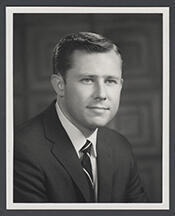
Andrew Thompson Judson (November 29, 1784 – March 17, 1853) was a United States representative from Connecticut and a United States district judge of the United States District Court for the District of Connecticut. He also served in the Connecticut House of Representatives. A member of the Toleration Party in state politics and later aligned with the Jacksonian, or Jackson, Party at the national level, he was an officer of the American Colonization Society. A leading white supremacist, he became a central figure in early nineteenth-century controversies over Black education in New England, opposing efforts to establish schools and colleges for African Americans in Connecticut and advocating that African Americans be subjugated in the United States or sent to Africa. Despite this record, as a federal judge he later presided over the celebrated case of United States v. The Amistad, in which he ordered that the enslaved captives aboard the schooner La Amistad be released and returned to Africa.
Judson was born on November 29, 1784, in Eastford, then part of Ashford, in Windham County, Connecticut. He came of age in the early national period, when Connecticut was transitioning from its colonial religious establishment toward a broader, though still limited, political and religious toleration. Details of his early family life are sparse in the historical record, but his subsequent prominence in state and national affairs suggests that he benefited from the educational and professional opportunities available to ambitious young white men in post-Revolutionary New England.
Judson received a common-school education and then studied law, following the customary path of legal apprenticeship rather than formal law school training, which was not yet widespread. After reading law, he was admitted to the bar and began practicing in Canterbury, Connecticut. His legal practice and growing involvement in public affairs quickly drew him into state politics. He became associated with the Toleration Party, a coalition that had arisen in opposition to the Federalist-dominated Standing Order and the Congregational establishment, and he used this affiliation to build a base of support in Windham County and the surrounding region.
Judson’s political career advanced through service in the Connecticut House of Representatives, where he participated in state legislative deliberations during a period of constitutional and political change. He also held local offices and became known as a forceful public speaker and organizer. At the national level, he aligned himself with the Jackson Party, reflecting the broader realignment of American politics in the 1820s and 1830s around the figure of Andrew Jackson and the emerging Democratic Party. As a member of the Jackson Party representing Connecticut, he served one term in the United States House of Representatives, contributing to the legislative process during a significant period in American history and participating in the democratic process on behalf of his constituents.
Judson’s most notorious public role arose from his opposition to Black education and abolitionist initiatives in Connecticut. In 1831, when the minister Simeon Jocelyn proposed establishing a “colored” college in New Haven—at a time when there was no such institution in the United States and African Americans were admitted to existing colleges only in rare instances, approximately once every seven years—Judson took the lead in organizing resistance. At a town meeting in New Haven that he called, the proposal was overwhelmingly rejected, with 99 percent of the vote against it. Abolitionist William Lloyd Garrison later referred to the uproar surrounding this episode as the “New Haven Excitement.” While Judson did not create the underlying racial antipathy, he placed himself at the head of it, and the project for the college was abandoned.
Judson soon became the principal antagonist of Prudence Crandall, a white Quaker educator in Canterbury who sought to operate a school for African American girls. Using his influence, he secured passage by the Connecticut legislature of a so‑called “Black Law,” which prohibited the teaching of Black students who were not residents of Connecticut. Under this statute, Crandall was arrested and spent a night in the county jail, an incident that received wide publicity. In her first trial, Judson was formally designated only as an assistant prosecutor, but when the state’s attorney and the court’s next choice, Lieutenant Governor Ebenezer Stoddard, were both reported “ill,” Judson, as the only prosecutor fully familiar with the case, effectively directed the prosecution: he called and questioned witnesses and delivered the closing argument. The jury failed to reach a verdict. At Crandall’s retrial, Judson was no longer merely an assistant prosecutor, and she was found guilty. On appeal, however, the higher court dismissed the case on a technicality, apparently seeking to avoid a direct ruling on the underlying issues. In the wake of these proceedings, violent opposition to Crandall’s school escalated, including an attempt to set the school building on fire and a nighttime attack in which all the windows were broken. Fearing for her students’ safety, Crandall closed the school and left Connecticut. In 2014, the State of Connecticut formally recognized her legacy by naming her the state heroine.
During the Canterbury controversy, Judson articulated his racial views with unusual bluntness. In a conversation with Samuel J. May, an abolitionist minister from Brooklyn, Connecticut, who supported Crandall, Judson declared that he and his allies were not merely opposed to Crandall’s school in Canterbury but intended to prevent any such school from being established anywhere in the state. He insisted that Black people “never can rise from their menial condition in our country” and “ought not to be permitted to rise here,” describing them as “an inferior race of beings” who “never can or ought to be recognized as the equals of the whites.” Africa, he said, was “the place for them,” and he professed support for the colonization scheme, urging that “the niggers and their descendants be sent back to their fatherland” to improve themselves there and, if possible, “civilize and Christianize the natives.” He accused abolitionists of violating the Constitution by challenging what he claimed was the settled status of Black people in the United States, asserting that they “belong to Africa” and should either be sent there or “kept as they are here.” He warned May that the sooner abolitionists abandoned their project, the better for “our country, for the niggers, and yourselves.” These statements reflected both his personal convictions and the ideology of the American Colonization Society, in which he was an officer.
Judson’s involvement with the Crandall family extended beyond Connecticut. When Prudence’s brother, Dr. Reuben Crandall, was arrested in Washington, D.C., for illegally possessing abolitionist literature and was nearly lynched, Judson appeared as a character witness on his behalf. The prosecution in that case was led by Francis Scott Key, the author of “The Star-Spangled Banner” and a former law partner of Roger B. Taney, who sought to use the trial to advance the cause of colonization; Key himself was a founding member of the American Colonization Society. Judson’s support for Reuben Crandall was grounded not in sympathy for abolitionism but in the fact that Reuben had advised Prudence to abandon her plans to educate Black girls in Connecticut. After spending eight months in jail, Reuben Crandall was acquitted, but he soon died of tuberculosis contracted during his imprisonment.
Judson’s judicial career culminated in his appointment as a United States district judge for the District of Connecticut. In that capacity he presided over United States v. The Amistad, arising from the 1839 revolt of Africans who had been kidnapped and illegally sold into slavery, then transported aboard the Spanish schooner La Amistad. The case raised complex questions of international law, property, and human rights. In his decision, Judson ruled that the Africans had been unlawfully enslaved and ordered that they be released and returned to Africa. His ruling, which was later affirmed in substance by the United States Supreme Court, stood in marked tension with his long record of opposition to Black equality and education within the United States, but it was consistent with the legal principle that the international slave trade was illegal under both Spanish and American law.
Andrew Thompson Judson continued to serve on the federal bench until his death. He died on March 17, 1853, in Canterbury, Connecticut. His career left a complex legacy: he was a prominent Jacksonian congressman and federal judge, an influential state legislator and party leader, and a central figure in some of the most contentious racial and educational conflicts of his era, remembered both for his role in suppressing Black education in Connecticut and for his judicial order freeing the captives of the Amistad and returning them to Africa.
Congressional Record